
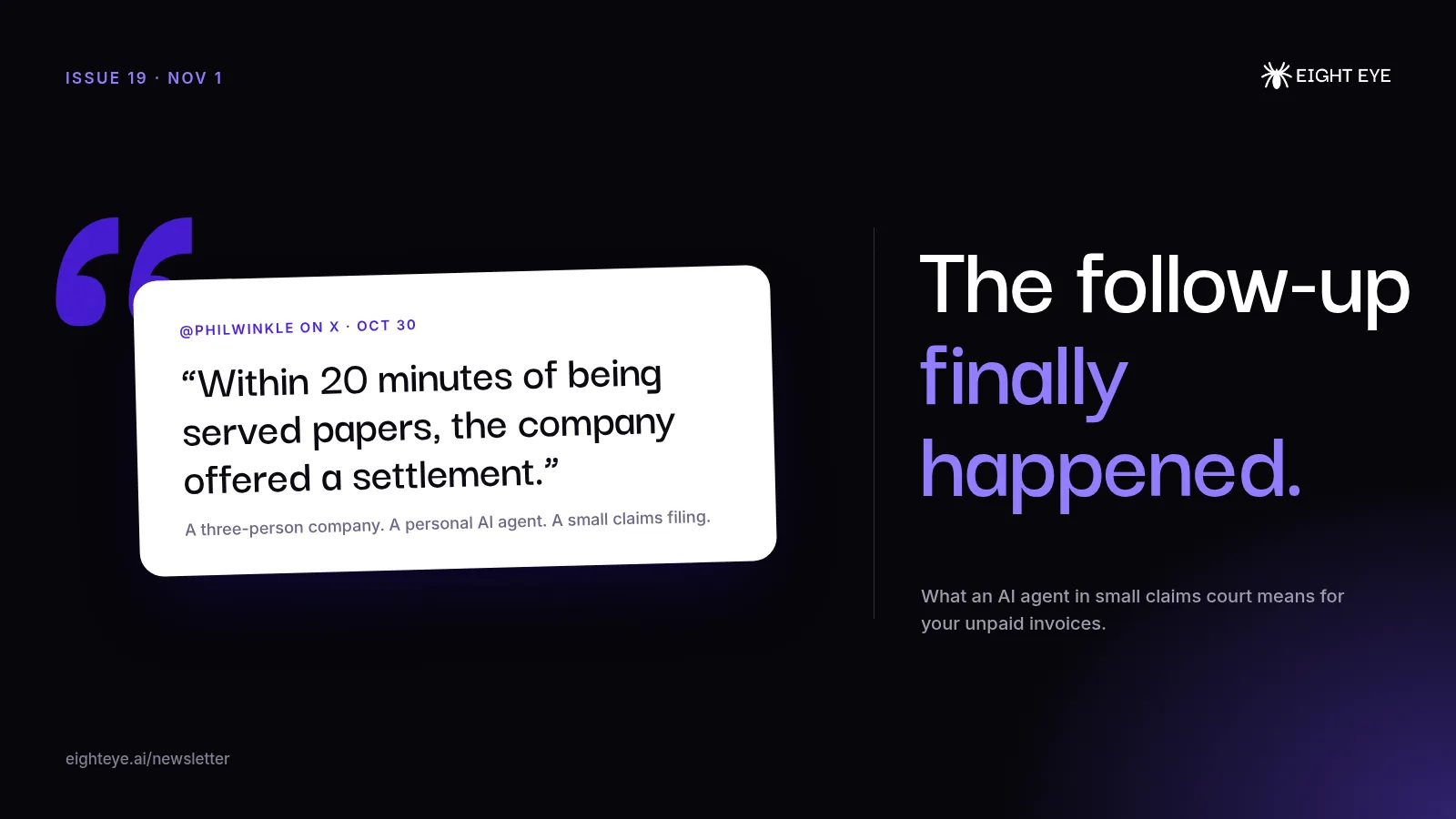
Every contractor has one. The job that got finished, invoiced and then went quiet. A builder who stopped returning calls. A property manager who keeps saying "next week." It isn't big enough to hire a lawyer, so it sits in the back of your head for months.
This week, one small business owner handed a dispute like that to an AI agent, and his post about how it ended passed 700,000 views on X. Our lead is about what actually happened and what a trades shop should take from it (hint: it isn't "let a bot be your lawyer"). After that: Google quietly starting to let an AI answer the messages people send your Business Profile, and a ChatGPT bug that's a good reminder about links in the office. Each item links to the original post on X, and engagement numbers are as of the morning of November 1.
1. An AI agent filed a small claims case. The other side offered to settle in 20 minutes
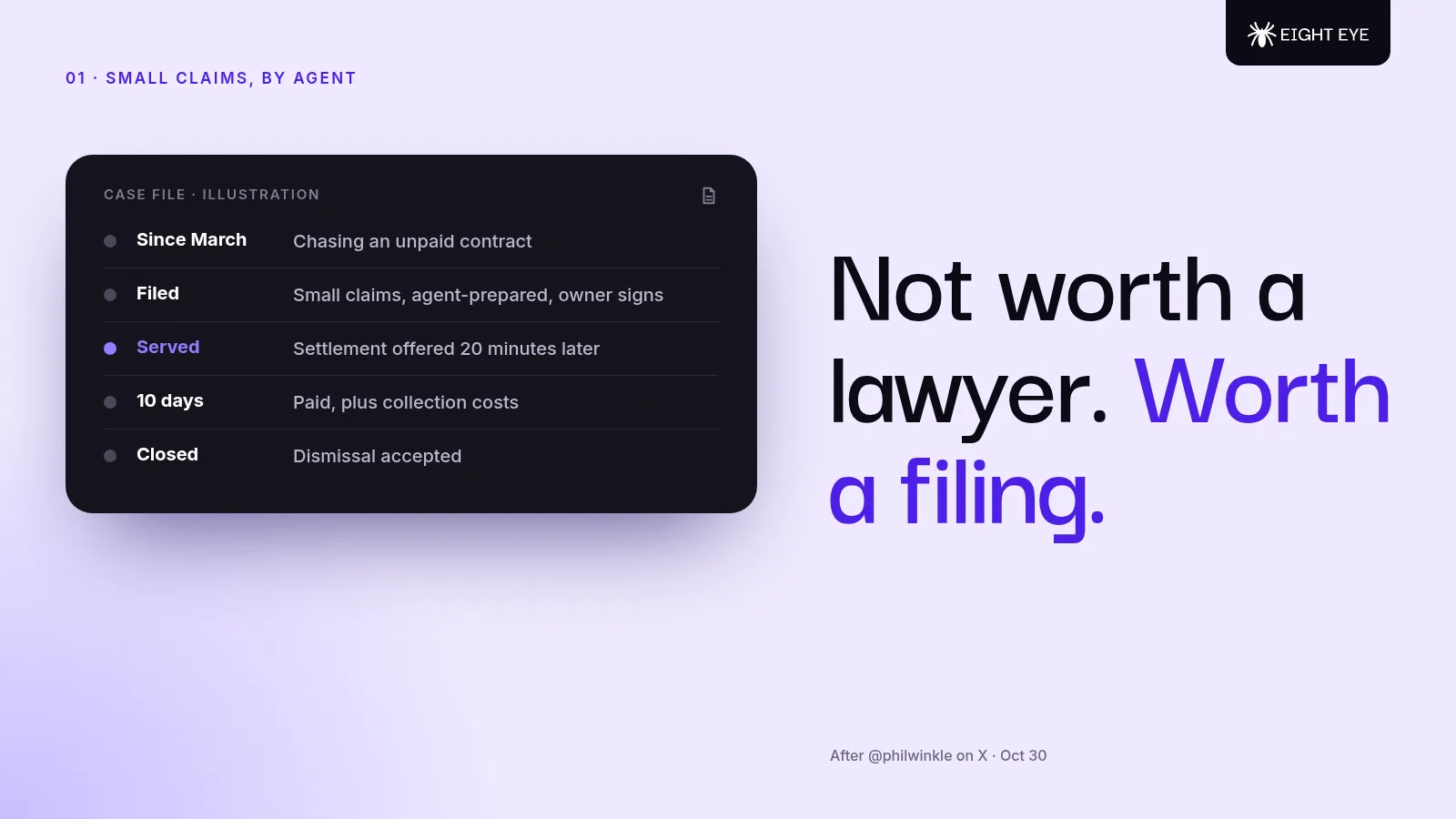
@philwinkle, October 30. About 4,800 likes and 700,000 views.
Phillip Jackson posted an update on a small claims case he'd had Meta's new personal agent, Muse, handle for him. His summary: within 20 minutes of the company being served, it offered to settle. Within ten days it paid him, plus extra for what it cost him to collect. Muse then filed the motion to dismiss, and he says the court accepted it the day before he posted.
The replies filled in the details that matter. Jackson said he'd been chasing the company since March over a contract it didn't make good on, and that his business has three people while the other side had about 100. He was also clear that the agent didn't do it alone: he had to sign the statement of claim himself, agree to the sworn statements and hit the final submit in the court's portal. And his most-liked reply was a warning, not a victory lap: "don't litigate with a company that has legal on staff." Another reply pointed out that the other side can file a counterclaim, which can turn a simple case into a bigger one.
Our take: The headline is the AI, but the lesson is the follow-up. Most unpaid invoices don't die because the customer refuses to pay. They die because nobody had time to chase them. This one sat from March until a tool made the next step easy enough to actually take.
For a plumbing, HVAC or electrical shop, the order matters. Send the invoice the day the job is done. Follow up on a schedule, by text and email, with the invoice attached every time. If that fails, send a short written demand with a date. Small claims is the last step, not the first, and Massachusetts has its own rules and dollar limits, so read the court's guidance or ask your accountant before you file anything. AI can help draft the reminders, organize the paperwork and keep the timeline straight. You still sign your name to it, and you're responsible for every word.
2. Google is putting an AI agent on your Business Profile messages
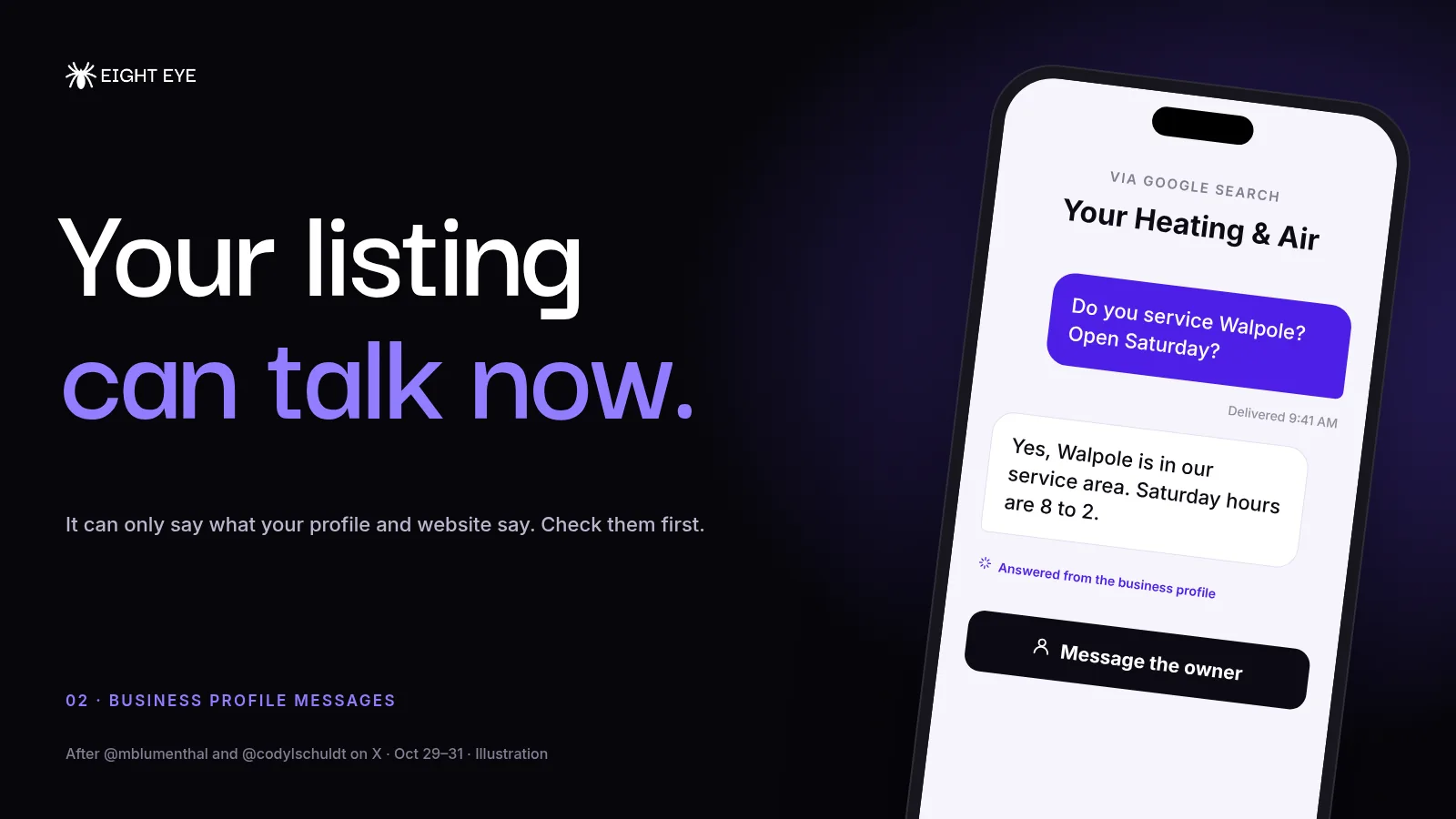
@mblumenthal, October 29, about 1,100 views. Plus a detailed breakdown from @codylschuldt, October 31.
Mike Blumenthal, who has tracked Google's local listings for years, posted that Google is actively rolling out an AI agent for Google Business Profiles. Cody Schuldt filled in how it seems to work. A customer taps Message on your listing in Search or Maps, and the conversation opens in their phone's regular texting app. An AI agent answers right away, using only two sources: your verified Business Profile (hours, address, phone, services) and your verified website. It only replies to people on phones and carriers that support the newer RCS texting standard. Everyone else's messages skip the agent and go straight to the owner's phone as normal texts. Per Schuldt, the pilot starts with restaurants, beauty services and vehicle services. Google shut down the old Business Profile chat in July 2024, so this is a comeback with an AI on the front end.
Our take: Home services aren't in that first group, which gives you time to get ready. And getting ready is simple, because the agent can only repeat what your profile and website say. If your Saturday hours are wrong, it will tell customers the wrong hours. If your service list says "plumbing" and nothing else, it can't tell someone you do water heaters in Walpole. Spend 20 minutes this week checking your hours, service areas, the services you actually offer and your website link. That pays off whether or not the agent ever reaches you, because people and search engines read the same listing.
3. A ChatGPT share link could read your private chats. It's fixed, but the lesson stays
@econographs, November 1, and a longer walk-through from @DeepWater_SI.
Security firm Parameter showed that a public ChatGPT share link could be rigged to run the attacker's code inside the session of anyone who opened it while signed in. In its test, the code listed the victim's recent conversations, read private chats that had never been shared, and sent a piece of one off-site. In the worst version, opening the link was the only click needed. Parameter reported it on October 18, and OpenAI fixed it eight days later, rated it in its most serious category and paid a $5,000 bounty. There's no sign it was used against real users, and there's nothing you need to do now, since the fix is on OpenAI's side.
Our take: Nothing to panic about, but it's a good moment for one office habit. A link from a stranger is a link from a stranger, even when it points to a site you trust. And think about what lives in your team's AI chat history. If someone has pasted in customer addresses, gate codes or card details to "clean them up," that's worth stopping. Use AI for the wording, keep the sensitive details in the systems built to hold them.
For the tech crowd
ChatGPT and Codex will share one usage limit. @pankajkumar_dev (about 7,500 views) flagged that starting in December, Plus, Pro and Business plans draw from a single token-based allowance across ChatGPT and Codex, with Instant chats not counted. Heavy coding days will leave less room for everything else. @CodexUpdate suggested getting a baseline now with /usage daily and /usage weekly in the Codex CLI, so you know whether your plan still fits.
Teaching an agent when to stay quiet. Gabe Mulley (about 140 likes and 10,000 views), who works on Anthropic's Claude Duet, wrote that early versions of its proactive alerts were too noisy, pinging him about things he already knew. The team chose quality over quantity: stay quiet unless there's something worth saying. That's the right bar for any assistant that interrupts a busy owner.
The small claims story, from the other side. A few replies, like this one, raised the obvious next question: if filing gets this easy, courts may need a plan for a lot more of them. Worth watching.
That's issue nineteen
Got an invoice that's been sitting since summer? Start with the follow-up, not the filing. And if your phones, texts and follow-ups are where jobs slip through, write to us at support@eighteye.ai. Eight Eye is the AI growth partner for small businesses. We answer your calls, text back missed leads, follow up until they book and help you get found online, while you keep the final say. See how it works, compare plans and pricing, or book a demo.
See you in the next issue.