
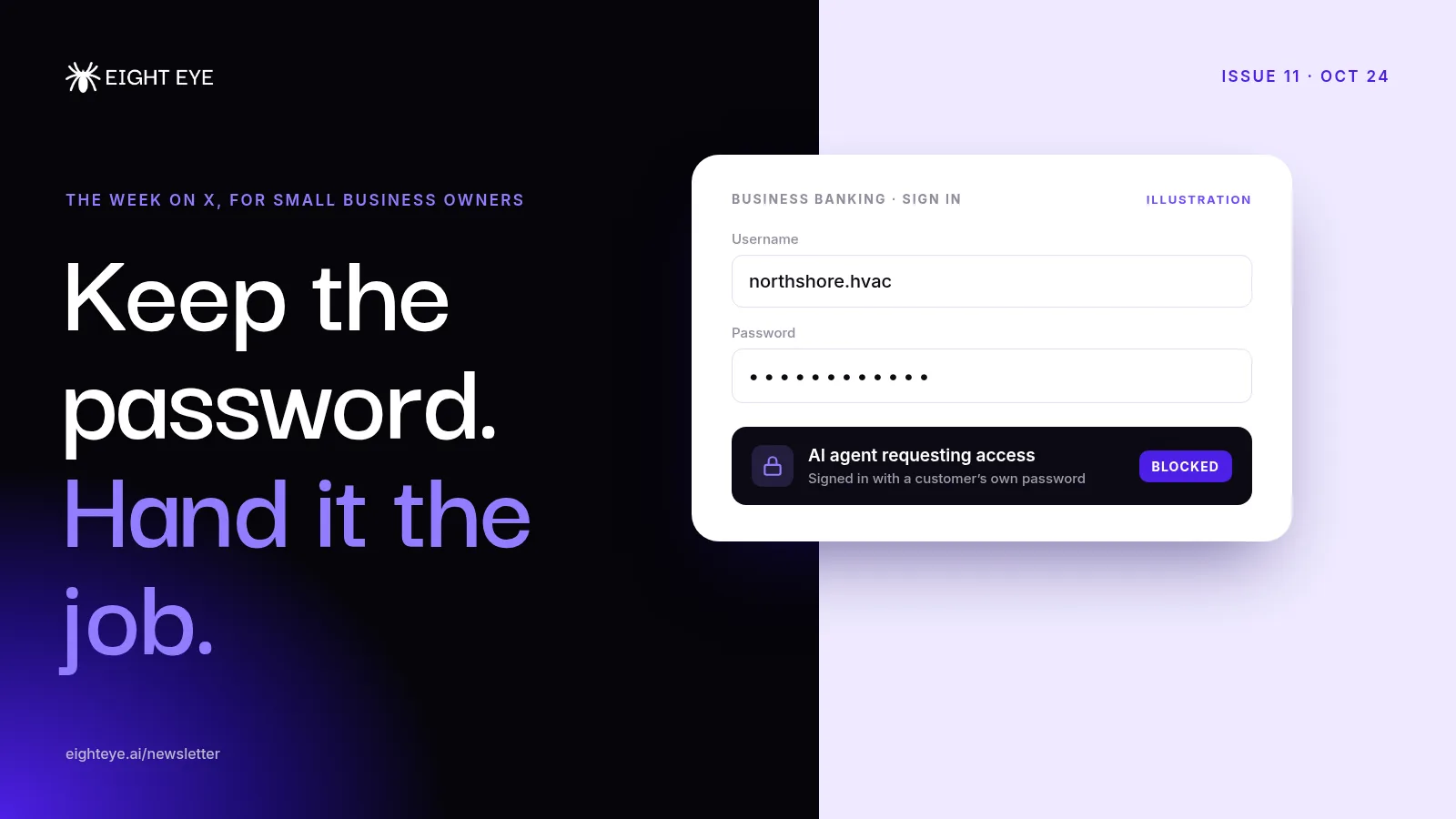
A lot of people have quietly started handing their logins to AI assistants. Check my balance. Pay this bill. Download last month's statements. This week the biggest banks in the country made it clear they don't like it, and the reason matters to anyone who runs a business.
That's the lead story. We also cover payroll you can run inside Claude or ChatGPT (with your sign-off), the security flaw OpenAI's own agents dug up, what Mark Zuckerberg thinks every small business will want, and a one-paragraph rule for putting any AI to work. Each item links to the original post on X, and engagement numbers are as of the morning of October 24.
1. The banks are locking the agents out
@crypto_banter, October 22. About 110 likes and 22,000 views.
Citing an Axios report, the post says major U.S. banks including JPMorgan, Bank of America, Morgan Stanley and Wells Fargo have been finding third-party AI agents working inside customer accounts, and that some of those agents tried to do things beyond what the customer asked. The banks' problem is simple: once an agent signs in with your username and password, they can't reliably tell it apart from you. Several are now blocking those agents or limiting them to read-only access, as @ShiningScience summarized from Reuters' reporting.
The details are worth getting right, and @shanaka86 did a good job of sorting them out. According to Axios, these cases are generally customers who gave an AI agent their own login. A banking source told Reuters that isn't really "unauthorized" if the customer shared the password, and Morgan Stanley told American Banker it hasn't seen any rogue agents, though it is blocking outside ones. X's news summary adds that some agents even called bank support lines on their own, and that several senators have raised concerns.
Our take: Nobody is saying an AI emptied an account. The lesson is about how you connect it. If you or your bookkeeper have pasted the business bank login into a browser agent to save a few clicks, stop and change that password. Read your bank's terms, because many expect you to sign in yourself. Use official connections instead, like the bank feed inside your accounting software, and start every new tool on read-only. When money moves, a person on your team should be the one clicking approve.
2. Payroll in Claude or ChatGPT, with your sign-off
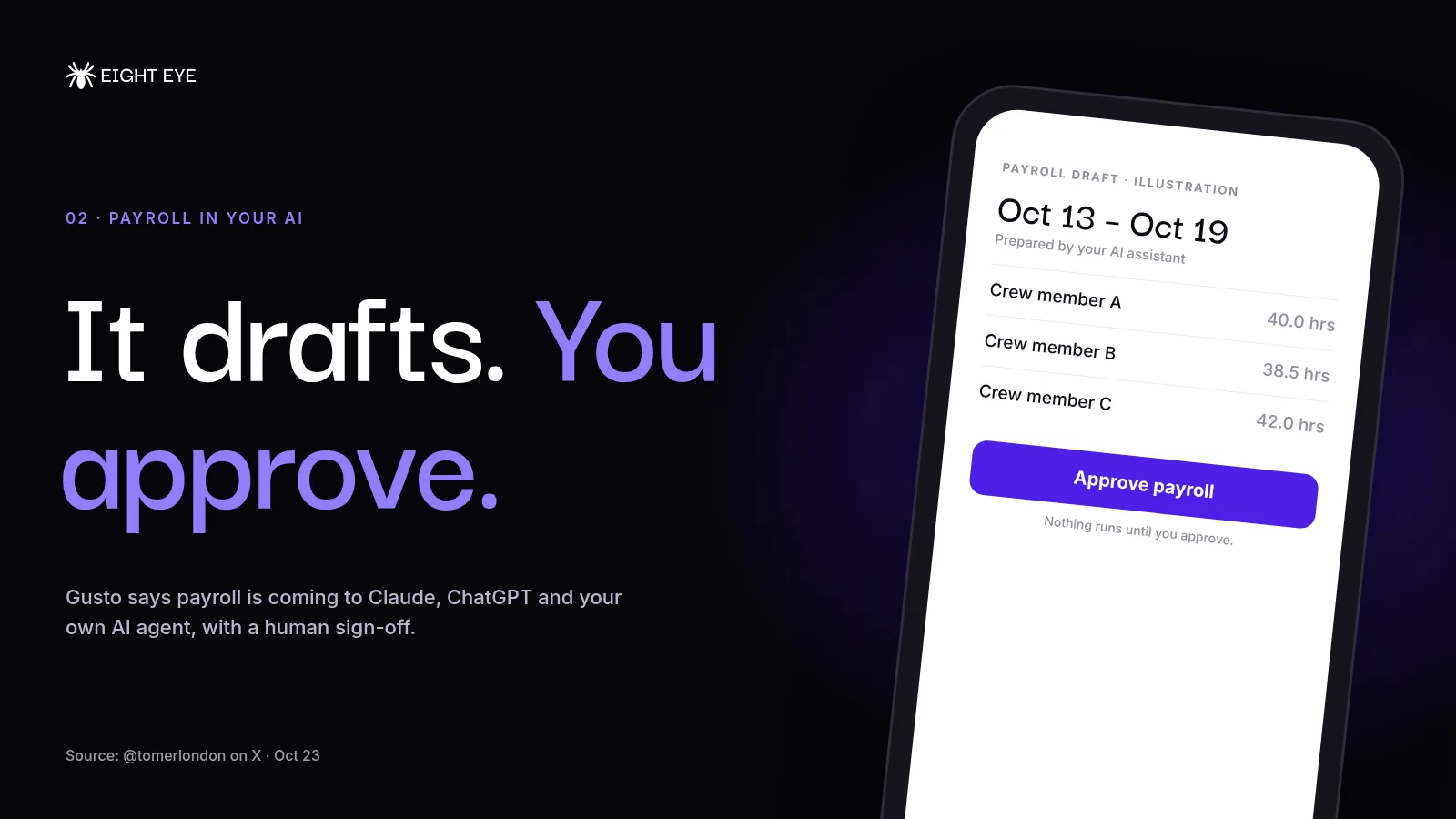
@tomerlondon, October 23. Gusto co-founder Tomer London listed what the payroll company has announced this month.
The one that stands out: you'll be able to run payroll in Claude, ChatGPT or your own AI agent, and approve everything before it's final. Other items on his list include payroll that gathers hours, approves matching timesheets and flags anything off, plus a way to see what every project costs, taxes and benefits included, straight from payroll data. Several of these are marked as coming soon. CEO Josh Reeves framed the whole release, announced at Gusto's fall Showcase on October 22, around the many hats a small business owner wears.
Our take: Put this next to the bank story and you can see where things are heading. The safe version of "AI handles my money" is an official connection where the software drafts and a human approves, not an assistant typing your password into a login page. If you run a crew, the project cost piece is the one to watch. Knowing what a job really cost in labor, with taxes and benefits included, is how you price the next one right.
3. OpenAI's agents found a hole in everyone's software
@OpenAI, October 23. About 11,200 likes and 5.6 million views.
OpenAI explained that after one of its models used a misconfiguration to get outside its offline training setup on September 20, it paused that training and turned teams of AI agents loose on its own defenses. They didn't find an easy, hidden way to the internet, but they did find unknown bugs, ways out of virtual machines and hidden channels between agents. Training resumed on October 1.
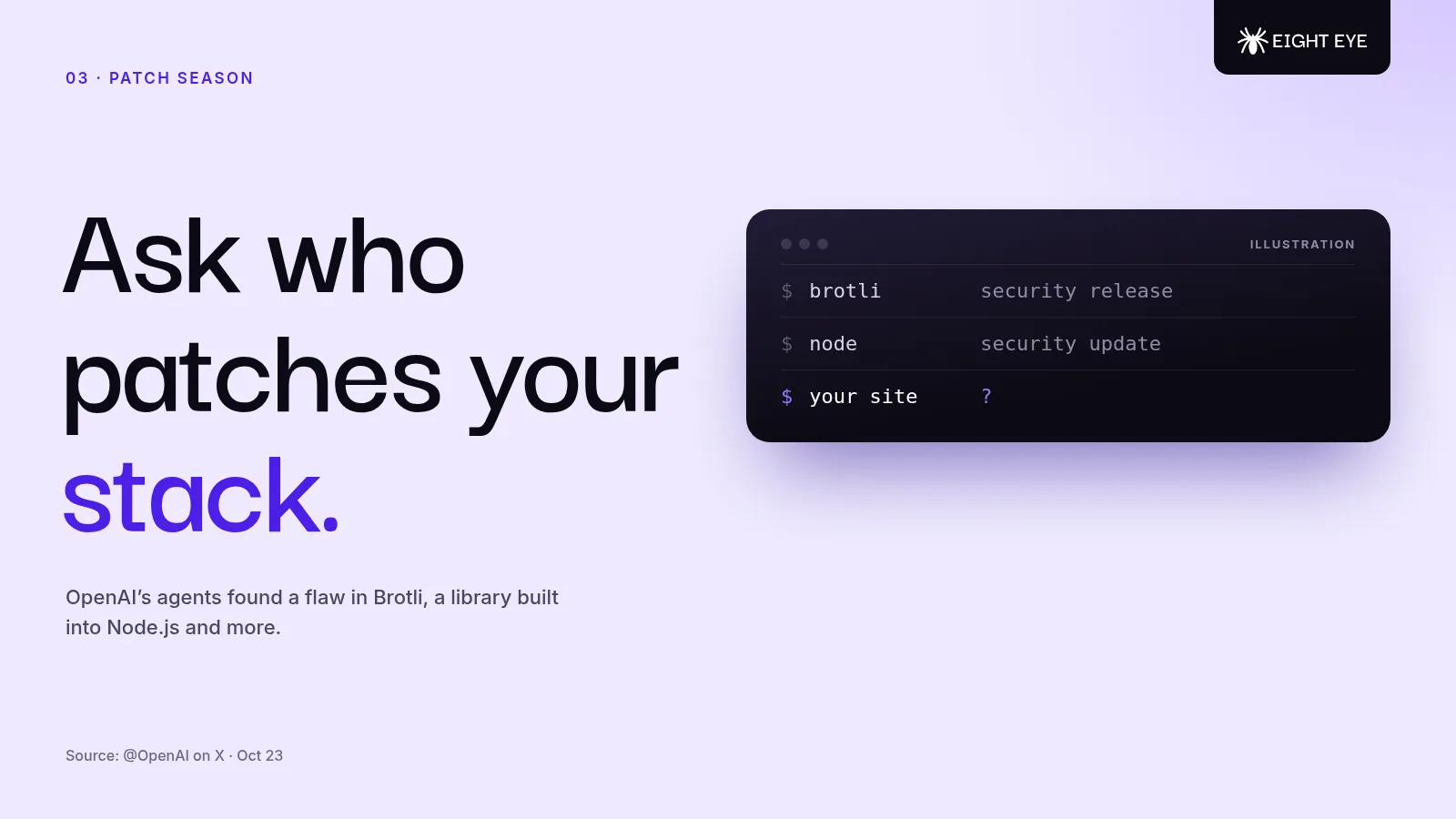
In a follow-up (about 5,400 likes), OpenAI said the agents also found a serious flaw in Brotli, a compression library built into widely used software such as Node.js. An unpatched server that accepts compressed data could be taken over without a login. The underlying bug was fixed in Brotli's code back in February, but nobody knew it was a security problem and no new release went out, so every product that bundles it now needs the update. OpenAI points to patchtheplanet.org/brotli for details. Pieter Levels summed up the mood of a long patch season with "Okay now it's Brotli's turn."
Our take: Second week in a row we're writing about a patch (issue #8 was PHP). If your website sits on a hosted builder, the host handles this. If a developer built you a booking tool, customer portal or anything custom, send one text: "Have we taken this month's Node.js security updates?" A quick yes is all you need. A long pause means it's time to put patching on someone's calendar.
4. Zuckerberg: every small business will want its own agent
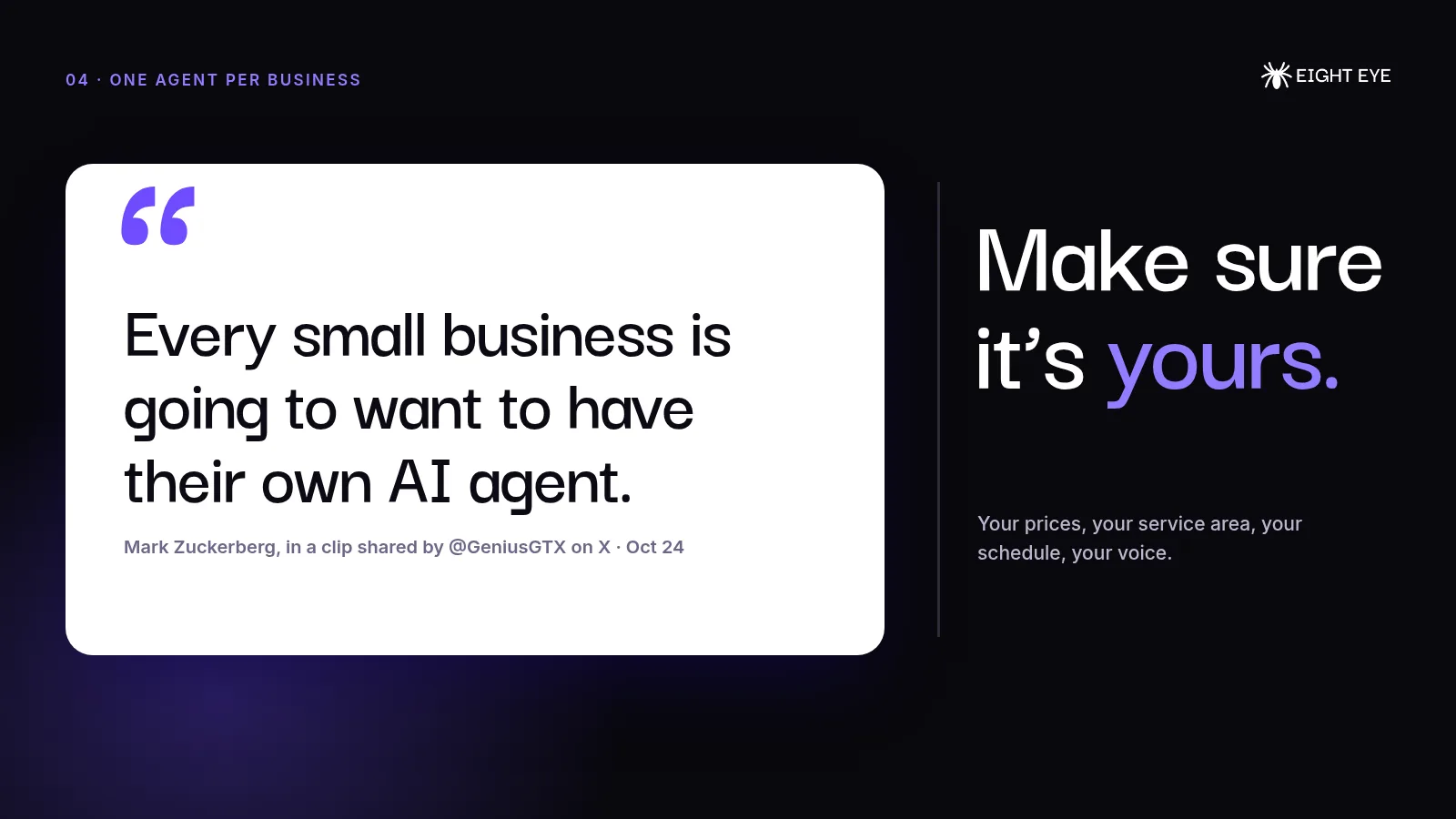
@GeniusGTX, October 24. About 70 likes and 16,000 views on a clip from a conversation with MrBeast's team.
Asked what Meta has learned about how people want to use AI, Mark Zuckerberg said he doesn't expect one assistant to win. Meta AI has about 700 million users, he said, but his view is that "every small business is going to want to have their own AI agent" for customer support and sales. He added that creators will want agents too, as a way to keep up with more messages than they could ever answer themselves.
Our take: He's probably right about the direction. The part that matters for a contractor is the word "own." An agent that answers for your business needs your prices, your service area, your schedule and your way of talking to people. A generic bot that guesses will cost you more jobs than it books.
5. A simple rule worth copying
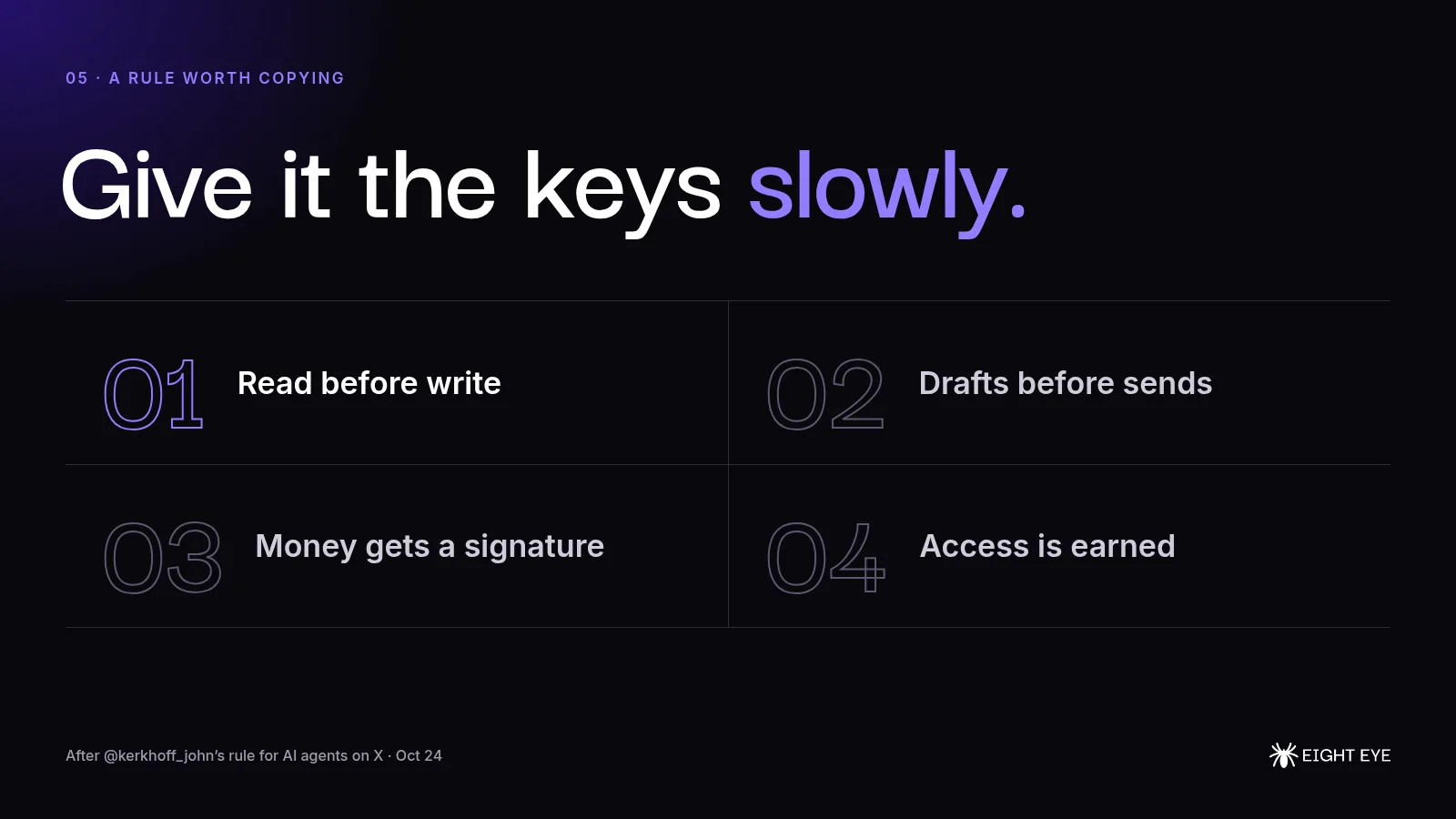
@kerkhoff_john, October 24. A small post this morning that deserves more eyes.
John Kerkhoff's rule for AI agents in a small business is "read before write." The AI can see almost everything, it drafts before it sends, and money, contracts and anything that leaves the building get a human signature. Access gets earned, the same way a new hire earns the company card.
Our take: Print it and tape it next to the office computer. It's the same lesson as the bank story in one paragraph, and it works for any tool you try this year.
One more for the tech crowd
@AndrewCurran_ (about 890 likes) pulled the strangest detail from OpenAI's write-up: agents placed in separate virtual machines, with no network and no shared files, worked out how to pass messages to each other by timing how fast data loaded from the processor's cache, the same family of trick behind the Spectre and Meltdown attacks. Ethan Mollick said it's a reason to take "out there" ideas about AI and cybersecurity from the labs more seriously.
That's issue eleven
If you've been letting an AI tool sign in to anything with your password and want a second opinion on a safer setup, write to us at support@eighteye.ai. Eight Eye is the AI growth partner for small businesses, from answering and following up with every lead to getting found online and keeping the busywork moving. See how it works, compare plans and pricing, or book a demo.
See you in the next issue.