
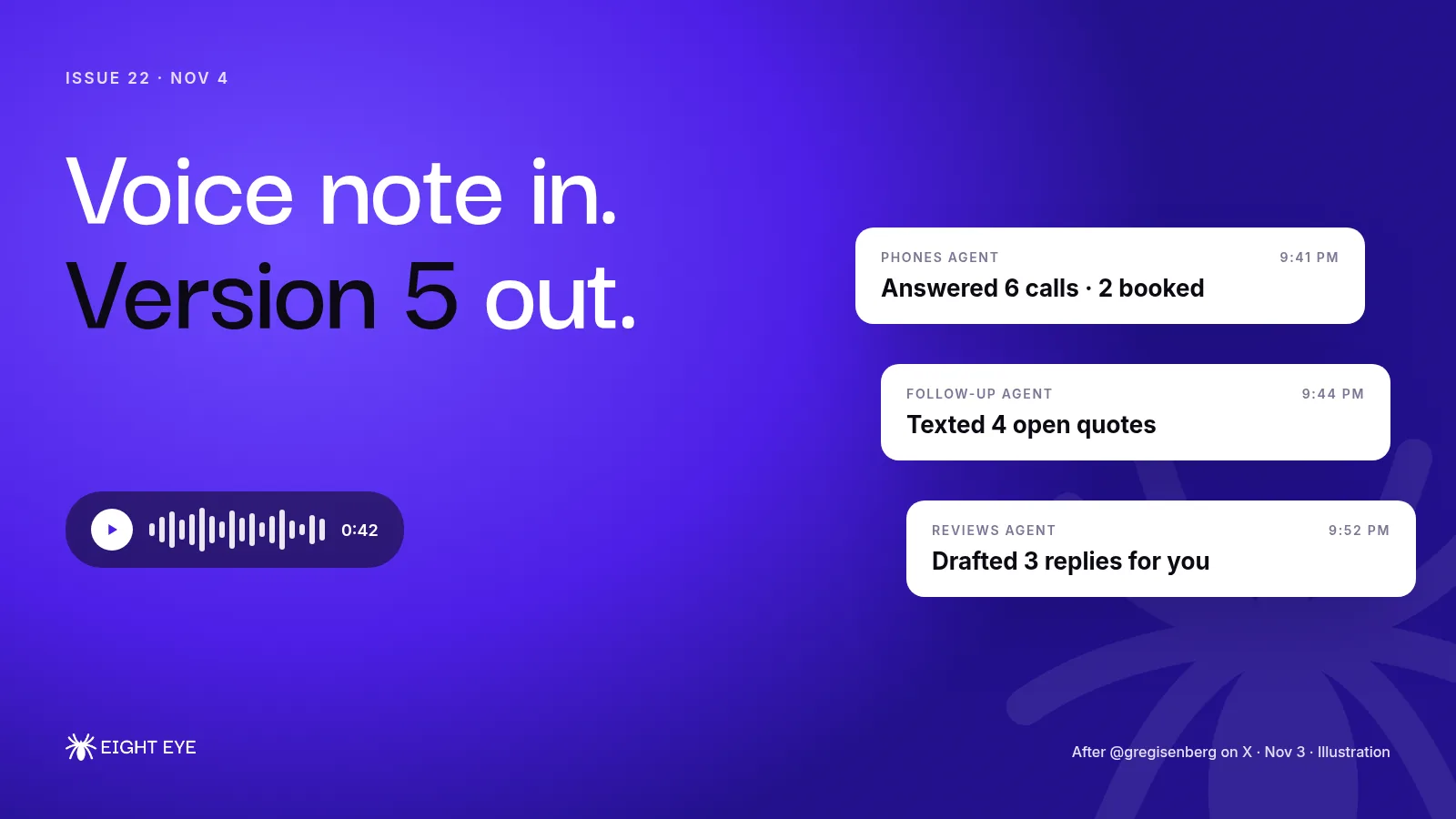
There's a version of the AI conversation that's all model names and benchmark charts. This issue isn't that. The posts that got people talking over the last day or two were about something more practical: what it actually looks like to run a business when software does a big share of the work, and what still needs a person.
Our lead is a founder who laid out every AI agent his company uses, step by step, and got more than 12,000 bookmarks for it. Most of his list won't fit a trades shop, but a handful of his habits will. After that: a fair question about whether the trades are as safe from AI as everyone says, and a reminder that customers can tell when a reply was written by a machine and nobody read it. Each item links to the original post on X, and engagement numbers are as of the morning of November 4.
1. "I talk to my agents more than my human teammates"
@gregisenberg, November 3. About 4,100 likes, 12,300 bookmarks, 450 replies and 483,000 views.
Greg Isenberg runs a holding company with more than 50 people in 12 countries, and he said running it "feels kinda dystopian" because he now talks to his agents more than his human teammates. Then he posted the whole setup. Ideas start as a voice note to an AI assistant. One agent reads every competitor's website, pricing page and product updates. Another pulls customer reviews and lists the ten complaints that come up most, with quotes. Agents design several versions of each screen, write the code, test it like impatient, confused and phone-only customers, and open fixes for bugs, with a person approving. Every morning at 7, an agent checks the previous day's sales funnel, and every Monday it gathers every cancellation reason into one document.
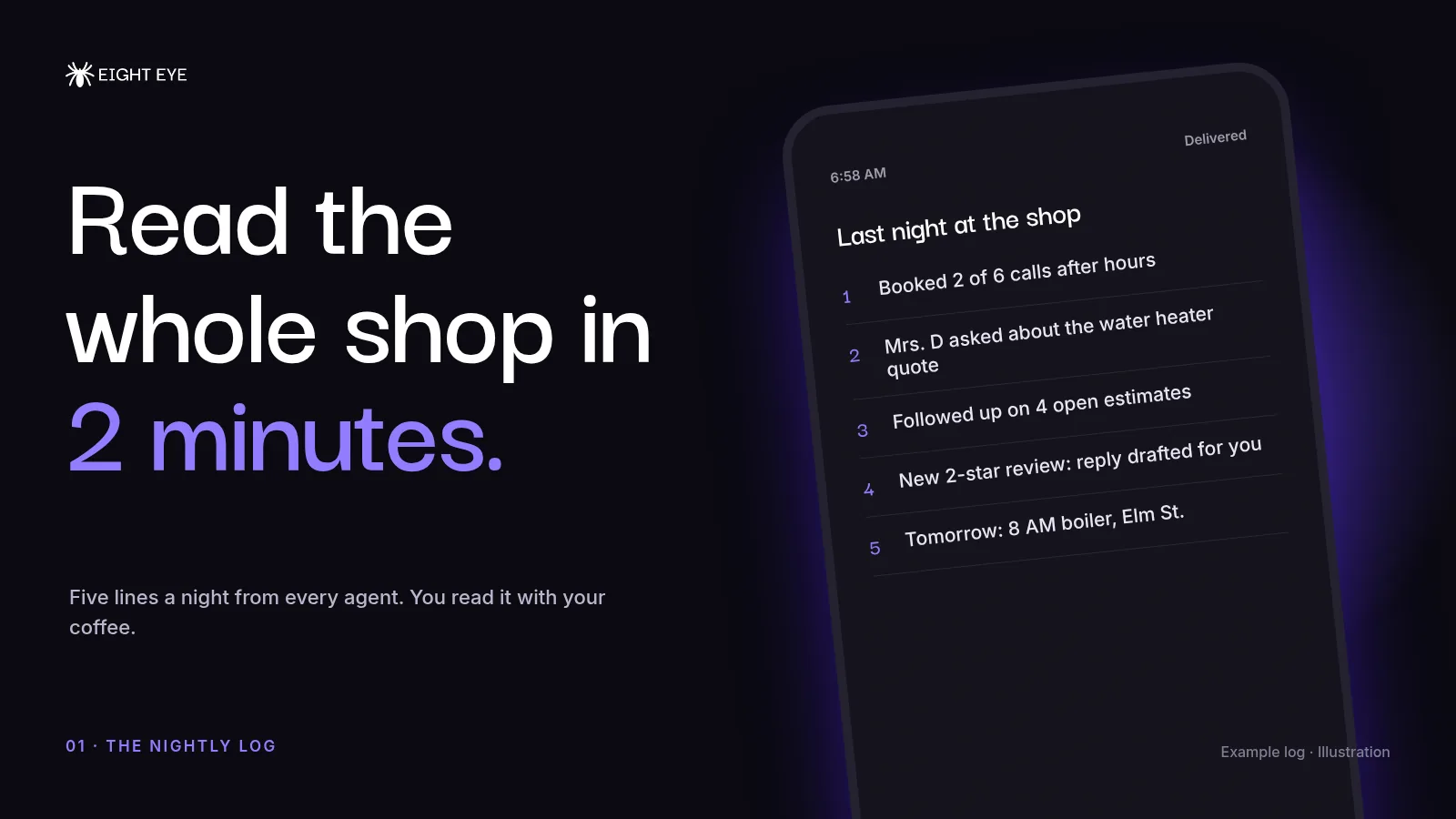
The part most people bookmarked was near the bottom, under "some helpful tricks." Each agent sticks to one job. A cheap model sorts the easy stuff, and the strongest model handles anything that goes out the door. Every agent writes a five-line log at night so he can "read the whole company in 2 minutes." Every mistake an agent makes becomes a written rule so it only happens once. And his human team gets "version 5, not my voice note." Their job is feedback, relationships and telling the agents what they got wrong.
Our take: You don't need 40 tools to borrow the useful ideas here. Four of them translate straight to a plumbing, heating or electrical shop:
- One job per helper. Whatever answers your phones shouldn't also be writing your Facebook posts. Small, clear jobs are easier to check and easier to fix.
- A short report you actually read. Five lines in the morning: calls that came in after hours, who booked, which quotes are still open, any new reviews. If you can't read it with your coffee, it's too long.
- Mistakes become rules. When a helper quotes the wrong service area or promises a same-day visit you can't make, write the rule down once so it doesn't happen again. That's how you'd train a new dispatcher, too.
- People handle the relationship. Notice what Isenberg kept for humans: judgment and relationships. For a trades shop, that's the tech at the door, the call with an upset customer and the decision on a big job. The software should clear the path to those moments, not replace them.
2. Are the trades really safe from AI?
@staysaasy, November 2. About 140 likes, 20 replies and 8,000 views.
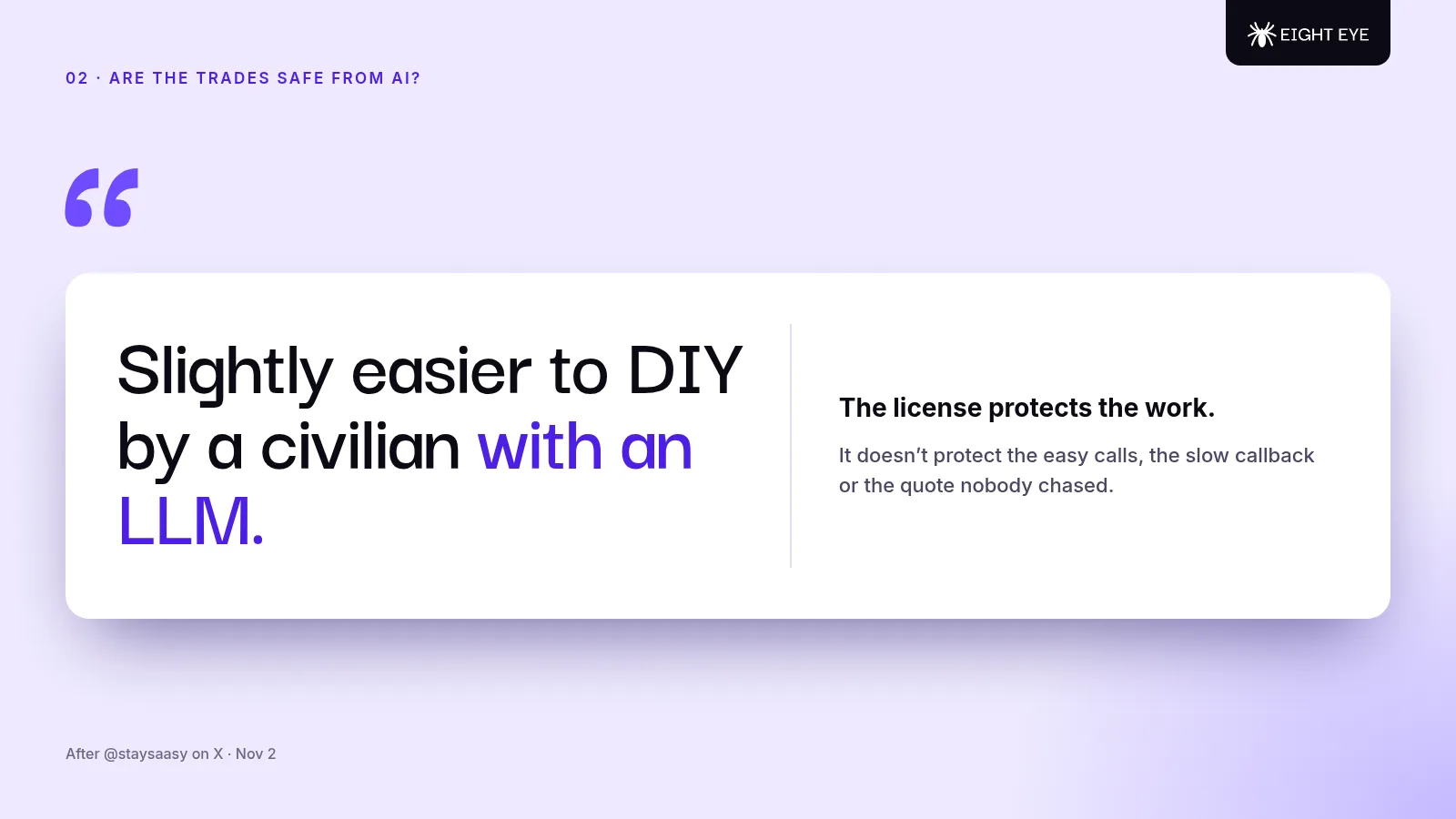
The anonymous account staysaasy, which writes about software companies and management, pushed back on a popular idea: that HVAC techs, electricians and other trades have a strong moat because AI can't do physical work. The post wondered whether the real answer to the shortage will be home systems built to be "slightly easier to DIY by a civilian with an LLM," meaning a homeowner with a chatbot walking them through the repair.
Our take: It's a fair point, and it's worth taking seriously instead of brushing off. Nobody is going to rough in a panel upgrade or braze a line set with a chatbot. Licenses, permits, inspections and insurance aren't going anywhere in Massachusetts. But the easy end of the work is already moving. Homeowners are asking AI why their furnace short-cycles, how to reset a tripped GFCI and whether a running toilet is worth a service call, and some of those calls never come in.
That isn't a reason to panic. It's a reason to be the obvious choice for everything a homeowner can't or shouldn't do. When someone gives up on the DIY fix at 9 p.m., the shop that answers, texts back fast and shows up when it said it would gets the job. The license protects the work. It doesn't protect a slow callback.
3. Customers can smell AI slop
@emollick, November 3. About 290 likes, 150 replies and 24,000 views.
Ethan Mollick, the Wharton professor who studies AI, said AI-written "slopcomments" on X are "out-of-control," and that they'd be easy to stop if the company wanted to. In a small experiment, he found that running as few as five of an account's comments together through Pangram, an AI-text detector, was enough to weed out the slop without punishing real people. The same morning, Greg Isenberg (about 230 likes and 310 bookmarks) posted a video on how not to write AI slop, and it drew about 100 replies.
Our take: The lesson for a local business isn't about X. It's about every message with your name on it. Review replies, estimate follow-ups and social posts that read like they came out of a machine make people trust you less, and customers notice faster than you'd think. "Thank you for your valuable feedback! We strive to provide exceptional service" convinces nobody.
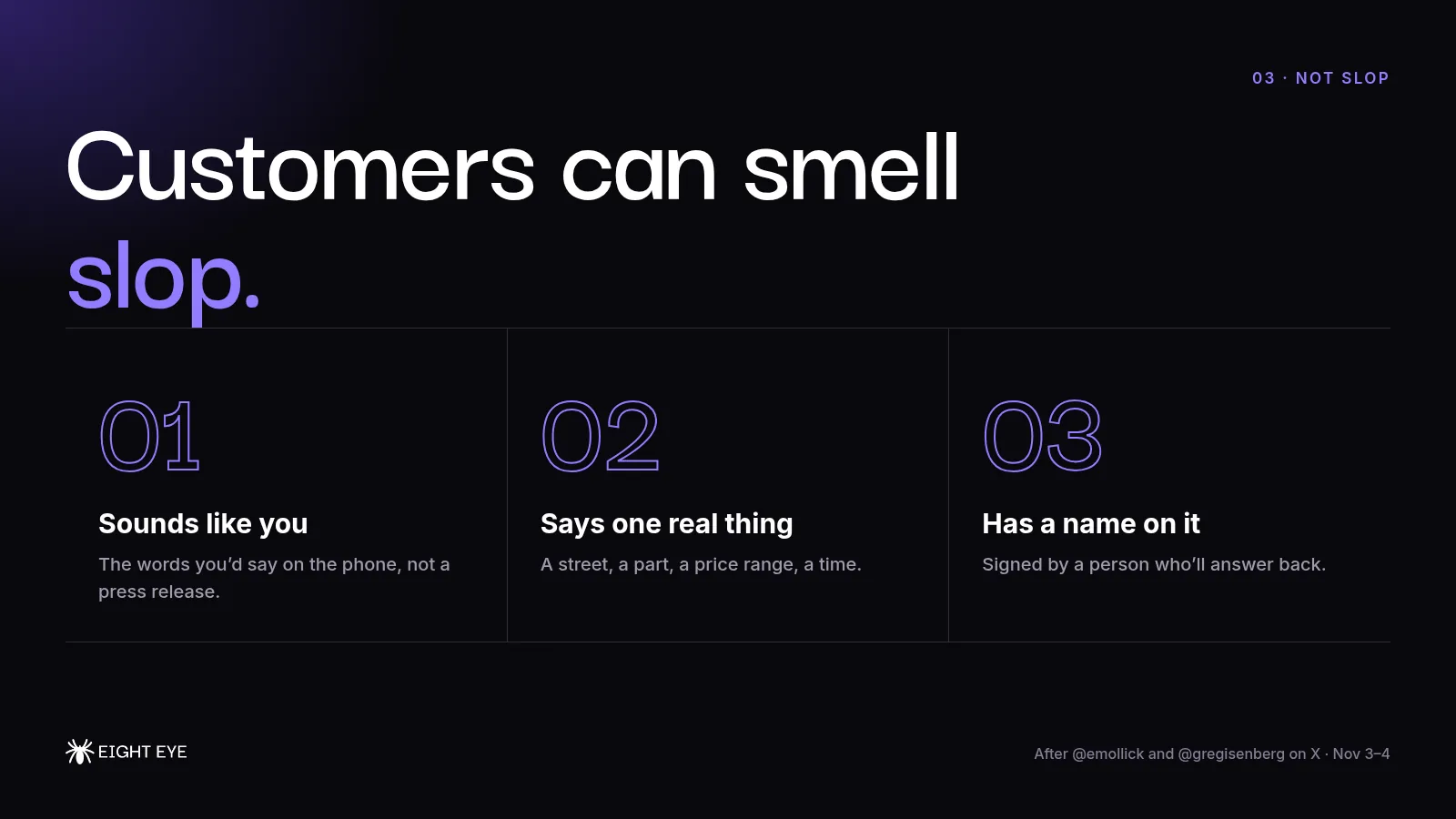
Use AI to get a first draft fast, then make it sound like you. A good reply sounds like what you'd say on the phone. It mentions one real detail, like the street, the part or the day. And it's signed by a person who'll answer if the customer writes back. If you wouldn't say it out loud to the homeowner, don't post it.
For the tech crowd
Proving which AI answered. Anthropic (about 4,600 likes and 515,000 views) shared research on FlashProve, a method that lets developers verify that a response really came from a particular AI model. The company says it's much more efficient than earlier open-source approaches, and that it could make it harder for attackers to hijack a chat or let safety testers confirm the model they evaluated is the one customers actually get. Anthropic is open-sourcing the code.
The chaotic phase. Amjad Masad (about 670 likes and 720 bookmarks), the CEO of Replit, said we're "deep in the chaotic phase" of big companies adopting AI agents and "vibe coding," where people build software by describing it in plain language.
The backlog nobody asks about. Hiten Shah, a longtime software founder, pointed out that every company has an unwritten list of software changes people stopped requesting because engineering always had bigger priorities, and that coding agents make that list worth revisiting. For a small shop, the same goes for the little fixes to your website, booking form or price sheet you gave up on.
That's issue twenty-two
Two things to try this week: write down the five lines you'd want in a morning report about your business, and reread the last three review replies you posted out loud. If what's really eating your time is the phone, the missed texts and the follow-ups, write to us at support@eighteye.ai. Eight Eye is the AI growth partner for small businesses. We answer your calls, text back missed leads, follow up until they book and help you get found online, while you keep the final say. See how it works, compare plans and pricing, or book a demo.
See you in the next issue.