

Your phone rings at 10:40 on a Tuesday. You pick up. The voice on the other end is polite, clear and a little too calm. It says it's calling for a homeowner in Norwood who needs a furnace looked at this week. It wants to know if you have an opening and what a diagnostic visit costs.
It's not a person. It's an AI assistant.
A call like that just got a lot more likely. That's our lead today. After it: why United Airlines just banned booking bots, ChatGPT getting a wallet, and a cheap new Google model the tech crowd is excited about. Each item links to the original post on X. Engagement numbers are as of the morning of November 13.
1. Meta's AI assistant now makes phone calls
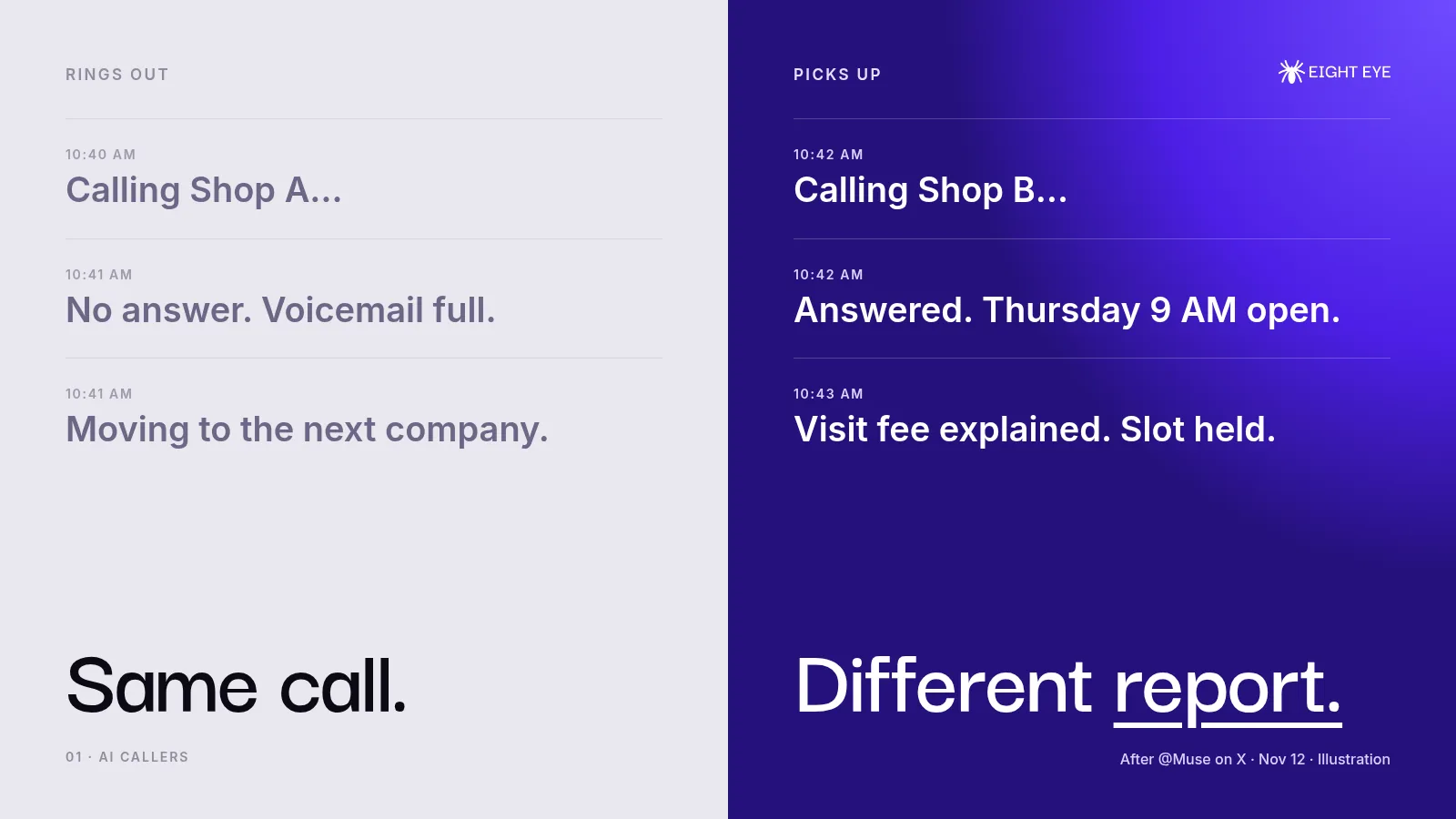
@Muse, November 12. About 1,400 likes and 132,000 views. Announced the same day by @alexandr_wang, Meta's chief AI officer (about 1,350 likes and 89,000 views).
Muse is Meta's personal AI agent. It can now place phone calls for paid subscribers in the US. Alexandr Wang listed the calls most people dread: insurance, cable, the DMV, a dinner reservation. A member of the Muse team described how it works: you tell it what you need and who to call, and it waits on hold, talks to the person and reports back. TechCrunch pointed out it's a paid feature, not a free one.
Our take: Today it's cable companies and restaurants. It won't stay there. Once people get used to handing off calls, "call three plumbers and find who can come Thursday" is an obvious ask. Here's the catch. The assistant reports back to its owner. If your phone rings out, or the person who answers can't give a straight answer, the report says so and your name drops off the list.
Get your shop ready for that call:
- Answer it like a customer. It is one. Someone sent it. Don't hang up because the voice sounds off.
- Have three answers ready. Your next opening, your service area and how pricing works. If you don't quote on the phone, say exactly what the visit fee covers.
- Give one next step. "I can hold Thursday at 9. What's the address and a callback number?" Assistants pass that back cleanly.
- Cover the missed calls. A call nobody answers is a lost job, whether a person or an AI dialed it. Text back every missed call within a few minutes.
- Write down what you told it. Same as any lead. If you held a slot, put it on the board.
2. United Airlines bans booking bots. You get to set rules too
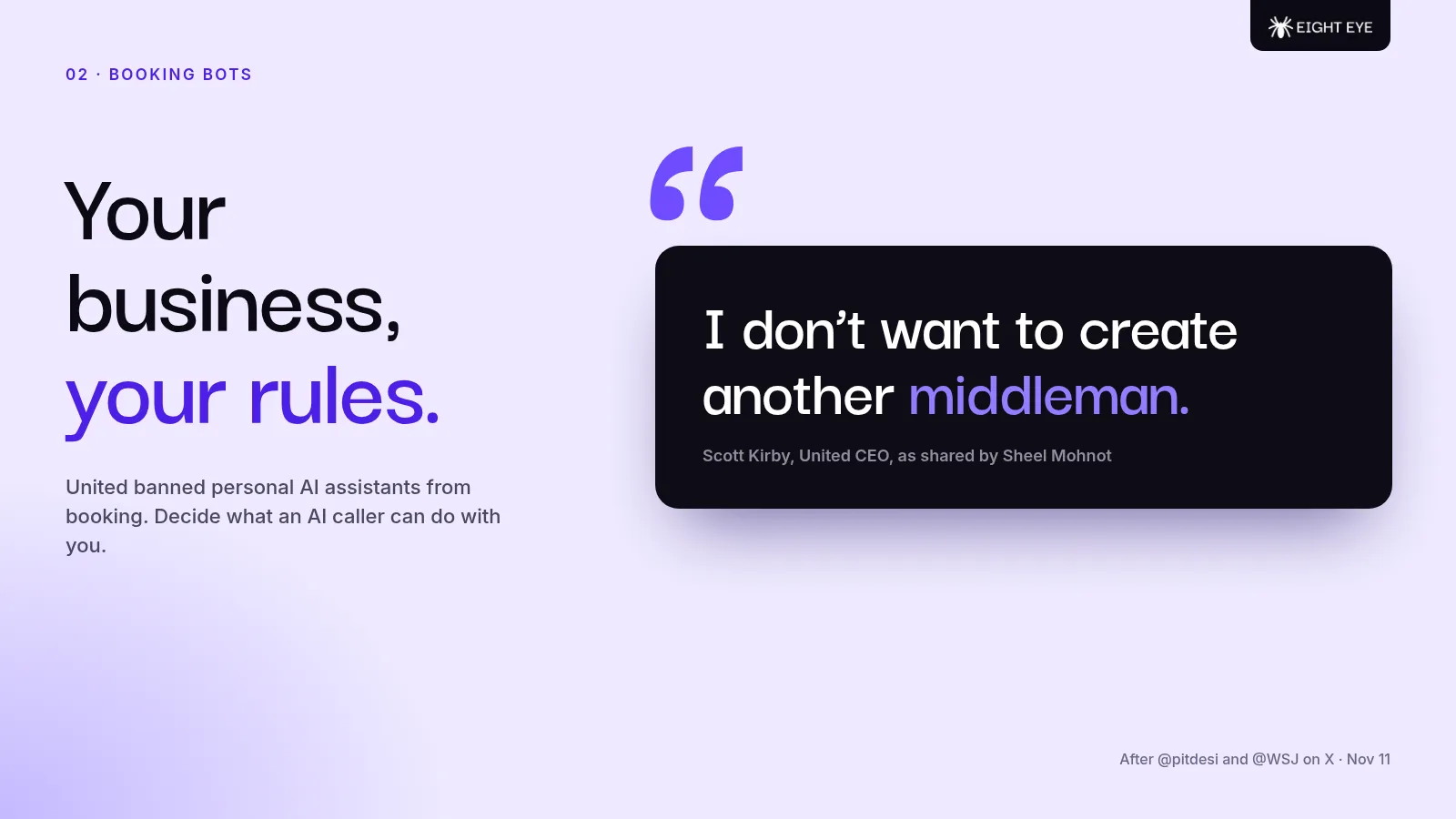
@Polymarket, November 11. About 1,700 likes and 230,000 views. Reported by @WSJ (about 360 likes and 155,000 views).
United Airlines says it will ban personal AI assistants from booking flights for customers. The Wall Street Journal reported the airline's reasons: privacy risks and possible conflicts with FAA rules. Investor Sheel Mohnot shared CEO Scott Kirby's line, "I don't want to create another middleman," and noted agents can still book through a travel site, which costs United more.
Plenty of people pushed back. @KatieMiller (about 1,070 likes) called it "a dumb move." One reply with about 540 likes, from @shortmagsmle, hit harder: companies spent years putting customers through phone robots and offshore call centers, and now they're upset that customers use a robot back.
Our take: Two lessons for a trade shop. First, that reply is the real warning. If your phone tree makes people press five buttons, don't be surprised when they send a bot to deal with it. Second, United is drawing a line, and you can too. Decide what an AI caller or agent is allowed to do with you. A simple version: it can ask about openings, service area and visit fees, and it can request an appointment window. Anything that involves a deposit, a card number or a change to a signed job goes to a human, every time.
3. ChatGPT can now pay for things
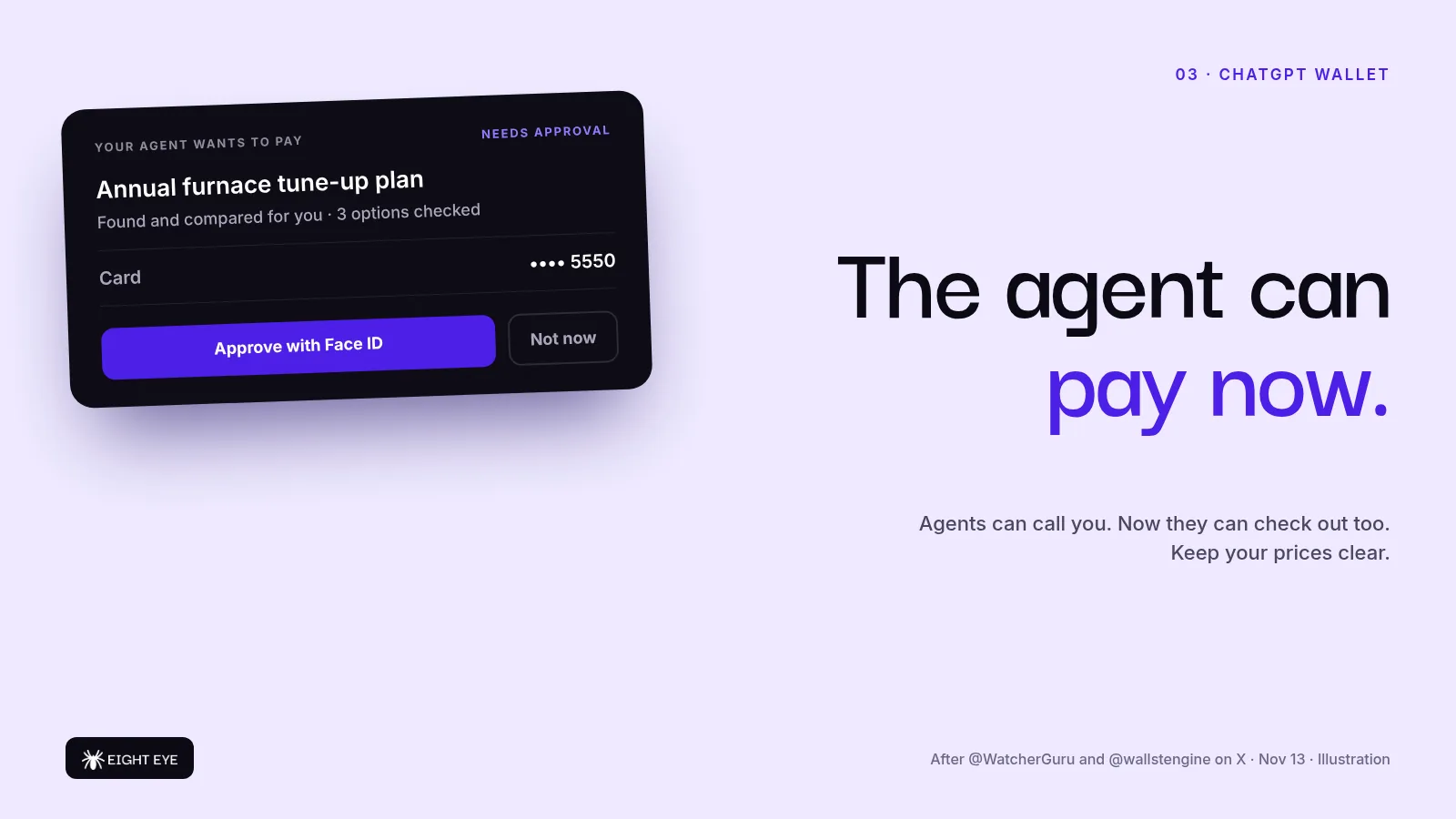
@WatcherGuru, November 13. About 1,000 likes and 120,000 views soon after it went up. Also reported by @CNBC.
OpenAI launched ChatGPT Wallet this morning. It lets its "dots" AI agents complete purchases for users, starting with ChatGPT Pro subscribers in the US, according to @wallstengine. Coin Bureau reported that agents can browse products, compare options and handle checkout, and that purchases need the user's review and explicit approval. Not everyone was thrilled. One reply summed up a common worry: "we're going to get a lot of scams out here with this."
Our take: Put this next to the Muse story. Agents can now call you, and agents can now pay. Today that's online shopping, not a water heater install. But if you take deposits or sell maintenance plans online, keep the checkout simple and the price clear. And yes, expect scammers to try this too. Your rule stays the same: confirm big payments and any change to payment details with a real person on a number you already have.
One more for the tech crowd
@OfficialLoganK (about 10,600 likes and 782,000 views) and @sundarpichai (about 8,000 likes) introduced Gemini Decision 1, a Google model built for picking answers instead of writing them. It scores up to 1,000 yes-or-no and multiple-choice questions in one request, across text, images, audio, video and PDFs, for $0.10 per million input tokens, and it's free to try in the API. For a small shop, think boring and useful: sorting leads as hot or cold, flagging which voicemails mention an emergency, or checking that a job photo shows the finished work.
And if you missed it, Nvidia's board accepted Jensen Huang's resignation as CEO on November 12, with CFO Colette Kress stepping in as interim CEO. By this morning, @WatcherGuru was reporting that employees were petitioning to bring him back (about 42,000 likes and 1.1 million views).
That's issue thirty-one
One thing to try today: call your own business from a number you don't recognize. Time how long it rings. Listen to what the caller hears. Then ask yourself whether an assistant would come away with an opening, a price answer and a next step. If not, fix that first. If calls are slipping while you're on a job, write to us at support@eighteye.ai. Eight Eye is the AI growth partner for small businesses. We answer your calls, text back missed leads, follow up until they book and help you get found online, while you keep the final say. See how it works, compare plans and pricing, or book a demo.
See you in the next issue.