

Pieter Levels shared a table that @theannalux designed with Claude Code. She is not a furniture designer. She is not a coder. She described a style, the AI drew it part by part, and it spit out a list of materials to order. His point: customers are getting more powerful.
Here is the part nobody in the trades is talking about yet. Somebody still has to build it. And when the project is a bathroom, a mini split or a panel upgrade, that somebody needs a license.
That is our lead. After it: Greg Isenberg's playbook for reading a competitor's worst reviews, Ethan Mollick on whether you still need to double-check AI, and Aaron Levie on why people with real experience are pulling away. Each item links to the original post on X. Engagement numbers are as of the morning of November 8.
1. Customers are designing the job with AI. Be the pro who builds it
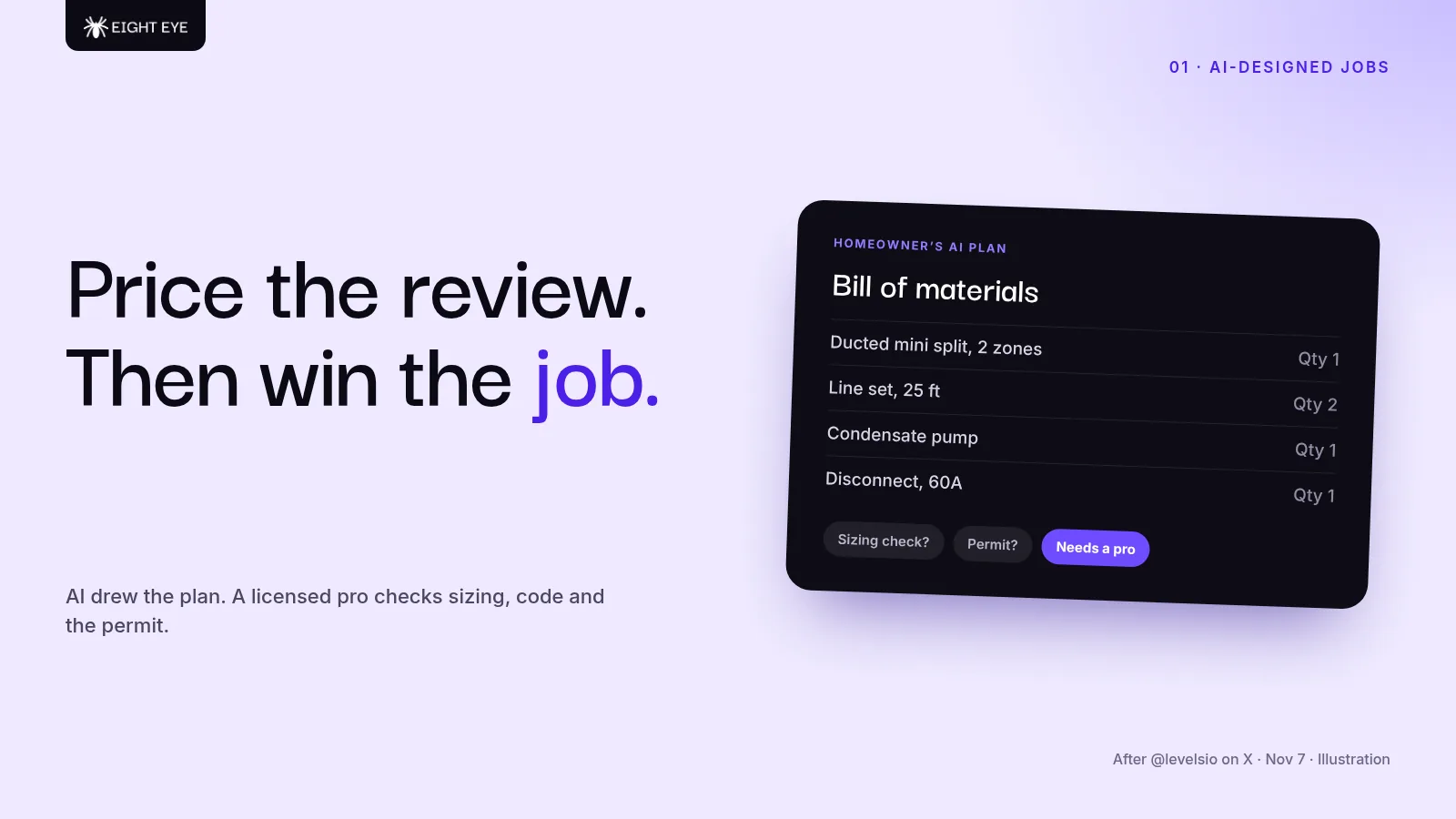
@levelsio, November 7. About 2,600 likes, 2,600 bookmarks and 252,000 views. Follow-up: a market for builders.
Pieter was furnishing his house and got sticker shock. One shop wanted $30,000 for a sofa. Then he showed a table @theannalux designed from scratch with Claude Code, with a bill of materials to order direct from suppliers. He says AI can now run free 3D tools like Blender and FreeCAD, and by his math, designing your own piece and buying raw materials can save around 85% versus premium brands. Those are his numbers, not ours. In a follow-up he said this could open a big market for woodworkers and carpenters who assemble what people design with their AI.
Our take: Furniture is first. Your trade is next. A homeowner in Framingham asks an AI to plan a basement bathroom or size a heat pump, and shows up with a parts list and a wish list. You can roll your eyes. Or you can be the shop that says yes the right way.
- Have a policy before the call comes. Will you install customer-supplied parts? If yes, say how warranty works on labor vs. parts. Write it once. Put it on your site.
- Price the plan review. A homeowner's AI plan still needs a pro to check sizing, venting, load and code. That review is real work. Charge for it, then credit it if they book the job.
- Lead with the license. In Massachusetts, plumbing, gas and electrical work generally needs a licensed pro and a permit. AI can draw the plan. It cannot pull the permit.
- Answer fast. The person who just spent a weekend designing their project is excited now. The first shop that picks up and gives a clear next step usually gets it.
2. Read your competitor's one-star reviews. Then fix those exact problems
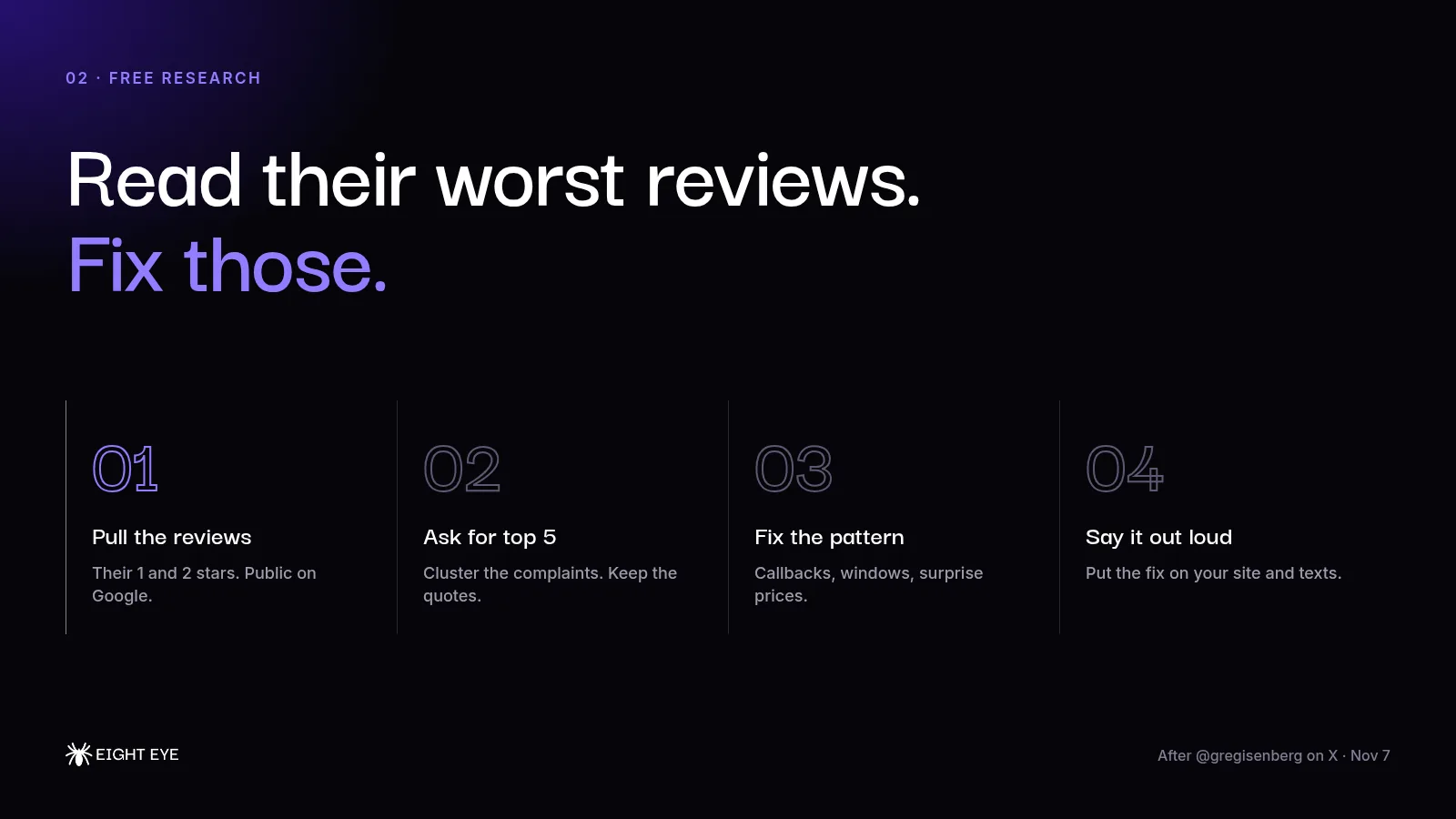
@gregisenberg, November 7. About 2,300 likes, 5,100 bookmarks and 160,000 views.
Greg laid out how he would build an iOS app with AI agents now that Apple put Xcode inside Claude Code. Most of it is app-specific. One step is gold for any business. Pull every review for the top apps in a category, then ask an agent to "cluster the 1 and 2 star reviews into the top 5 complaints." If people complain about bugs, that is your opening. Then make your screenshots answer each complaint directly.
Our take: Do this with the shops in your town. Their Google reviews are public. Copy the one-star and two-star ones into ChatGPT or Claude and ask for the top five complaints, with quotes. In home services you will probably see the same handful: never called back, missed the window, surprise price, messy job. Then make your website, your truck wrap and your booking texts answer those five things. "We call back the same day." "Two-hour arrival window, and we text if we're late." Your competitor already told you what customers hate. Free research.
3. Do you still need to double-check AI? Check what costs money
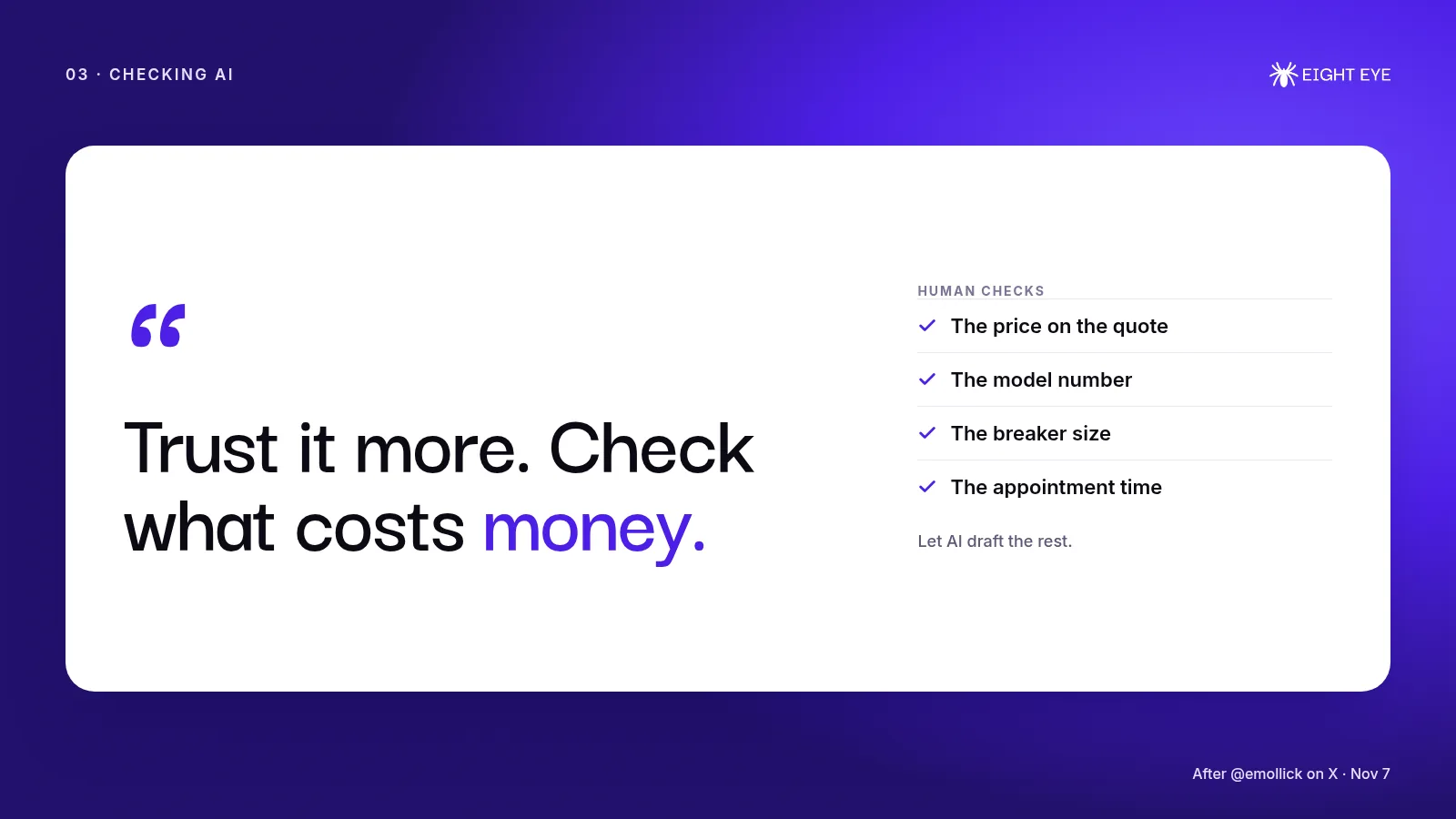
@emollick, November 7. About 1,400 likes, 670 bookmarks and 92,000 views.
Ethan Mollick, the Wharton professor who studies AI at work, said people worry too much about checking AI output for factual errors in everyday work. That used to be fair, he wrote, but data on newer models suggests they beat human experts, including PhD specialists, at finding facts and checking claims.
Our take: Fair point. A lot of owners still refuse to let AI draft a customer email because of one bad answer two years ago. That fear is costing them hours. Let it write the follow-up text, summarize the call, clean up the estimate wording. Then keep one rule: a human checks anything that costs money or touches safety. The price on the quote. The model number. The breaker size. The appointment time. Thirty seconds of checking on those beats an hour of rewriting everything else by hand.
4. Experience plus AI is pulling away from AI alone

@levie, November 7. About 710 likes, 530 bookmarks and 78,000 views.
Box CEO Aaron Levie said he is seeing productivity gains that are "an order of magnitude or two" above pre-AI output, mostly in software for now. The surprise, he wrote, is that the gap is not closing. People who had real depth before, and are willing to work a new way, get the most leverage. He expects the same in other fields, and he named AEC: architecture, engineering and construction.
Our take: This is good news for the 25-year tech. AI does not know that the 1960s ranch on your street has undersized returns, or that one town's inspector always asks for the same thing. You do. Put that knowledge into the AI and it gets sharper. Leave it in your head and the kid with ChatGPT sounds just as smart on the phone as you. The move: have your best tech talk through how he diagnoses a no-heat call, record it, and turn it into a checklist the whole crew and your AI tools can use.
That's issue twenty-six
One thing to try today: pull ten one-star reviews from a competitor, find the top three complaints, and fix one of them in how your shop answers the phone this week. If the phone is the problem, write to us at support@eighteye.ai. Eight Eye is the AI growth partner for small businesses. We answer your calls, text back missed leads, follow up until they book and help you get found online, while you keep the final say. See how it works, compare plans and pricing, or book a demo.
See you in the next issue.