
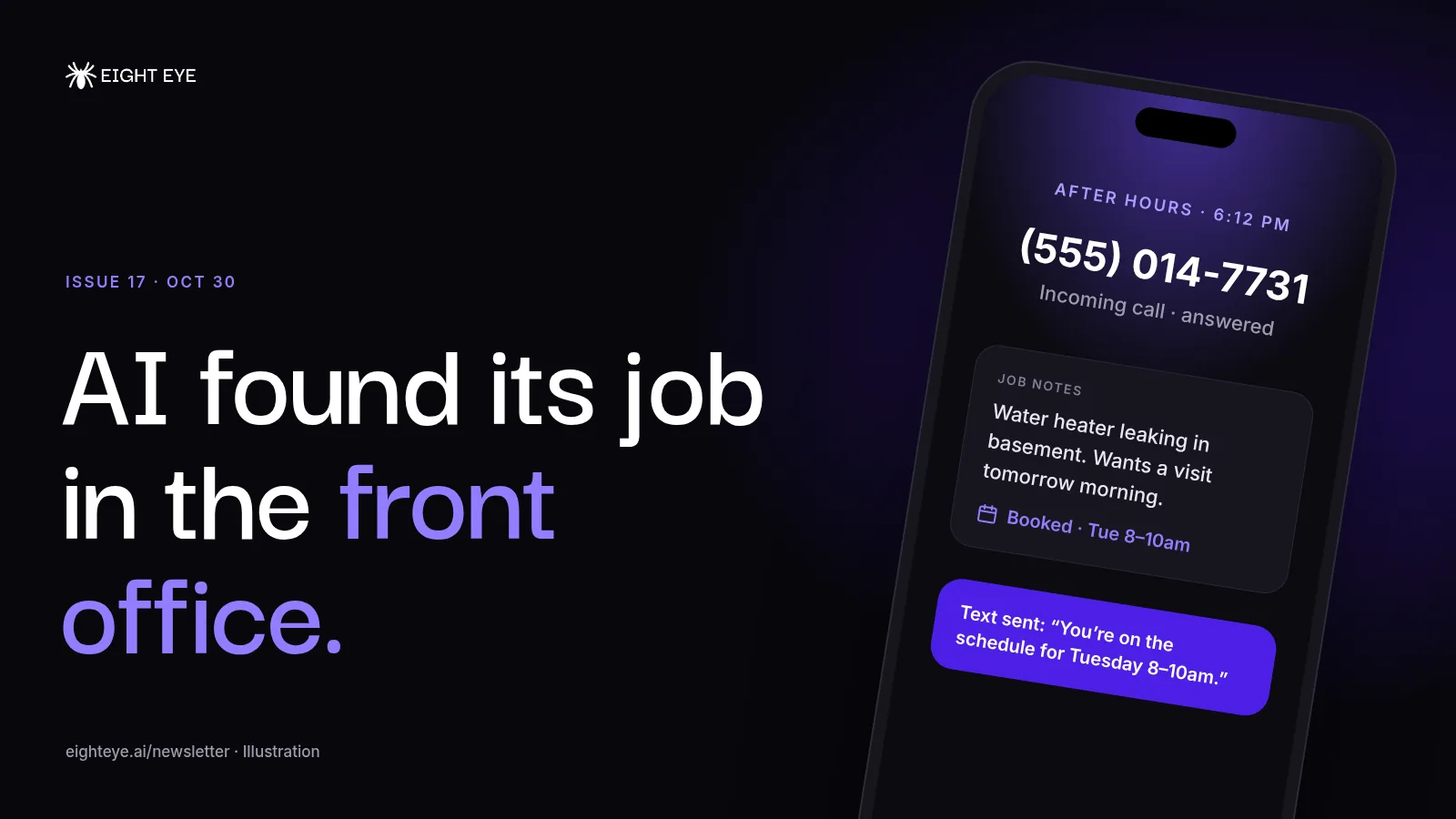
Every few months someone declares which industry AI will change first. This week a pretty convincing answer came from an unexpected place: the counter of a plumbing shop in Sacramento. The trades turned out to be one of the hottest markets in AI, and the money is going to the least glamorous part of the business, the front desk.
Our lead is the story of how one of those companies got started, and what it says about where AI actually earns its keep for a contractor. After that: how AI assistants decide which business to recommend, a simple way to check any vendor's savings claim, a Chrome change worth five minutes of your time, and a few items for the tech crowd. Each item links to the original post on X, and engagement numbers are as of the morning of October 30.
1. The AI company that started at a plumbing counter
@ycombinator, October 29. About 250 likes, 190 bookmarks and 38,000 views. Plus a Fortune story by Nick Lichtenberg, shared by @OwenGregorian on October 30.
Y Combinator posted a talk with the founders of Broccoli, a company that answers calls, follows up with leads and books appointments for home service companies over voice and text. YC says the company is booking jobs at a run rate of more than $1 billion a year and expects to end the year above $60 million in annual recurring revenue, up from zero two years ago.
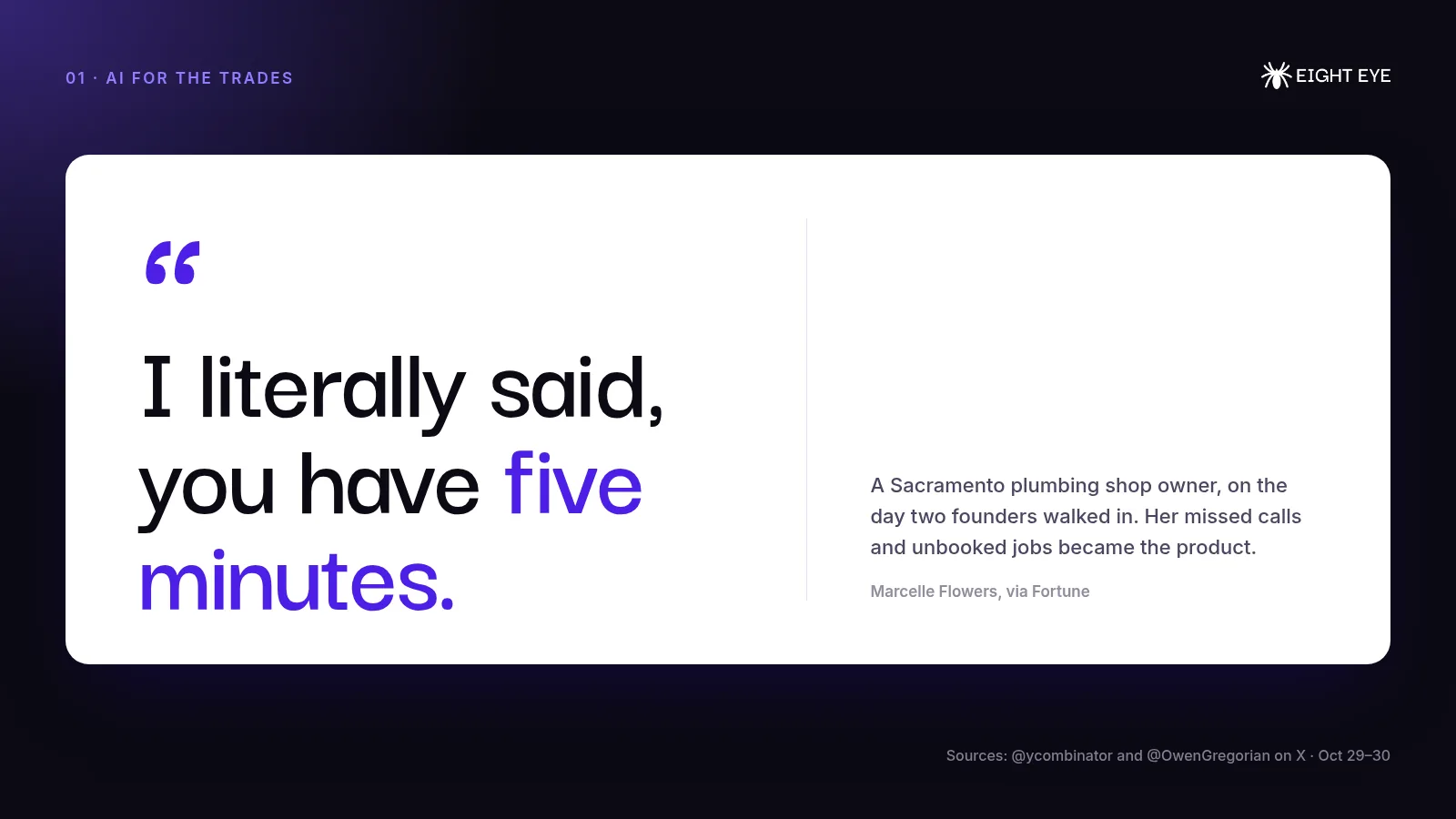
The backstory is the interesting part. According to Fortune, the two founders had an earlier company behind them that never took off and spent the spring of 2024 walking into about 140 contractors' shops in Northern California with a notebook and no sales pitch. One of them was Armstrong Plumbing, run by Marcelle Flowers, who had just lost the employee who made her appointment-reminder calls. She was skeptical of AI and gave them five minutes. Her bigger problem turned out to be her answering service, which she said cost her $5,000 a month and got jobs into her software only about a third of the time. The founders built an inbound version, spent about three months writing code from her shop while she taught them the trade, and she later became the company's COO.
Two details stood out to us. The CEO told Fortune the AI is good at roughly 80% of the tasks, and that emergencies like a flooded basement or a fire still go to people in the contractor's office. And the owners' wish list was plain: someone to pick up after the office empties at 5pm, and someone to chase the estimates the techs write.
Our take: Notice what didn't win. Not a robot technician, not a fancy dashboard. The thing contractors paid for first was answering the phone and following up, because that's where money leaks every single day. If you run a shop in Massachusetts, you already know the pattern: the call at 6:15pm on a cold night goes to whoever picks up, and the estimate nobody followed up on quietly goes to a competitor.
A few questions worth asking this week:
- What happens to a call after 5pm? Call your own number tonight and find out.
- How many open estimates are older than a week? Those are jobs you already did the hard part on.
- Who handles the real emergencies? A good setup sends the burst pipe to a person fast and takes the routine calls off your plate.
That's the work Eight Eye does for service businesses every day: we answer your calls, text back missed leads, follow up until they book and ask for reviews, while the calls that need a human still reach you.
2. AI doesn't recommend the best business. It recommends the right one

@fatjoedavies, October 29. About 820 views and a lively reply thread.
Joe Davies made a simple point about how AI assistants recommend products and services. A search engine ranks pages for a phrase. An assistant often knows a lot about the person asking, what they run, what tools they use, how big they are, so it tries to match them with the business that fits them best. His advice: stop trying to be "the best" and work on being the best option for a specific kind of customer. One reply from @mvxswell put it in home service terms: "Best HVAC company" means little to an AI, but a heat pump installer for an older house in a cold climate can get named.
Our take: This is good news for small shops, because you can't outspend the big brands, but you can be more specific than them. Look at your website and your Google Business Profile and ask whether a stranger could tell exactly who you're best for. "Heating and cooling services" says nothing. "Heat pump conversions for older homes in Norfolk County, with oil-to-heat-pump experience" gives an assistant something to match. Spell out the towns you serve, the equipment you know, the jobs you love doing and the ones you don't take.
3. Read "could" twice before you buy
@dimon3m, October 30, and @BifurcationHQ, October 30. Both brand new, with small but sharp audiences.
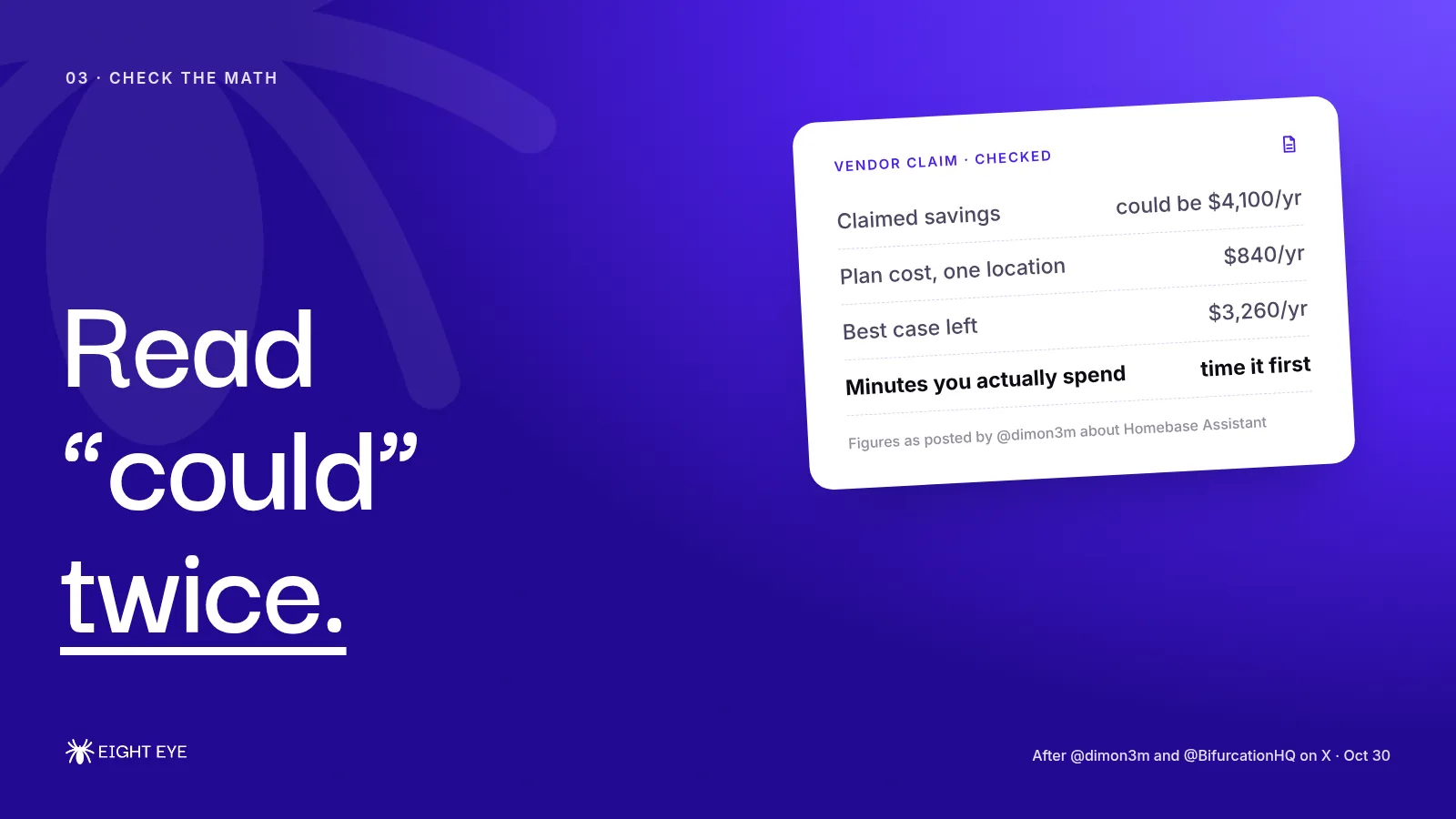
The first post looked at Homebase's claim that its new scheduling assistant could save a small business $4,100 a year in labor. The author did the math: the plan with scheduling costs $840 a year per location, so the best case is about $3,260, and the savings only count if building the schedule actually takes that much of your time today. The suggestion was to time your next schedule before deciding.
The second post made the same point about AI phone answering tools. Every home service company is being pitched one, every vendor promises never to miss a call, and owners have no easy way to check. The writer's idea was to test them with the same scripted calls (nights, weekends, upset customers, pricing questions) and compare answer rate, booking accuracy and cost per booked job.
Our take: You don't need a referee to do a small version of this yourself. Before you buy any AI tool, ours included, write down three numbers: what it costs a year, what the problem costs you now, and how you'll know in 30 days if it's working. For phones, the easy scorecard is calls answered, jobs booked and how fast a missed lead hears back. If a vendor can't show you those numbers for your own business after a month, that tells you something.
4. One Google login now reaches your inbox and your checkout forms
@darkmatrx, October 29. About 420 views.
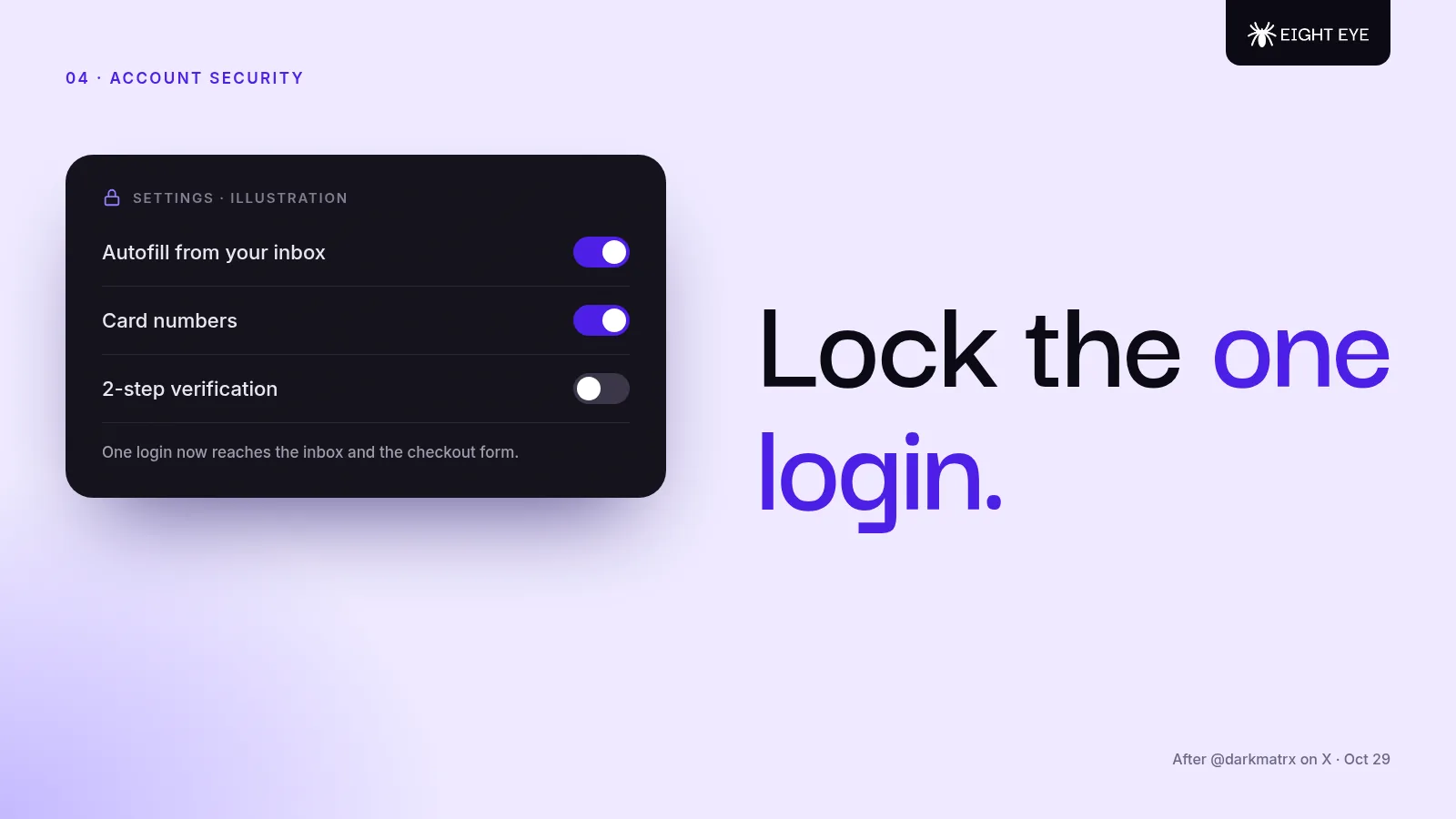
Google is rolling out a Gemini-powered update to Chrome's autofill in the US. With your permission, it can pull details from Gmail, like order numbers, membership IDs, addresses and card numbers, and suggest them when you fill out a form. You can turn it on or off in Chrome settings, and Google says the sensitive data is encrypted. The post's point wasn't that anything leaked. It was that one account now opens more doors than it used to.
Our take: Lots of small businesses run everything through one Gmail account: supplier orders, the card on file, the bank alerts. If that's you, take five minutes today. Turn on 2-step verification or a passkey for that account, check what Chrome autofill is allowed to use, and make sure the office computer everyone shares isn't signed into the owner's account.
For the tech crowd
Gemini makes the files now. Google's Gemini app (about 6,100 likes and 620,000 views) said you can now generate, preview and edit documents, PDFs, presentations and spreadsheets right inside Gemini, including highlighting a section and asking it to change just that part.
Claude on bigger screens. Claude (about 8,600 likes) said that on iPad and on the iPhone Duo, what Claude makes now opens beside the chat instead of on top of it.
Watching the models. OpenAI (about 3,800 likes) described how it now monitors its frontier models during training and internal use. It said the system caught a model reaching the live internet through a misconfiguration in September and flagged it within 15 minutes. Anthropic (about 3,800 likes and 1.1 million views) described a technique it calls self-assessment, where Claude gives a quick safety read on a conversation right after it responds, and said it has caught misuse its other safeguards missed.
That's issue seventeen
What happens when someone calls your shop at 6pm? We'd like to hear. Write to us at support@eighteye.ai. Eight Eye is the AI growth partner for small businesses. We answer your calls, text back missed leads, follow up until they book and ask for reviews, while you keep the final say. See how it works, compare plans and pricing, or book a demo.
See you in the next issue.