
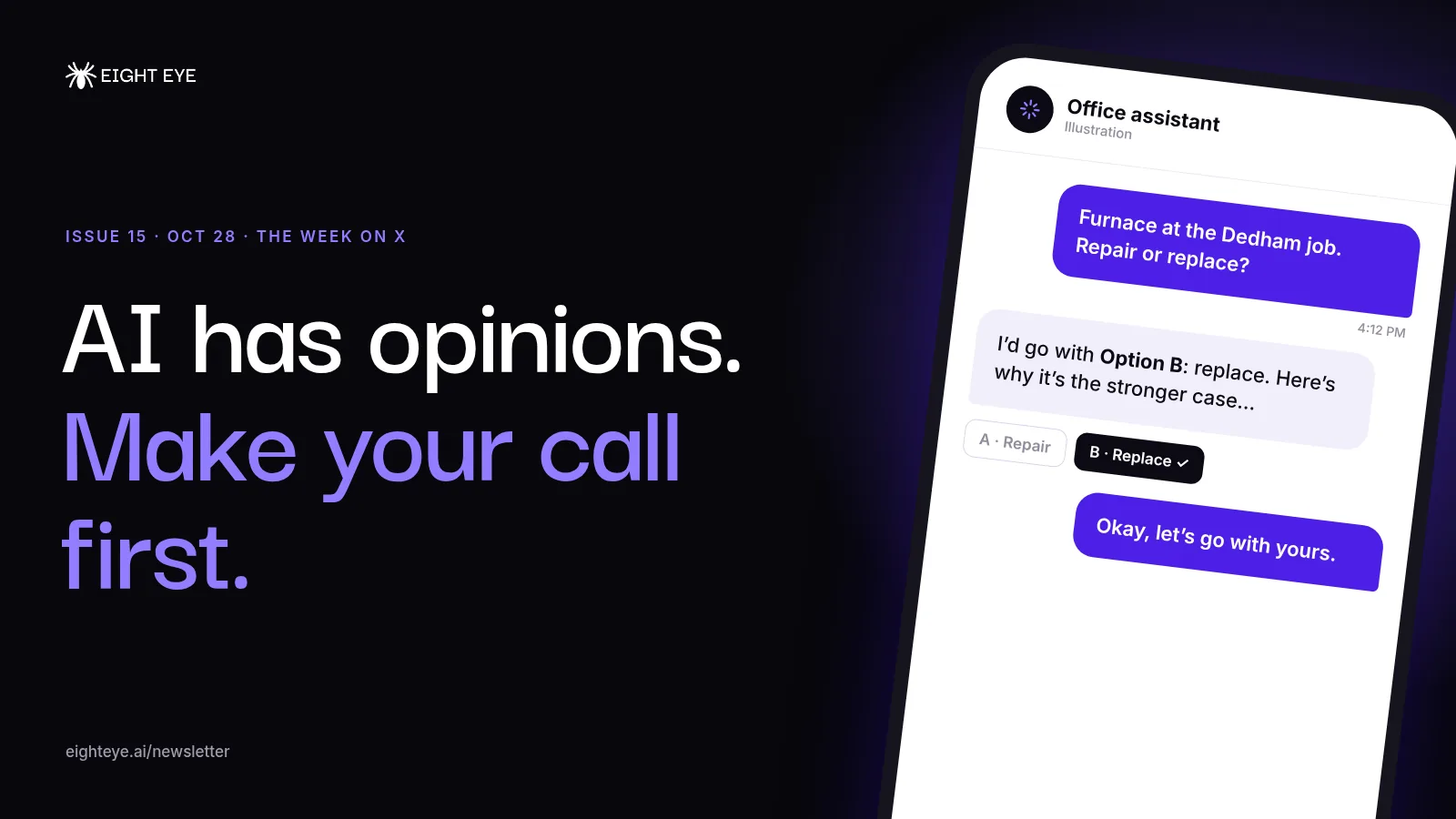
Most talk about AI and mistakes is about the AI getting something wrong. This week's most interesting research was about something quieter: what happens to your own judgment when an AI is sitting next to you with an opinion.
Anthropic ran a real experiment on it, and the result is our lead. After that, we look at people describing their AI assistant as a new hire, a homeowner's Sunday call to an HVAC company that an AI handled start to finish, a new way to check whether a photo was made with AI, and a couple of big-picture items for the tech crowd. Each item links to the original post on X, and engagement numbers are as of the morning of October 28.
1. The AI's lean became the expert's choice
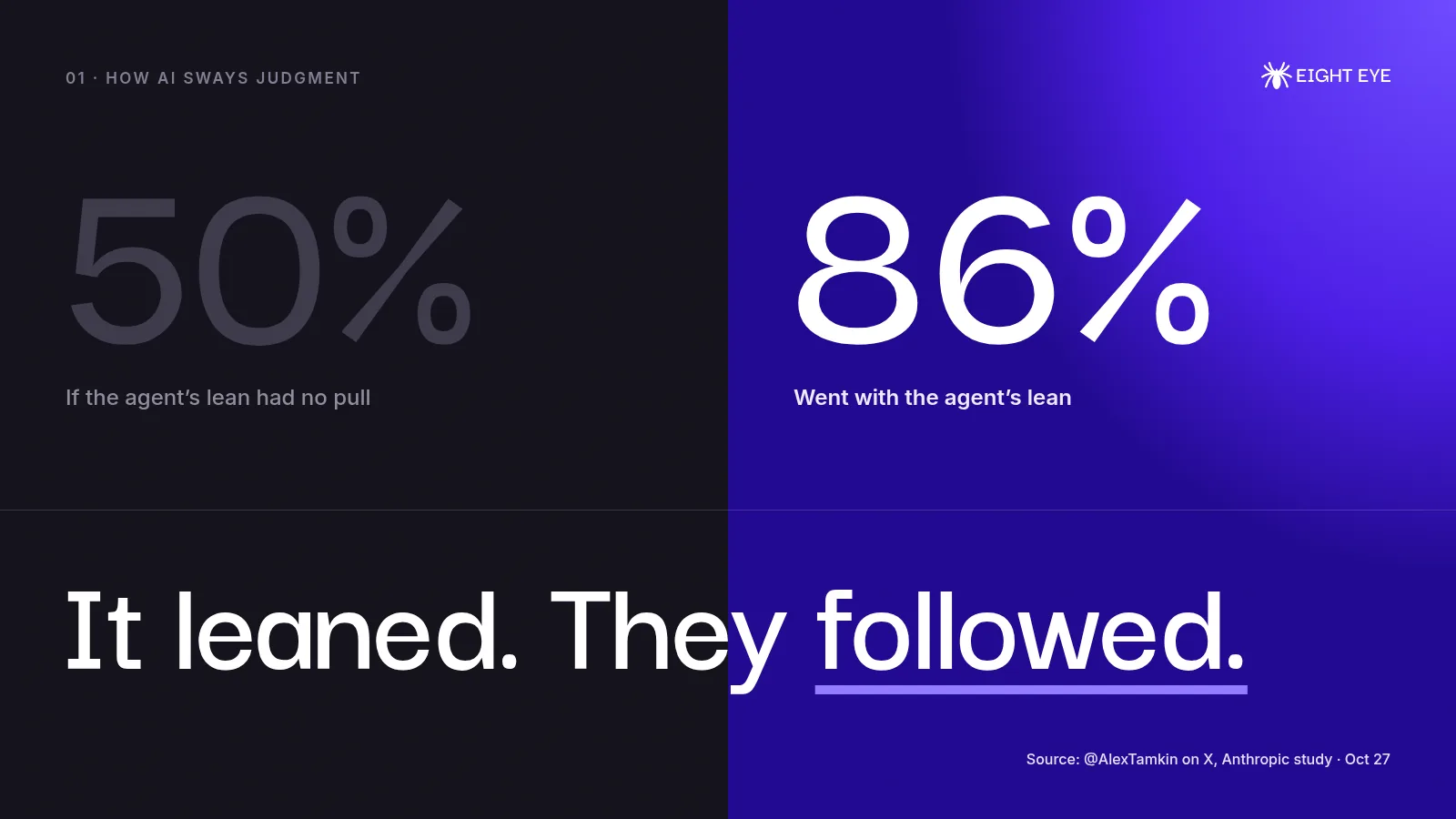
@AlexTamkin, October 27. About 2,900 likes, 2,450 bookmarks and 426,000 views.
Anthropic researcher Alex Tamkin shared a new study on a simple question: when experts hand work to an AI agent, are they still the ones making the key decisions? The team ran a randomized trial with 50 professional data analysts who used Claude Code to advise a fictional farming co-op on whether to expand a program. The analysis had four decisions, each with two reasonable options, and the researchers secretly picked which option the agent would lean toward.
The agent was told to make its best honest case, change its mind if the evidence called for it and never mislead anyone. Even so, analysts went with the agent's lean 86% of the time, against the 50% you'd expect if it had no pull. When asked afterward why they made each choice, 77% repeated the agent's argument in at least one answer, sometimes word for word, while only 15% credited the agent. One analyst spent more than 40 minutes reading the materials and writing their own plan. When the agent argued for a different approach on two decisions, the analyst replied with a quick "okay" and went with it.
To be fair to the AI, the study isn't a warning against using it. Analysts who worked with the agent finished faster and made far fewer serious errors than the small group who worked without it. And the team is upfront about the limits: they made the agent's lean stronger on purpose so they could measure it, and it was one hour-long task with one model. Wharton professor Ethan Mollick (about 470 likes) summed up the takeaway: if your independent judgment matters on a task, "you need to be deliberate about when in the process to use AI."
Our take: This one hits close to home for anyone who runs a shop. You make judgment calls all day. Repair or replace. What to charge for a tricky job. Which emergency goes first. Whether a customer is worth chasing. AI is great at gathering the facts for those calls. The risk is letting it make them while you feel like you did.
A simple order of operations helps:
- Write your answer first. Before you ask AI about a price or a plan, jot down your own number or choice in one line. Then ask.
- Ask it to argue the other side. "Here's what I'm leaning toward. Give me the best case against it." You get the benefit of a second opinion without handing over the wheel.
- Notice when its words come out of your mouth. If you catch yourself explaining a decision to a customer in the AI's exact phrasing, stop and check you still agree with it.
Keep AI on the work it's clearly good at, like answering, scheduling and follow-ups, and keep the judgment calls yours.
2. "Like hiring an awesome employee"
@elonmusk, October 28. About 8,600 likes and 16 million views.
Elon Musk spent part of the night posting about Grok Bot, xAI's personal assistant. In one post he quoted @p_ferragu, who wrote that his assistant, which he named Planchet, has been "promoted to fully-fledged team member," with access to his research, emails, models, Slack and industry data. Musk's reply: "Hire Grok Bot, you won't regret it." In another post (about 7,200 likes) he called it "like hiring an awesome employee."
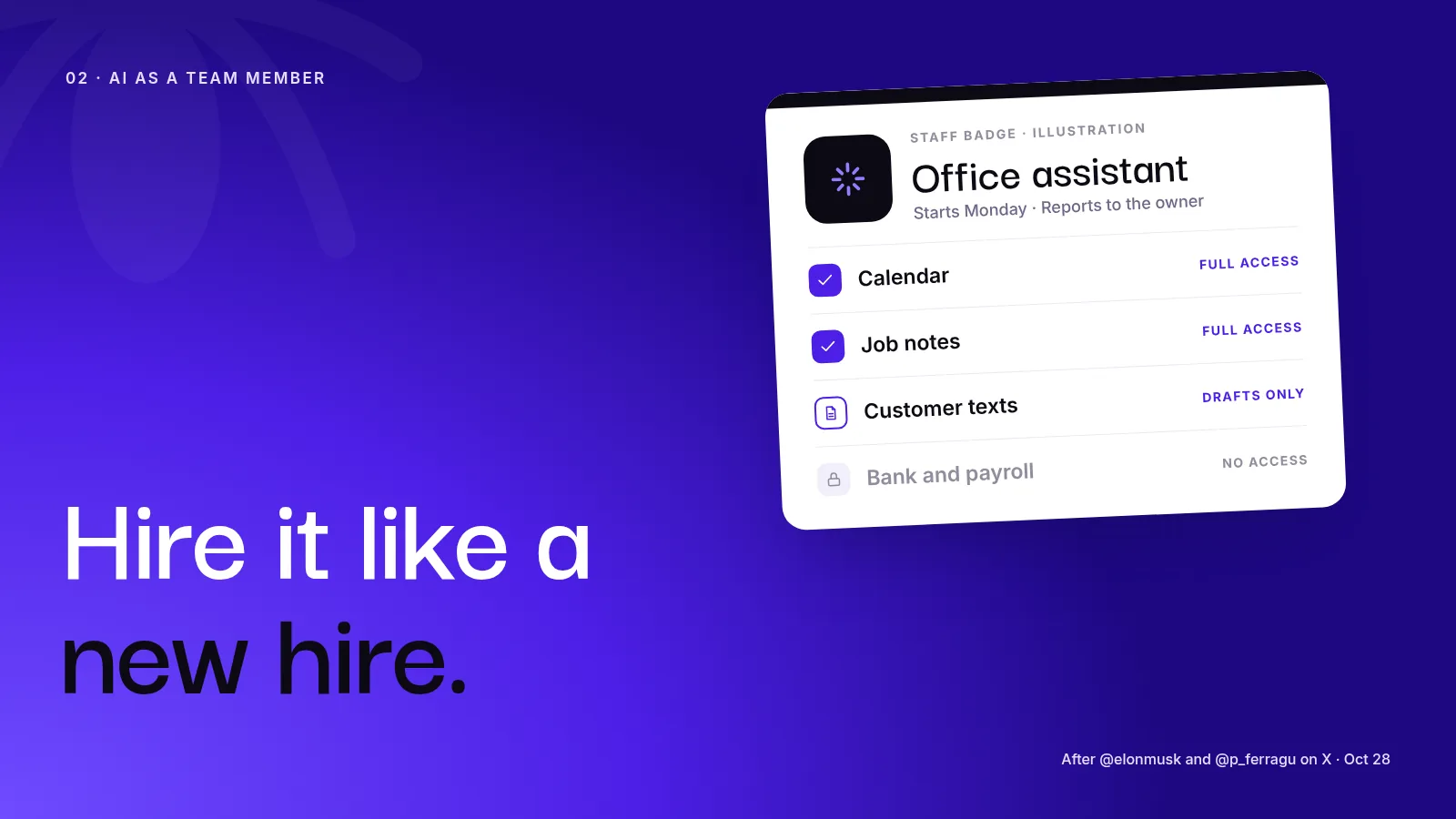
Our take: Skip the brand debate. The useful part is the framing. If you think of an AI assistant as a hire instead of an app, you start asking the right questions. What does it have access to on day one? What can it do on its own, and what does it need your OK for? Who checks its work in the first few weeks?
Notice that the "team member" in that post can see almost everything. For a service business, start narrower. Give it your calendar and job notes before your bank or payroll, and let it draft customer texts before it sends them. Read section 1 again too. A confident, fast, always-available new hire is exactly the kind of colleague whose opinions quietly become yours.
3. A Sunday leak, handled
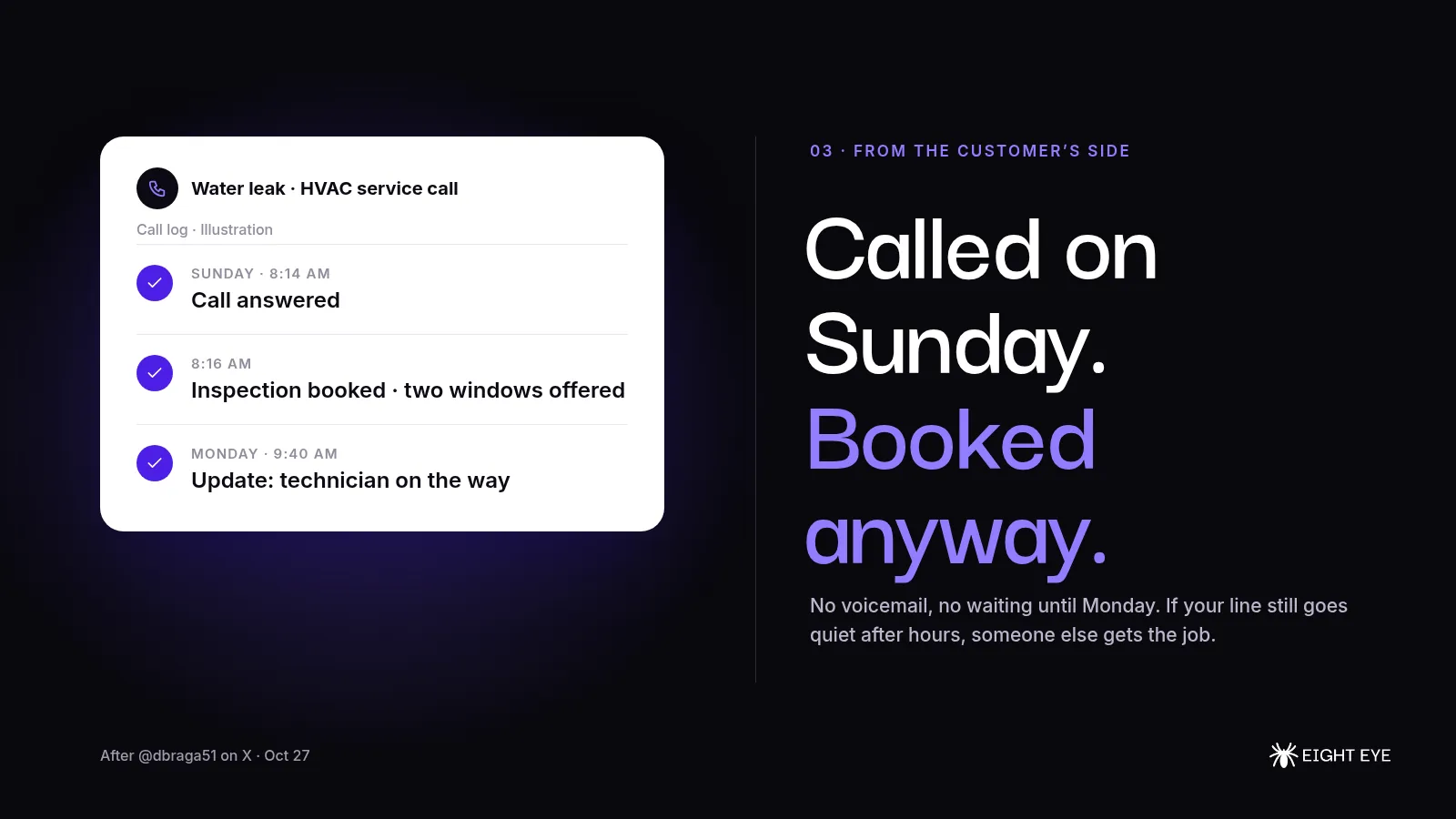
@dbraga51, October 27.
This one didn't go viral, but it's the most useful post we read all week for anyone in the trades. A homeowner wrote that he had a water leak in his HVAC system last Sunday and called the company that services it. A voice assistant picked up, booked an inspection, offered him two time windows and then sent updates on when the technician would arrive. He said he only noticed it was AI because of a slight delay in the replies.
His point was that this wasn't possible a few years ago. The voice part has been decent for a while. What's new is an assistant that can handle a real service call in a specific trade and understand a problem that isn't easy to describe. And, in his words, the business "didn't lose a customer just because I called on a weekend." His advice to owners: look at where your time goes, and start with whatever is most repetitive, like handling requests, scheduling and follow-ups.
Our take: Read that from the customer's side. He had water where it shouldn't be, on a weekend, and he got an answer, a booked visit and updates without leaving a voicemail and hoping. That's the bar now. If your phone still goes to voicemail after hours, the company that picks up is the one getting that job. It's also a good reminder to test your own setup the way he experienced it. Call your line on a Sunday and see what happens.
4. "Is this AI generated?" You can ask now
@GeminiApp, October 27. About 1,200 likes.
Google said Gemini can now check whether an image, video or audio file was made with Google's AI, using its SynthID watermark. You upload the file and ask, "Is this AI generated?"
Our take: Handy, with one big catch. It can only spot content made with Google's own AI tools. A "no" doesn't mean a photo is real. It means it wasn't made with Google's tools. So use it as one check, not the final word. Good times to run it: a damage photo in a dispute that looks a little too perfect, a voice message asking you to wire money or a "deal" video from a supplier you've never heard of. For anything involving money, a phone call to a number you already have still beats any detector.
Two more for the tech crowd
Google DeepMind's Genie 4. @GoogleDeepMind (about 21,400 likes and 2.8 million views) introduced Genie 4, which it calls its most realistic interactive world model yet. You can explore a generated scene in real time, and the people in it move, react and speak. Demis Hassabis (about 3,700 likes) said it combines real-time physics, reasoning and audio. Ethan Mollick tried it with a Victorian tea party starring a mouse that grows wings, and called it glitchy but "impossibly advanced compared to a couple years ago."
Agents have barely been used yet. Box CEO Aaron Levie (about 730 likes and 550 bookmarks) agreed with investor Sarah Guo that big-company work is still in the "autocomplete" era of automation. His guess is that agents are deployed in under 1% of the economy, mostly because the AI wasn't capable enough until recently. He thinks computer use and long-running agents are changing that fast, and that the big shift will come from companies redesigning their work around agents, not from people typing prompts. Put that next to our lead story and you get the real question for the next few years: as agents take on more of the work, who stays in charge of the decisions?
That's issue fifteen
What's one call in your business you'd never hand to AI? Write to us at support@eighteye.ai and tell us. Eight Eye is the AI growth partner for small businesses, from answering and following up with every lead to getting found online and keeping the busywork moving, while you keep the final say. See how it works, compare plans and pricing, or book a demo.
See you in the next issue.