
For years the big AI story was the chat window: you go to a website, you type, it answers. This week the window started to disappear. AI is showing up where people already talk, in the same text thread they use for their family, their bank and the plumber.
Our lead is OpenAI letting people text ChatGPT a task the way they'd text a person. After that: Google search ads that open straight into a conversation with an AI agent, a map of the voice AI tools now selling to home service companies (and the mistakes worth testing for), a sensible take on getting started without fixing every system first, and a few big-picture items for the tech crowd. Each item links to the original post on X, and engagement numbers are as of the morning of October 29.
1. You can now text your AI a job
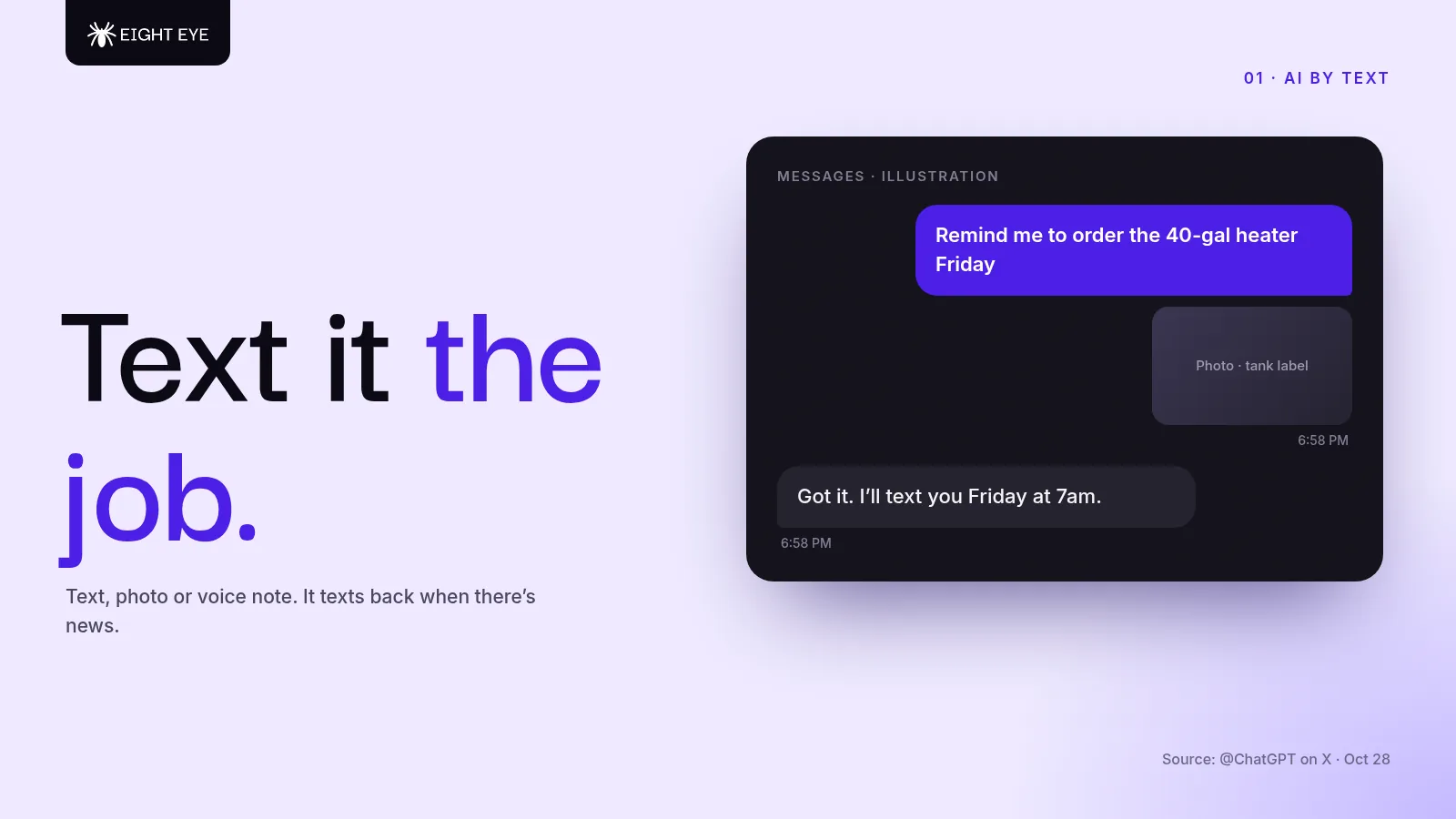
@ChatGPT, October 28. About 6,800 likes, 1,600 bookmarks and 1.8 million views. OpenAI's main account shared it too.
OpenAI said that "by popular request" people can now text their ChatGPT assistant, which it calls your dot. You give it a task to take off your plate or something to keep an eye on, using a text, a photo or a voice note, and it texts you back on its own when there's something worth knowing. It runs over iMessage or RCS, and OpenAI stressed that you're the only one who can text your dot and it can only text you. For now it's a preview for Pro users in the US.
Our take: The feature itself is for personal use, so don't plan your business around it. The signal is what matters. The most-watched AI company in the world just decided the best place for an assistant is the text thread, because that's where people already are and it doesn't need a new app.
Your customers figured that out a long time ago. Plenty of homeowners would rather text "no heat, can someone come today?" than sit on hold, and they'll text whoever answers first. A few questions worth asking this week:
- Can customers text your business number at all? If your main line is a landline that can't receive texts, those messages go nowhere and nobody tells you.
- What happens to a missed call? A quick text back ("Sorry we missed you, what's going on?") often keeps a job that a voicemail greeting would lose.
- Who answers texts after 6pm? If the answer is "whoever remembers to check," that's the gap.
This is the part of the business Eight Eye handles every day: answering calls, texting back missed leads and following up until the job is booked, so the text thread works for you even when you're on a ladder.
2. A Google ad that opens a conversation
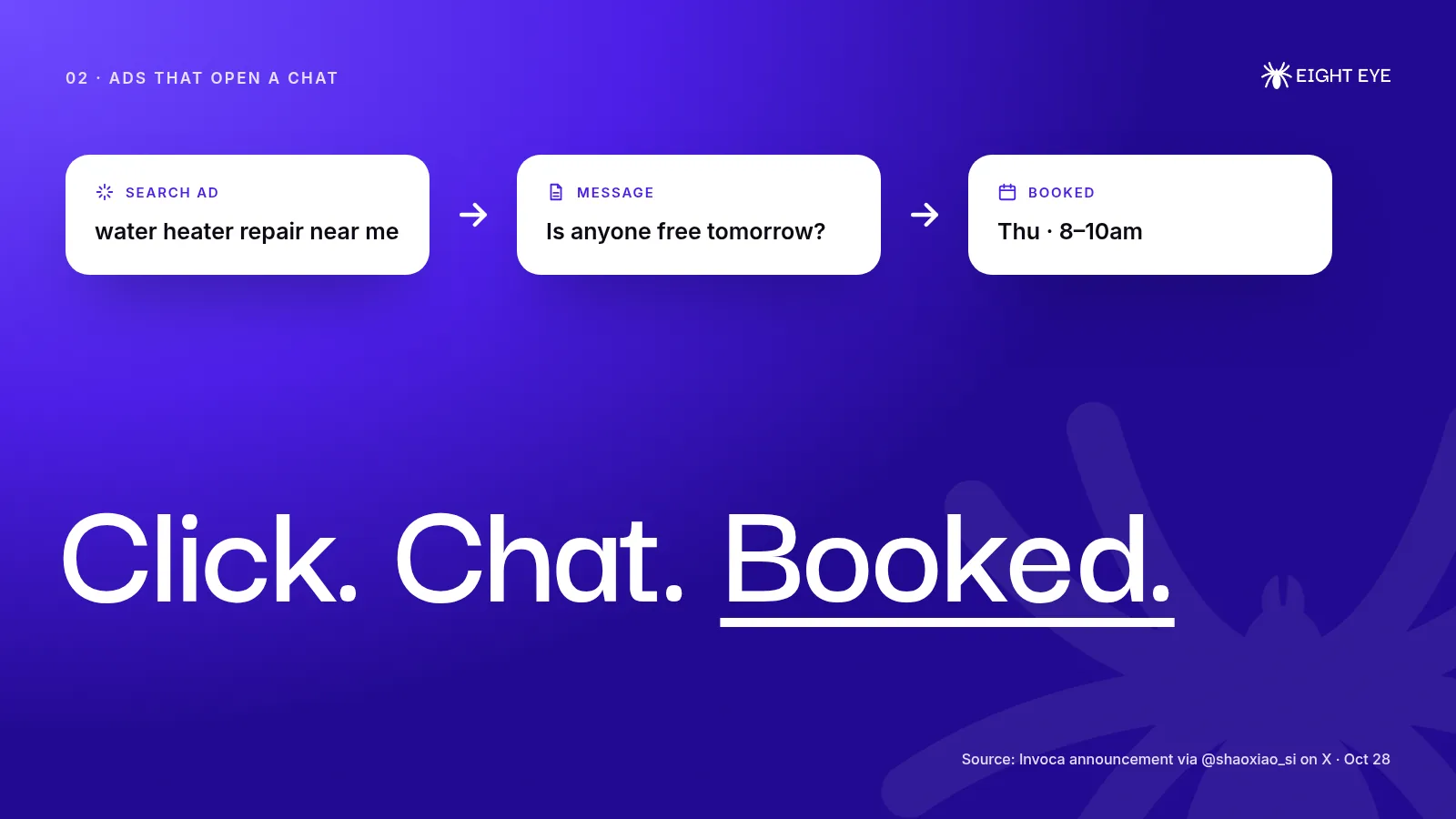
@shaoxiao_si, October 28, summarizing Invoca's announcement.
This one barely got noticed on X, but it's worth your attention if you pay for Google Ads. Invoca, a call-tracking company, announced Messaging Agents for Google Ads. When someone messages a business from a Google search ad over RCS, an AI agent replies around the clock, answers questions, qualifies the lead and books the appointment, using the company's own information about availability and service area. Home services is one of the target industries. It's in beta, and the agents are labeled as AI.
Our take: Put this next to story 1 and the pattern is clear. The path from "I need someone" to "I'm booked" is getting shorter, and more of it is happening in a message thread instead of a phone call. If you're paying for clicks, every lead that sends a message and hears nothing back for three hours is money spent on a competitor's customer.
You don't need this specific product to act on it. Look at your last ten ad leads and check how fast each one got a real answer. If it's slower than a few minutes, fix that before you raise the budget.
3. 39 voice AI tools, and the mistakes to test for
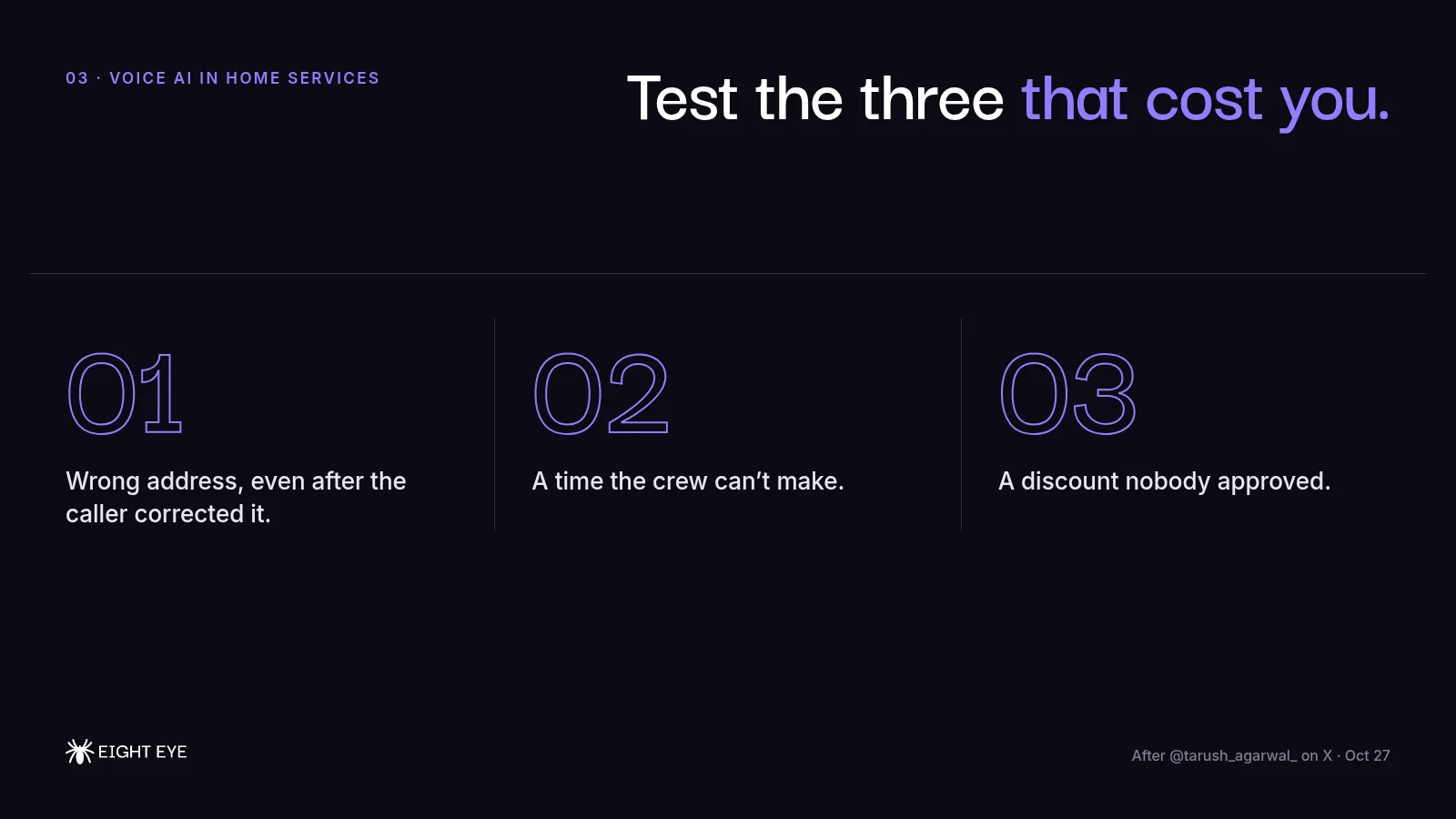
@tarush_agarwal_, October 27.
Tarush Agarwal, who works on testing voice agents at Cekura, mapped 39 companies selling voice AI to home service businesses. He sorted them into three jobs: answering calls and taking down the details, following up on leads and old estimates, and scheduling and field operations, which includes the big names like ServiceTitan, Jobber and Housecall Pro.
The more useful part was his list of what goes wrong. In home services, he pointed out, a mistake on the phone decides where a technician drives, when the customer expects them and what they expect to pay. His examples: an agent records the wrong service address even after the homeowner corrects it, promises a time the team can't make, or offers a price or discount the business never approved.
Our take: That's a better buying checklist than any feature list. Before you trust any AI on your phones, ours included, call it yourself and try to trip it up:
- Give an address, then correct it halfway through. Check what lands in the job notes.
- Ask for a time you know is full. It should offer real openings, not make one up.
- Ask for a discount. It should know your rules and hand you the call when it doesn't.
- Ask about a town you don't serve. It should say so politely and not book it anyway.
Run those four calls again any time you change your schedule or prices.
4. You don't have to fix everything first
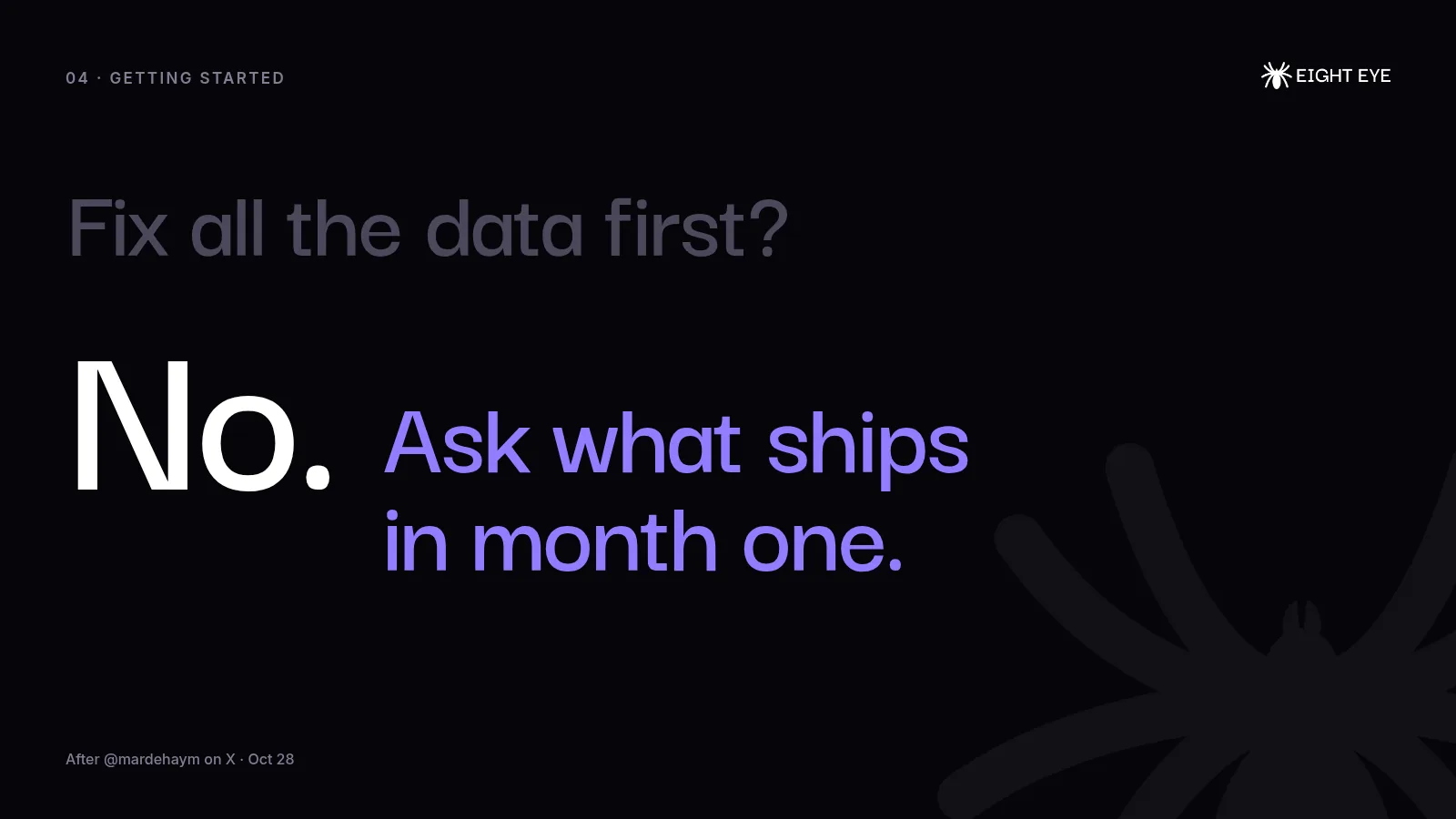
@mardehaym, October 28. About 64 likes and 11,800 views.
Mark Ajzenstadt described a home services company that grew by buying other shops. Each one came with its own software, reporting was scattered and someone was still combining the books by hand. The usual AI proposal, he said, starts with a year of moving everything into one system before anyone sees a result. He disagrees. Leave the systems that already run the business in place, pick one workflow, like month-end reconciliation, and do only the data work that one job needs. His closing advice: if the first AI proposal starts with a migration, "ask what ships in month one."
Our take: His example is a big roll-up, but the advice fits a five-truck shop even better. You don't need to clean up ten years of customer records or switch software to get value from AI. Pick the one job that leaks the most money, usually missed calls or quotes nobody followed up on, and fix that first. If someone pitches you a long setup before anything works, ask the same question he does.
For the tech crowd
Gemini 4 Carbon. Google CEO Sundar Pichai (about 31,700 likes and 5.6 million views) introduced Gemini 4 Carbon, two weeks after Argon. He said it ranks first on the updated Artificial Analysis Intelligence Index and leads on several cybersecurity tests for finding and patching vulnerabilities. Google DeepMind (about 13,400 likes) said it can work through complex tasks for days without getting stuck. It's rolling out first to a small group of cyber defenders, with wider access later.
Search is still growing. In his Q3 post (about 10,600 likes), Pichai said Search query growth, including commercial searches, is the highest it's been in five years, and he credited AI. For local businesses, that's a useful counterpoint to the "nobody searches anymore" talk. People are still looking. Make sure they find you.
Agents will run on a lot more compute. Box CEO Aaron Levie (about 360 likes) predicted agents will use 1,000 times more tokens than people do today, as they run inside everyday workflows, and said that will take both closed models and more efficient open ones.
That's issue sixteen
How do most of your customers reach you now, a call or a text? Tell us at support@eighteye.ai. Eight Eye is the AI growth partner for small businesses. We answer your calls, text back missed leads, follow up until they book and ask for reviews, while you keep the final say. See how it works, compare plans and pricing, or book a demo.
See you in the next issue.