
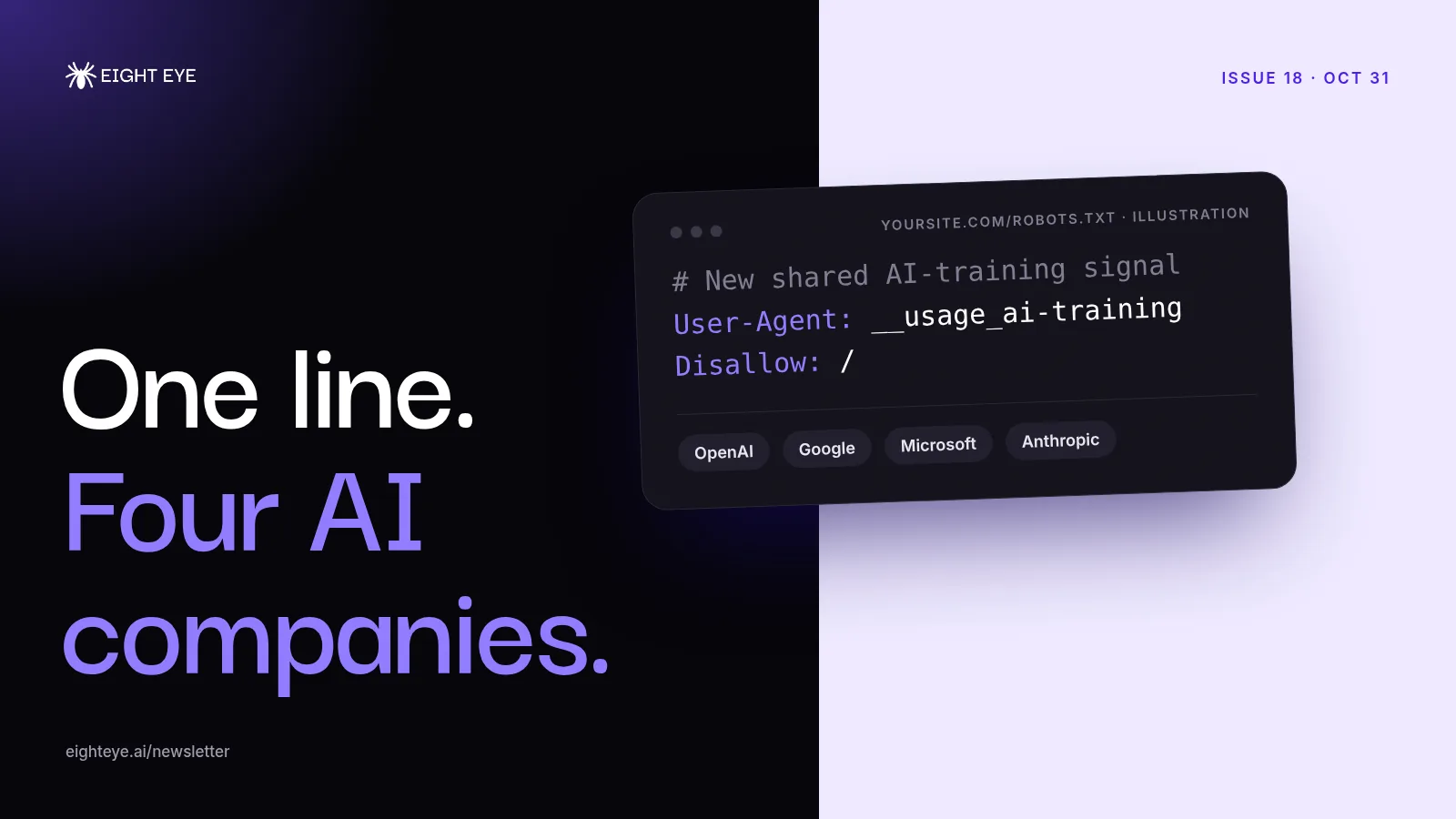
For years, website owners who didn't want their pages used to train AI had to chase a list of crawler names, one company at a time. On Friday, October 30, four of the biggest names in AI agreed on a single line that does the job for all of them. By Saturday morning, people who build websites for local businesses were already checking who uses it, and asking whether everyone should.
Short answer: probably not the way you'd think. Our lead walks through what the new line actually does, what it doesn't, and what a contractor's website should do about it. After that: why big companies are pumping the brakes on AI at work, what one home service company learned when its phone assistant stopped pretending to be a person, and a fraud story every office manager should hear. Each item links to the original post on X, and engagement numbers are as of the morning of October 31.
1. One line to tell AI companies “don’t train on my site”
@rustybrick, October 30. About 10,000 views. Also shared by @lilyraynyc and @engadget.
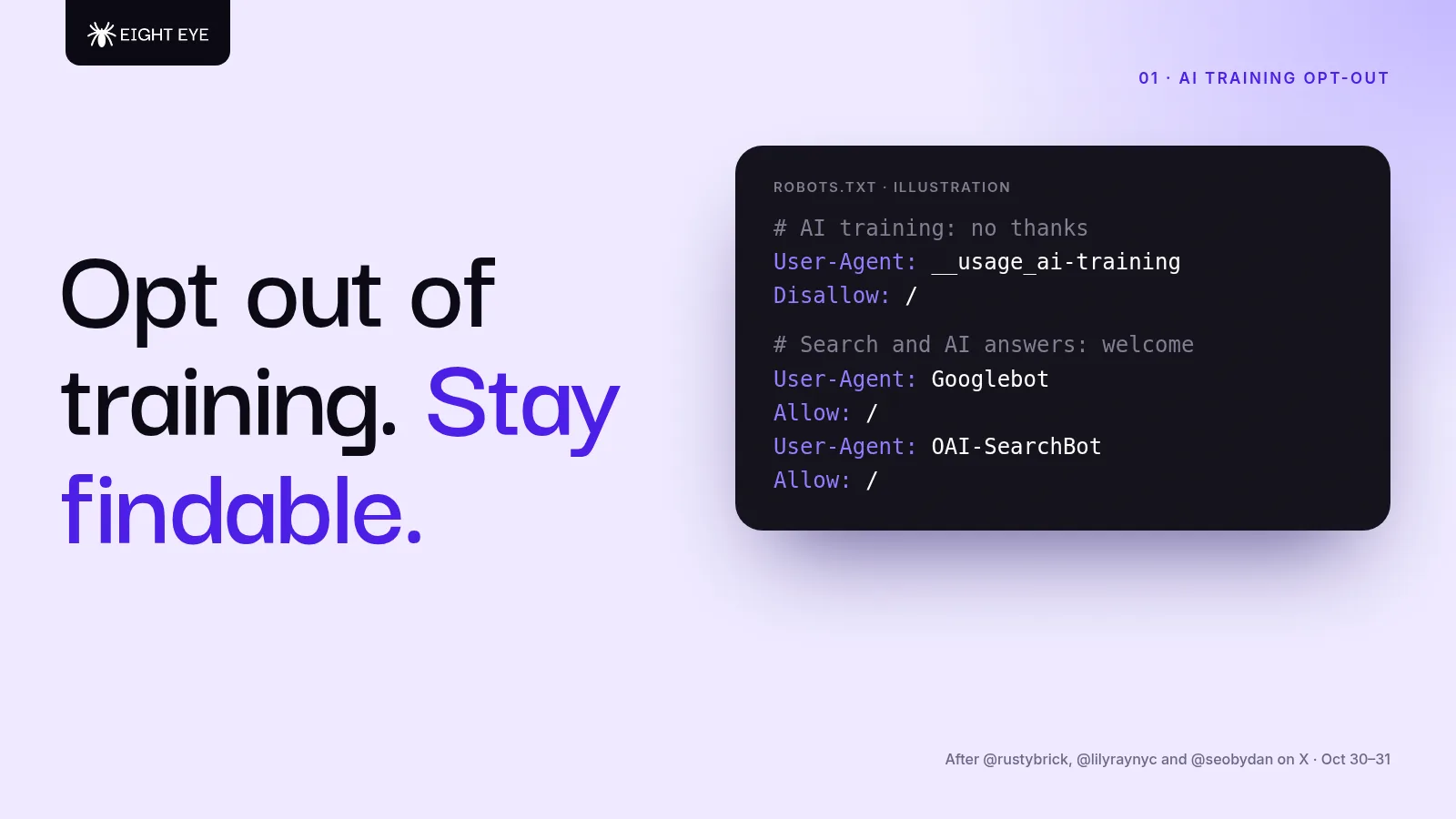
Barry Schwartz of Search Engine Roundtable reported that Google joined OpenAI, Microsoft and Anthropic in backing a shared "policy token" for robots.txt, the small text file that tells crawlers what they may and may not touch on your site. A site that adds a group for __usage_ai-training with Disallow: / is saying "please don't use my pages to train AI models," and every company that honors the token reads it the same way.
The fine print matters. The proposal comes from Anthropic's standards lead and is still a draft at the Internet Engineering Task Force. Anthropic says it has already started honoring it. OpenAI says it will in the coming months. Microsoft says it starts on February 1, 2027, and Google says early 2027. It covers future training only. And Google's John Mueller said a site can still allow Google's AI products separately, which is how a site stays eligible to show up and get clicks in Gemini answers. Microsoft and Google both cautioned that opting out of training could reduce how often a site surfaces in AI apps.
@seobydan checked 103 US home services sites the next morning. By his count, 10 already block OpenAI's training crawler, and 7 of those still let in the crawler that powers ChatGPT search. Zero block Googlebot.
Our take: For a plumbing, HVAC or electrical shop, your website isn't the product. It's the sign out front. You want it read by everything that sends people your way: Google, Bing, ChatGPT search, Gemini. So before anyone on your team adds the new line, ask one question: are we trying to protect something, or trying to get found? A news site with paid articles has something to protect. A contractor with a services page mostly wants to be found.
If you do want to opt out of training, do it on purpose and keep the search and answer crawlers open. Then check your robots.txt once a quarter, because a stray Disallow: / from a web designer can hide you from everyone. And notice a related data point from the same day: a small test by Cyrus Shepard, shared by @rustybrick, found that when his site was removed from Google's AI answers, regular search clicks dropped too. One small test isn't proof, but it points the same direction. Showing up in more places tends to help.
2. Big companies are slowing their AI rollouts. Small shops can skip that part
@SadCreatorTalks, October 30. About 110 likes and 3,600 views. Plus a careful read from @ebubxchii_.
A story made the rounds again this week about big employers pulling back on rushed AI rollouts. The examples: Meta scaling back plans to lean on AI agents after staff kept cleaning up errors, Microsoft executive Ryan Roslansky warning that AI-written documents had become an "ocean of sameness," and Walmart workers getting schedules that made no sense. The first poster compared it to the VR meeting rooms whose headsets ended up in a drawer.
The second post is worth reading in full. Its point: the underlying Guardian story is from October 13, and the headline is bigger than the article. Companies aren't quitting AI. They're quitting AI output that nobody checked. It also quoted a line from Microsoft that we'd tape to any office wall: adding agents to a broken process still leaves a broken process.
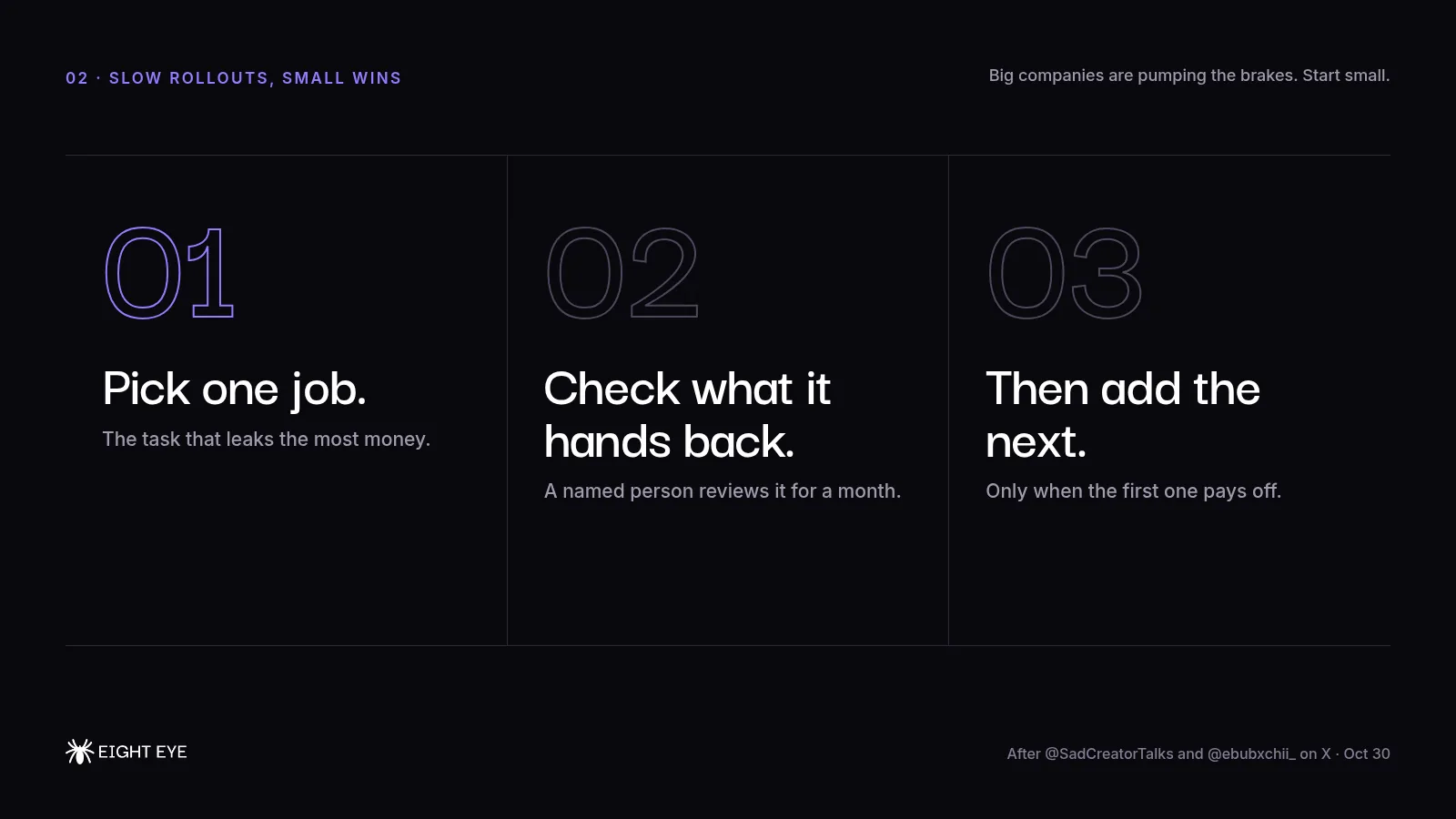
Our take: This is where a small business has a real edge. A company with 50,000 employees has to roll a tool out to everyone at once. You can start with one job. A sensible order for a trades shop: pick the one task that leaks the most money (usually missed calls or estimates nobody follows up on), decide who checks what the tool produces for the first month, and write down the result you expect. If the result shows up, add the next job. If it doesn't, you've lost a month, not a year.
3. “Hi, I’m the AI assistant” worked better than pretending
@MakadiaHarsh, October 31. About 1,500 views and a growing reply thread.
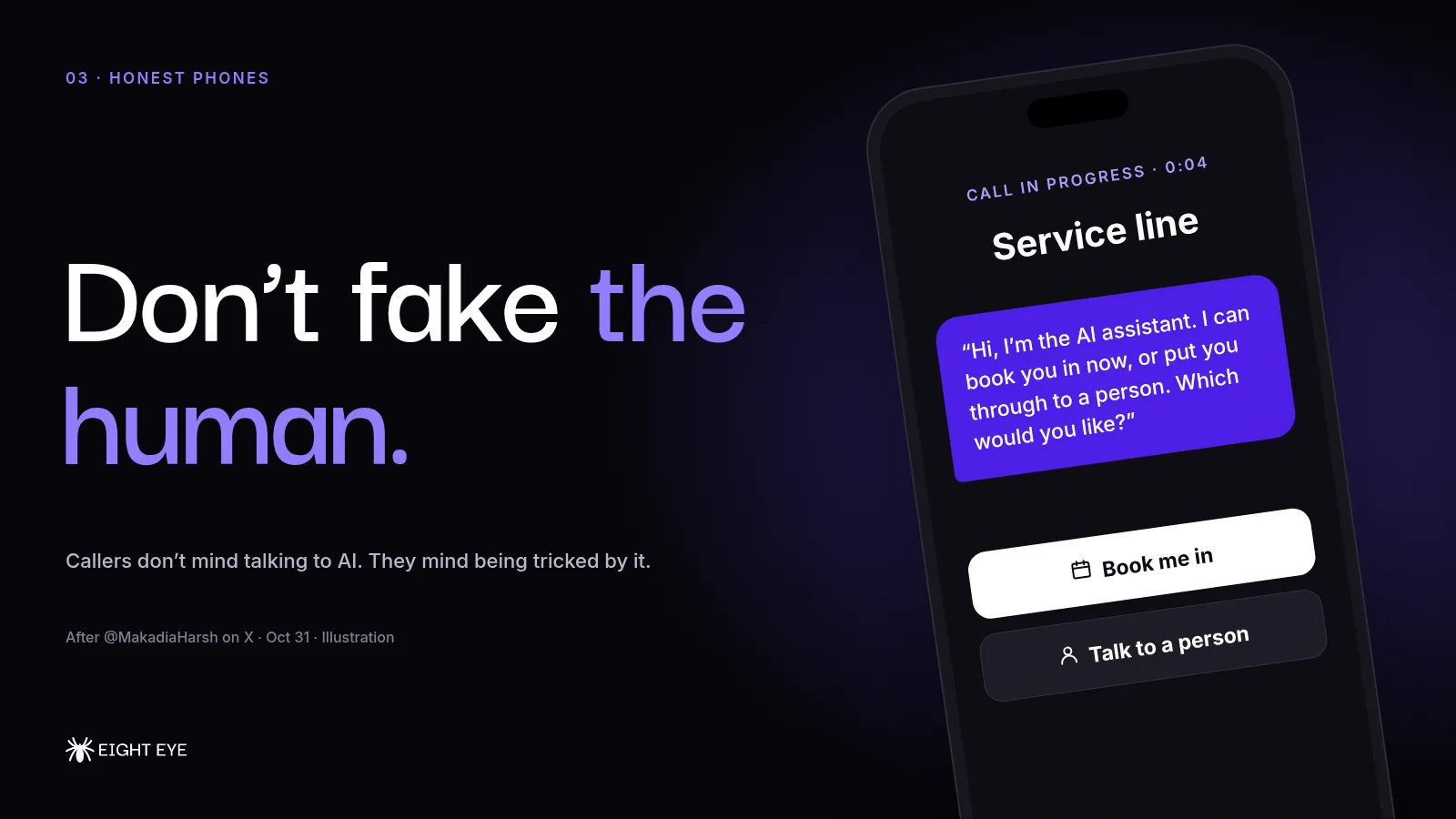
This one is a short story, told secondhand, but it rang true. A home service company put an AI voice agent on its phones. The first version had a friendly human name, small talk and little pauses. Callers figured it out in seconds and hung up. The second version opened by saying it was the AI assistant and offered two choices: book now, or get a person. According to the post, more callers stayed on the line and more jobs got booked. The closing line: people don't hate talking to AI, they hate being tricked by it.
Our take: We think that's right. Your customers aren't calling to judge the technology. They're calling because the furnace quit or the breaker keeps tripping. What they want is a fast answer, a booked time, and a clear way to reach a human when it's urgent or messy. Being upfront costs you nothing and buys trust. If you're shopping for any AI phone tool, ask the vendor to show you exactly how the call opens and how a caller gets to a person.
4. A cloned voice helped move €95 million. Your office needs a callback rule
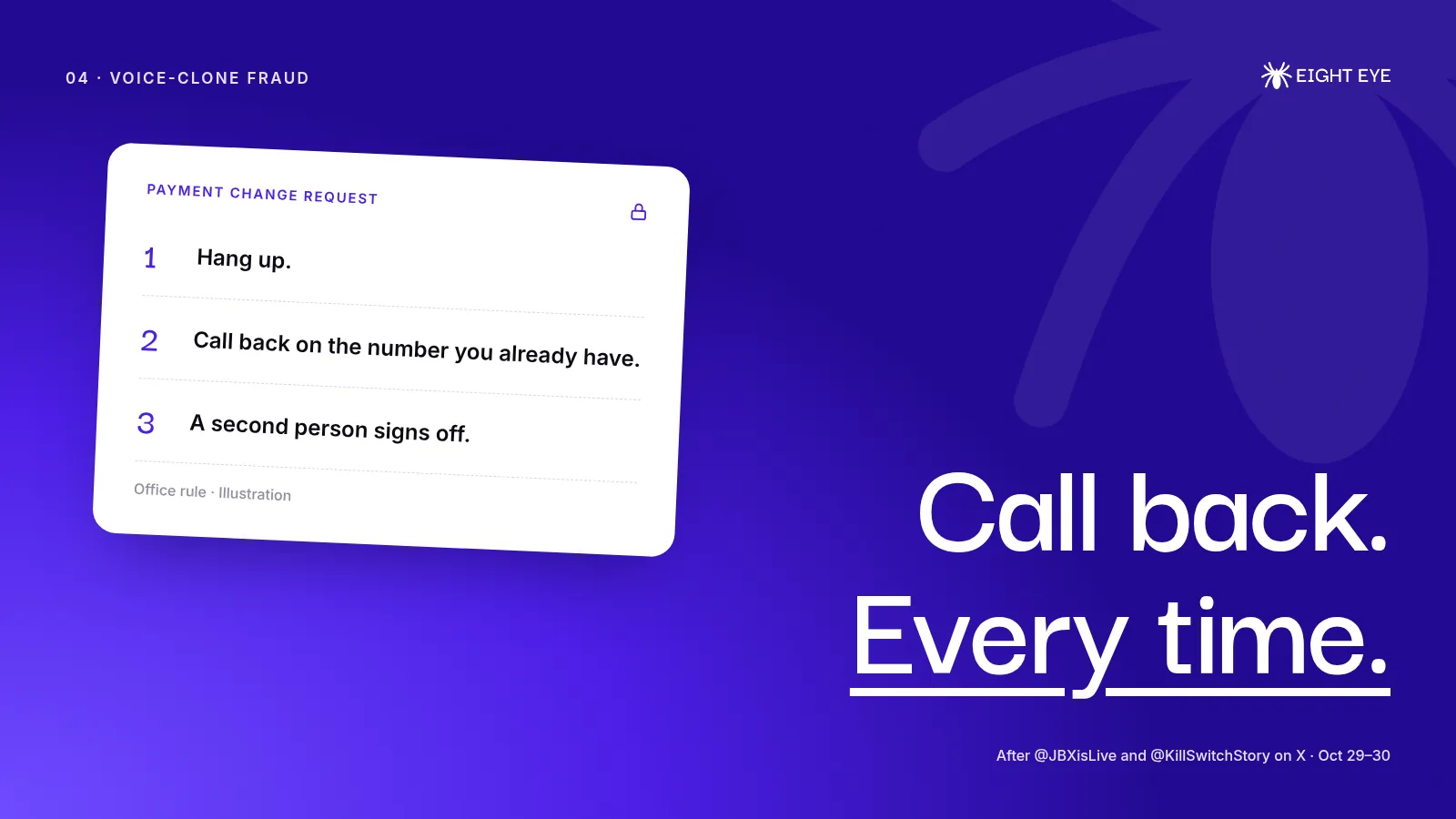
@JBXisLive, October 29, and @KillSwitchStory, October 30.
Posts this week rounded up a string of AI-assisted attacks on banks. The one that stuck with us happened at Fideuram, the private banking arm of Italy's Intesa Sanpaolo. As Reuters reported in September, the then-chairman got a WhatsApp message that appeared to come from Intesa's CEO, followed by a call from someone who sounded exactly like a lawyer he knew. Reuters' sources said the voice was copied with AI. He had his finance team send about €95 million abroad. More than half was recovered, but about €36 million is still missing, per Reuters.
Our take: If that can happen to a bank chairman, it can happen to the person who pays your supply house. The scam is usually the same shape: an urgent request, a familiar voice, and a reason to skip the normal steps. Set one rule this week. Any change to where money goes (a new account number, a rush wire, a vendor's "new" bank) gets confirmed by calling back on a number you already had, not one in the message. For bigger amounts, a second person signs off. A family-style code word for the office works too.
For the tech crowd
Claude agents as red-teamers. Anthropic (about 2,900 likes and 350,000 views) described setting thousands of Claude agents loose to sneak harmful lessons past a training-data monitor. The agents came up with innocent-looking material, like a veteran wrestler mentoring a newcomer, that still taught bad behavior. Anthropic says the examples can be used to build better monitors.
AI products don't live long. Ethan Mollick (about 530 likes) listed how quickly OpenAI has retired its own products, from Sora at about six months to Atlas at about nine, usually because something newer made them obsolete. Good reason not to build your whole office around one app's features. He also flagged that with personal agents, it's still hard to tell what they're working on and what they know about you.
Gemini gets skills. The Gemini app (about 1,100 likes and 115,000 views) rolled out a batch of updates, including skills: save the instructions you type over and over, then run them whenever you want. That's an easy win for anyone who writes the same estimate follow-up every week.
Old software, newly worth replacing. Mollick again (about 160 likes) said older firms are telling him AI is making long-delayed migrations off legacy systems cheaper, and those projects are moving faster than expected.
That's issue eighteen
Have you looked at your own robots.txt lately? Type your website address followed by /robots.txt into a browser and see what it says. If it's confusing, write to us at support@eighteye.ai. Eight Eye is the AI growth partner for small businesses. We answer your calls, text back missed leads, follow up until they book and help you get found online, while you keep the final say. See how it works, compare plans and pricing, or book a demo.
See you in the next issue.