
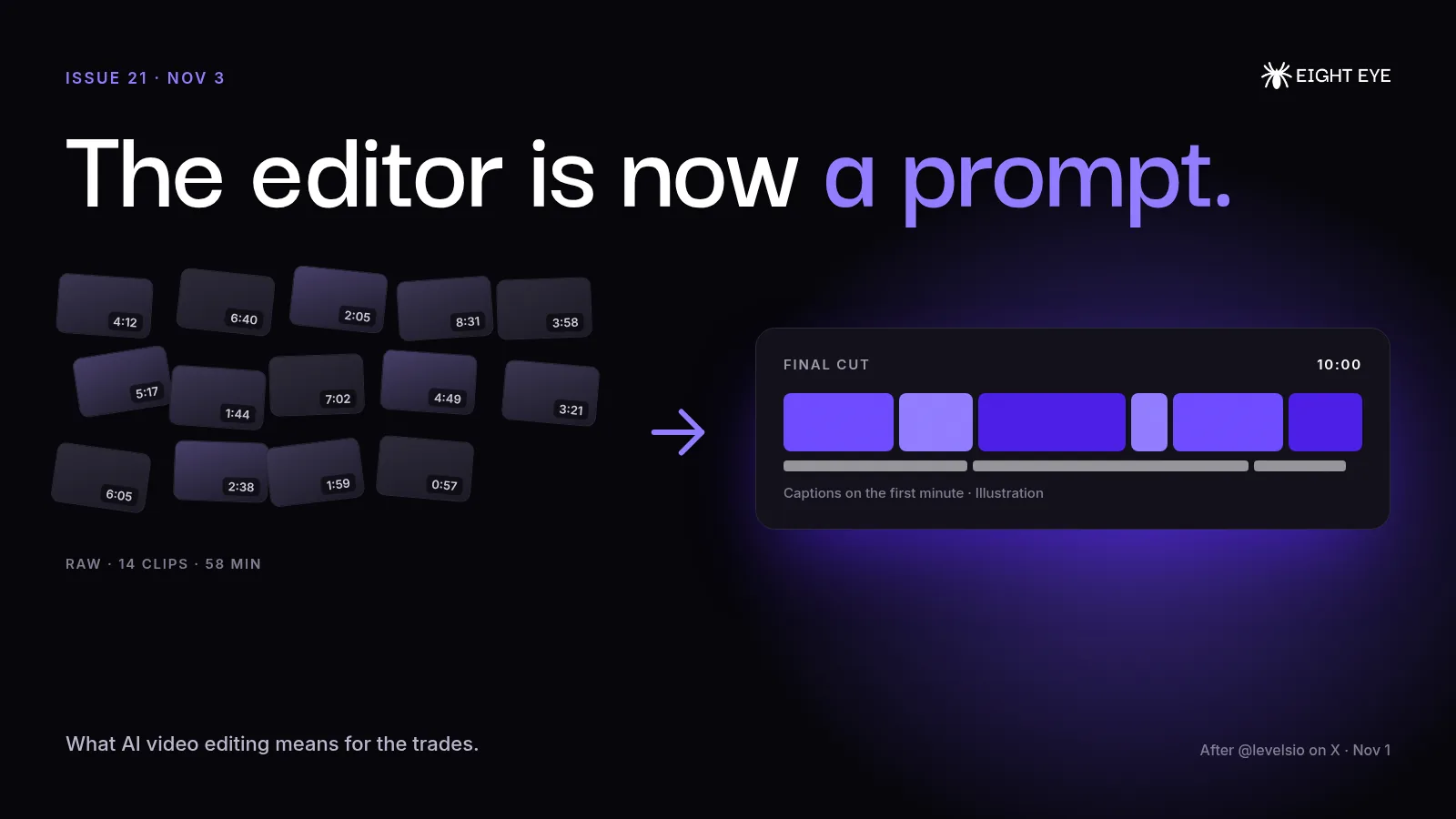
Ask most contractors why they don't post videos and you'll hear the same answer. It isn't the filming. Everybody has a phone full of clips: the rusted-out water heater, the panel that looked like a bird's nest, the new install that came out clean. It's the editing. Nobody wants to spend a Sunday night trimming footage, and hiring an editor feels like a lot for a few posts a month.
This weekend that excuse got a lot thinner. Our lead is a well-known solo founder who handed raw camera clips to an AI and got back a finished 10-minute vlog, and what a trades shop should actually do with that. After that: a six-question test for whether your business is "AI-proof" (good news for anyone who owns a truck), and a server bug that's worth one quick question to whoever runs your website. Each item links to the original post on X, and engagement numbers are as of the morning of November 3.
1. He asked for a 10-minute vlog. The AI did the editing
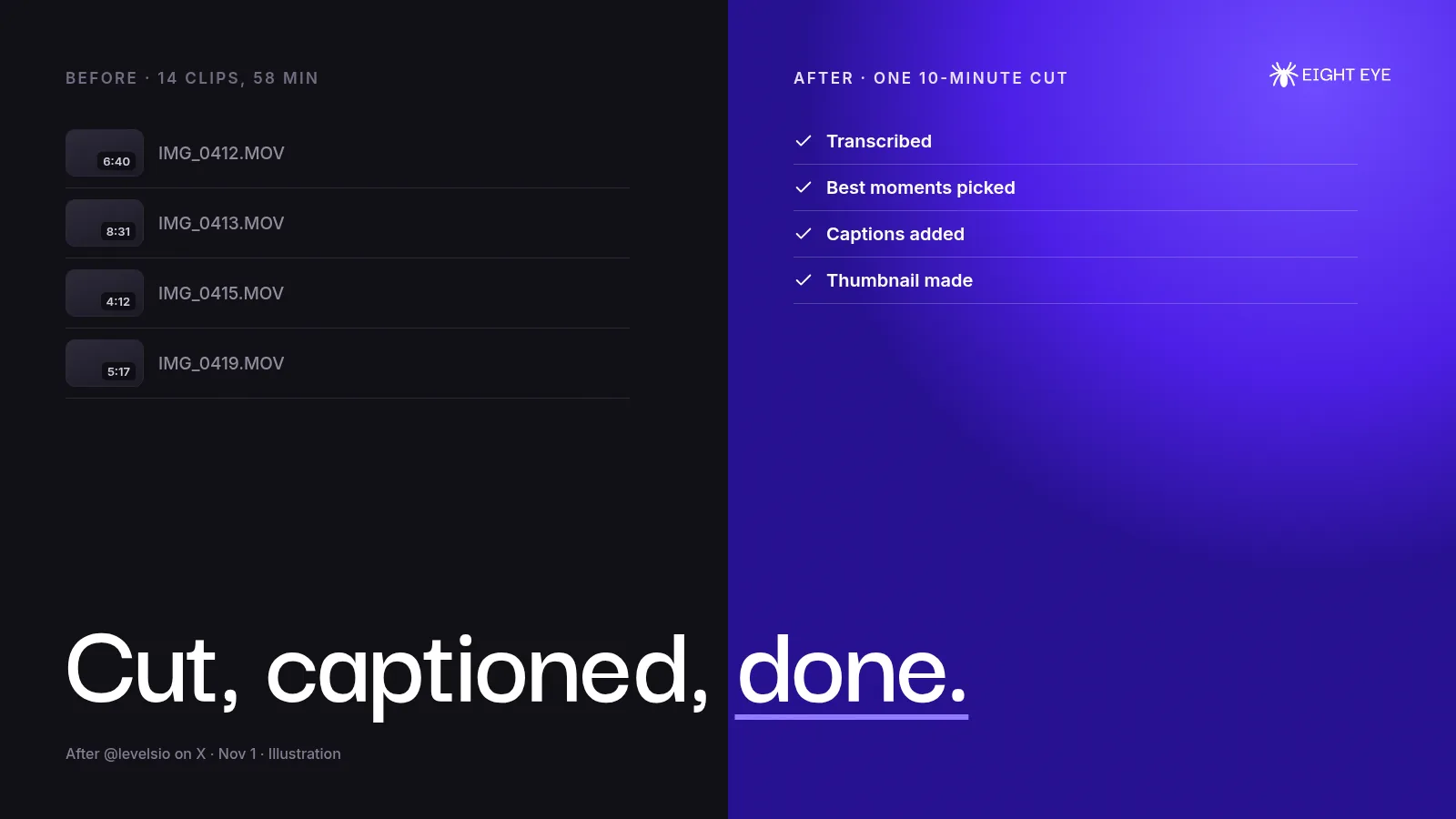
@levelsio, November 1. About 2,100 likes, 2,900 bookmarks and 200,000 views.
Pieter Levels, who runs several online businesses on his own, said his latest vlog was edited entirely by Claude Code, Anthropic's AI coding tool. He copied the clips off his camera into a folder and typed one request: edit these into a 10-minute vlog for X and YouTube. In a follow-up he said it was about 58 minutes of footage across 14 clips.
He only learned how it did the job when someone asked him. The AI transcribed everything he said, pulled still frames every few seconds so it could "see" each clip, worked out which voice was his and which belonged to other people, picked the pieces worth keeping from the transcript and the frames, added captions for the first minute, and made thumbnails. He said he made "a few adjustments but not a lot," and that without AI he probably wouldn't be vlogging at all, because editing is slow and hiring someone would be "even more hassle."
Greg Isenberg (about 2,200 likes and 206,000 views) took it a step further: he thinks this is the moment anyone who wanted to build "a video marketing machine" can do it without a team or editing skills, and that millions of people will start making videos over the next two years.
Our take: Levels is a programmer, and his setup isn't plug-and-play for most shops yet. But the direction is clear, and the simpler versions are already in the apps on your phone. The bottleneck is moving from editing to having good footage and a reason to post it.
You already have the footage. A 30-second "here's what we found, here's what we did" clip is one of the most convincing things a homeowner can see before they call, because it shows your work, your truck and your people. So start the habit now: film the before and the after on every interesting job, always ask the homeowner first, and keep addresses, faces and family photos out of the frame. Drop the clips into one shared folder by job. When the editing takes minutes instead of hours, you'll have months of material ready to go. And watch the first few edits like a hawk. An AI picking cuts from a transcript doesn't know which part of the job was the hard part. You do.
2. Is your business AI-proof? Six questions, one point each
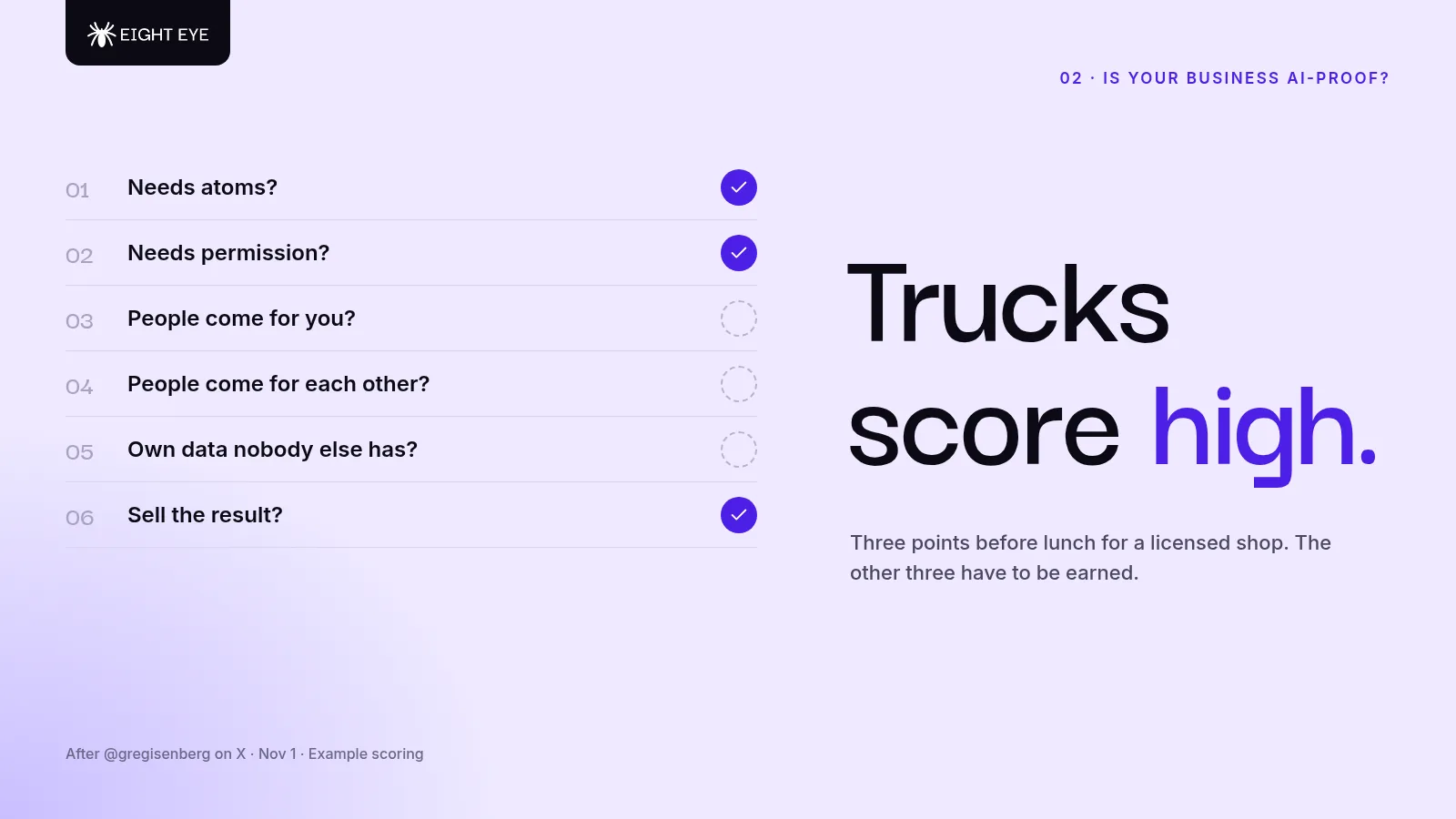
@gregisenberg, November 1. About 310 likes, 360 bookmarks and 39,000 views.
Isenberg also posted a simple scorecard. Give yourself a point for each yes: Does the work need atoms, meaning someone has to show up, build or fix something? Do you need permission, like a license, approval or contract "you can't prompt into"? Do people come for you specifically? Do they come for each other, as in a community or marketplace? Do you own data nobody else has? Do you sell the result rather than the work? Zero or one point is at risk, two is solid, three or more is really solid. More than a hundred people replied, mostly scoring their own businesses.
Our take: A licensed Massachusetts plumber or electrician probably gets three points before lunch. Your work needs atoms, it needs a license, and homeowners pay for the result (heat back on, leak stopped), not the hours. That's real protection.
But read the list again and notice which points aren't automatic. "Do people come for you" is earned through reviews, referrals and how fast you answer the phone. "Data nobody else has" is only true if you write it down: which neighborhoods have the old cast-iron stacks, which brands fail in year eight, which customers are due for service. AI can't do the job in the basement. It can absolutely help the shop down the street answer faster, follow up better and show up first in search. The safe part of your business is the work. The part to protect is everything around it.
3. One open port: a Linux bug worth a quick call to your web person

@alive_, November 1. About 10,000 likes and 1.4 million views.
Ali Yahya, a general partner at the venture firm a16z, called a newly disclosed Linux flaw "hard to overstate." His summary: any unpatched Linux server with even one network port open to the internet, such as the ones used for websites or remote logins, and a networking feature called MPTCP switched on (which he says is the default for many web servers written in Go) is open to complete takeover. Pieter Levels followed up (about 4,400 likes, 5,300 bookmarks and 618,000 views) with his own rule: keep every public port closed, reach your servers only through a private network, and send web traffic in through a tunnel. As a stopgap, he suggested turning MPTCP off.
Our take: If your website runs on a hosted builder, this is mostly your host's job, and they're likely already on it. Where it matters for a small shop is anything someone set up on its own server: a custom booking page, a customer portal, a file share, a camera system, a box a nephew configured three years ago. You don't need to understand the bug. Send one message to whoever handles your tech this week: "Are our servers patched for the new Linux MPTCP issue, and which ports are open to the internet?" If nobody can answer that, that's the real finding, and it's worth fixing before something forces you to.
For the tech crowd
HackerTube. Andrej Karpathy (about 50,000 likes and 4.7 million views) was tired of YouTube's recommendations, so he had Claude go through 43 million Hacker News comments from 20 years and pull out the 6,454 videos people keep recommending. He said it took about two hours, with him doing only the browser chores (an API key, a server, a domain), and he published the underlying data so others can build their own version. In the same post he told Claude to "secure, harden" the server it deployed to, which is a good reminder that item 3 applies to weekend projects too.
When agentic work started. Ethan Mollick (about 770 likes and 250 replies), the Wharton professor, pointed out that GPT-4 could handle about four minutes of independent work with a coin-flip chance of success, while current models can work for weeks. He picked January 2026 as a reasonable starting line for real agentic work, and said big productivity effects before that were mostly limited to coding. Useful context if you're wondering why the stories in this newsletter feel different from a year ago.
That's issue twenty-one
Two things to do this week: start a "before and after" folder for your job videos, and ask your tech person the one question in item 3. If what's really holding you back is the phone, the missed texts and the follow-ups, write to us at support@eighteye.ai. Eight Eye is the AI growth partner for small businesses. We answer your calls, text back missed leads, follow up until they book and help you get found online, while you keep the final say. See how it works, compare plans and pricing, or book a demo.
See you in the next issue.