

Remember when Google let you claim your business listing? The shops that did it early got the calls. The ones that waited spent years catching up.
Yesterday OpenAI opened something that looks a lot like that, inside ChatGPT. You can now claim your business, fix your details and see how often ChatGPT mentions you. It's free and it's in beta.
That's our lead, with a step-by-step setup. After it: why AI is great at tasks but not jobs yet, a new open-source agent that handles office chores, the "AI CEO" pitch, and one CEO's warning about AI slop. Each item links to the original post on X. Engagement numbers are as of the morning of November 11.
1. Claim your business in ChatGPT
@OpenAI, November 10. About 16,000 likes, 18,000 bookmarks and 4.7 million views.
OpenAI announced Businesses in ChatGPT, now in beta. Through a dashboard called Business Hub, you claim your business, keep your info current and see insights on how people engage with you. In a follow-up post, it added that eligible businesses can also publish a Business Agent that answers customer questions using information you provide. For now, the agents are limited to eligible U.S. ecommerce and online service businesses.
According to OpenAI's announcement, any eligible business located where ChatGPT is available can claim its profile. The insights show mentions and website clicks, plus "discovery topics," the themes in conversations where your website gets cited. OpenAI says it does not share people's chats with businesses.
Greg Isenberg (about 4,000 likes and 8,100 bookmarks) called it a possible "google my business moment for ai." His sharpest points: your agent is only as good as the info you write for it, and agents for plumbers, dentists and other local businesses aren't open yet. Shirish (about 3,500 likes and 750,000 views) put it shorter: "don't be late twice."
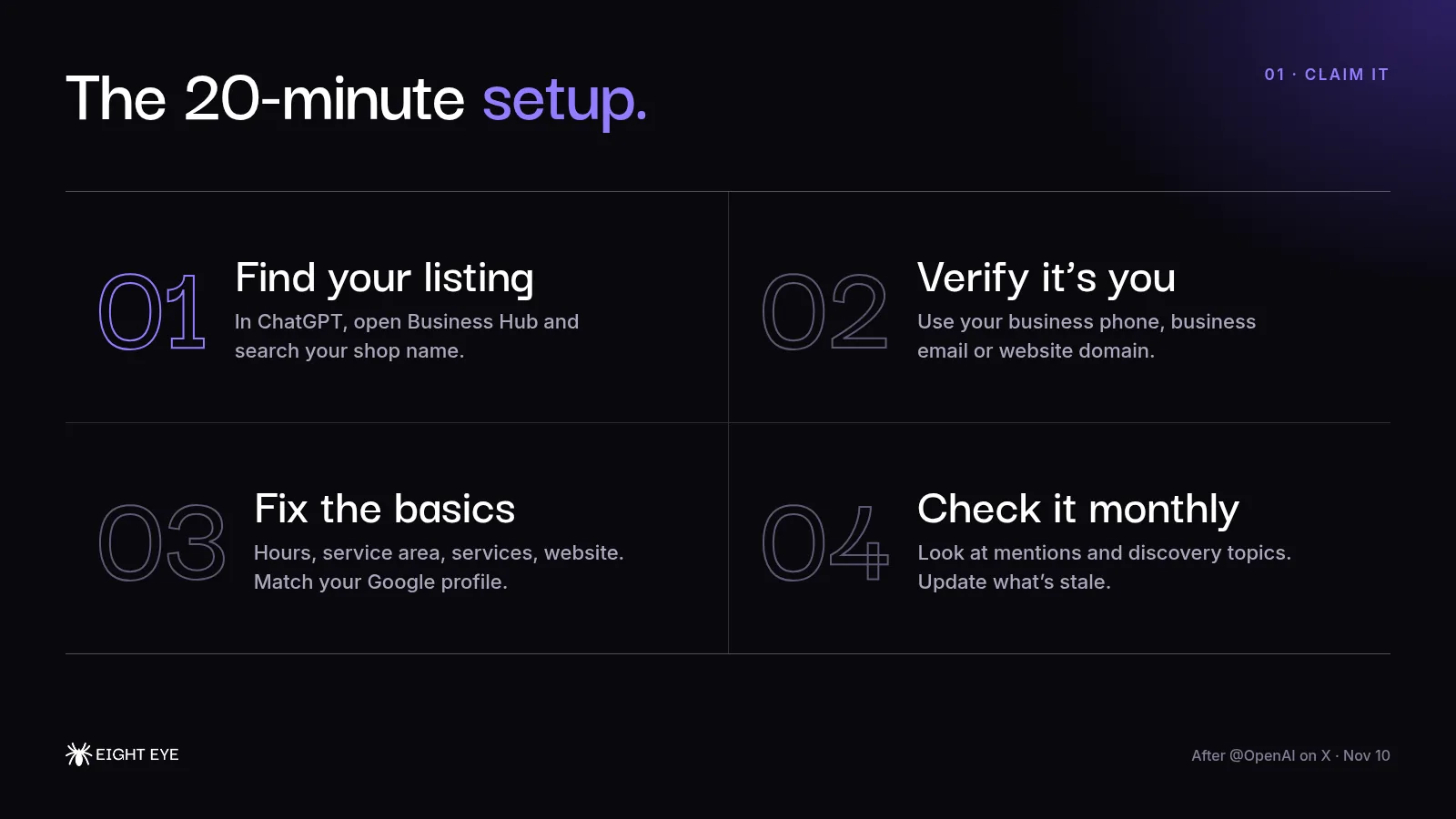
Our take: You don't need the agent to win here. You need the profile. When a homeowner in Norwood asks ChatGPT who can fix a heat pump this week, you want the answer to have your real hours, your real service area and your real website. Here's the setup:
- Find your listing. Sign in to ChatGPT, open Business Hub from the sidebar and search your shop name.
- Verify it's you. OpenAI's help page lists options like your business phone, business email, website domain or Shopify. You'll also do an ID check with Persona before you can publish changes or see insights.
- Fix the basics. Website, description, category, service area. Write it the way a customer talks: "heat pump repair in Norfolk County," not "comprehensive climate solutions."
- Match everything. Same name, phone and hours as your Google profile and your website. Mixed signals hurt you everywhere.
- Check it monthly. Look at mentions and discovery topics. If ChatGPT keeps citing you for boilers but you mostly do heat pumps, your website needs a heat pump page.
Changes go through OpenAI review, so they won't show up instantly. Do it this week anyway.
2. AI does tasks well. Full jobs, not yet
@johnarnold, November 10. About 490 likes, 100 replies and 100,000 views.
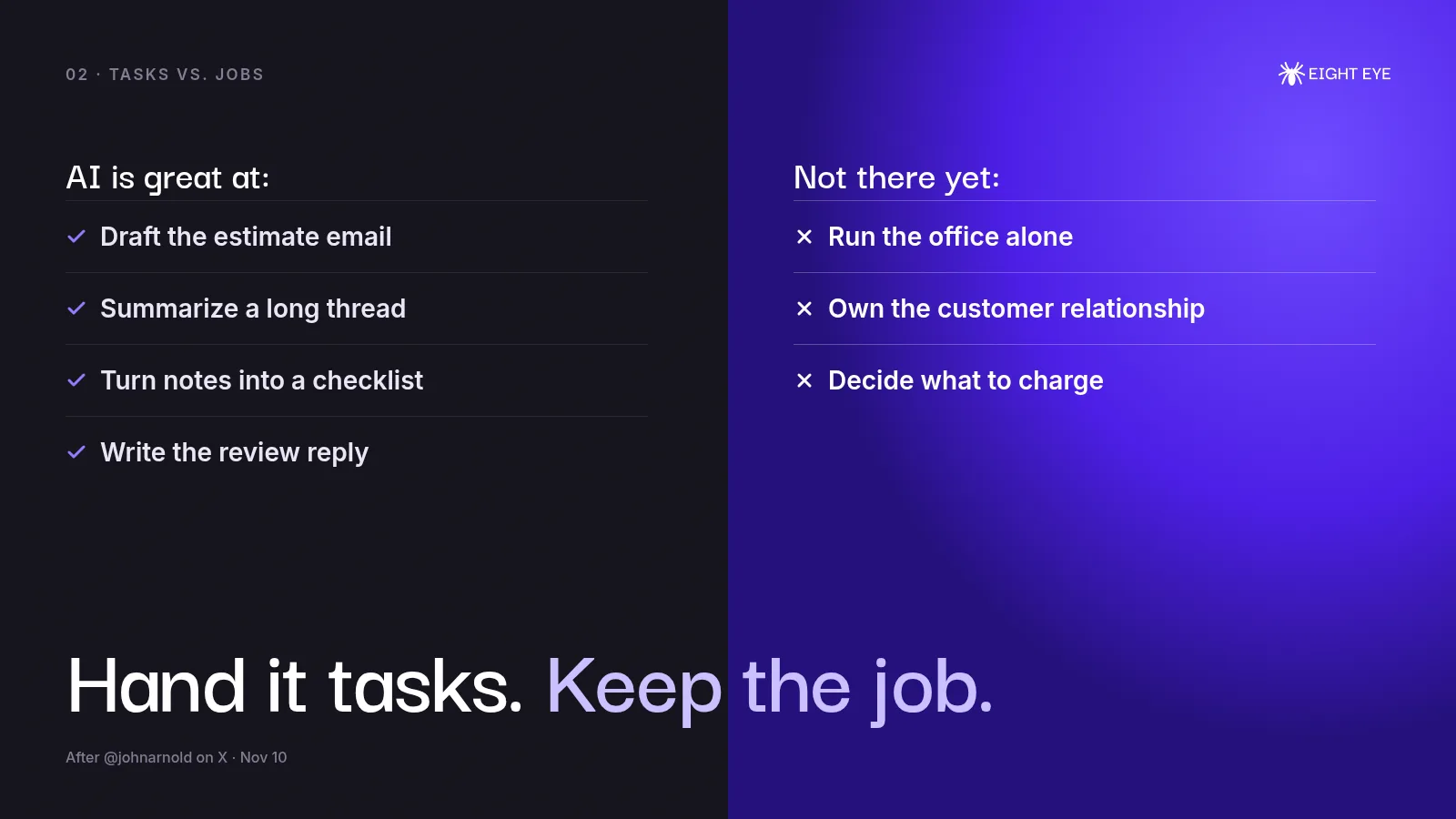
John Arnold, co-chair of Arnold Ventures, shared what he keeps hearing from non-tech small business CEOs. They pay for AI for most of their office staff. They can name a few tasks where it blows them away. But ask if it can do a full job and they say it's not there yet. Some haven't laid anyone off, but they also haven't refilled a role or two. He asked whether the gap is how companies use AI, today's models, or a deeper limit.
Our take: That matches what shop owners tell us. So stop asking "can AI replace my office manager?" Ask "which of her tasks eat the most time?" Then hand off one at a time. Estimate emails. Review replies. Turning job notes into a checklist. She keeps the customer relationships and the judgment calls. Pricing stays with you.
3. A free agent for the boring office chores
@n8n_io, November 11. About 900 likes and 2.6 million views.
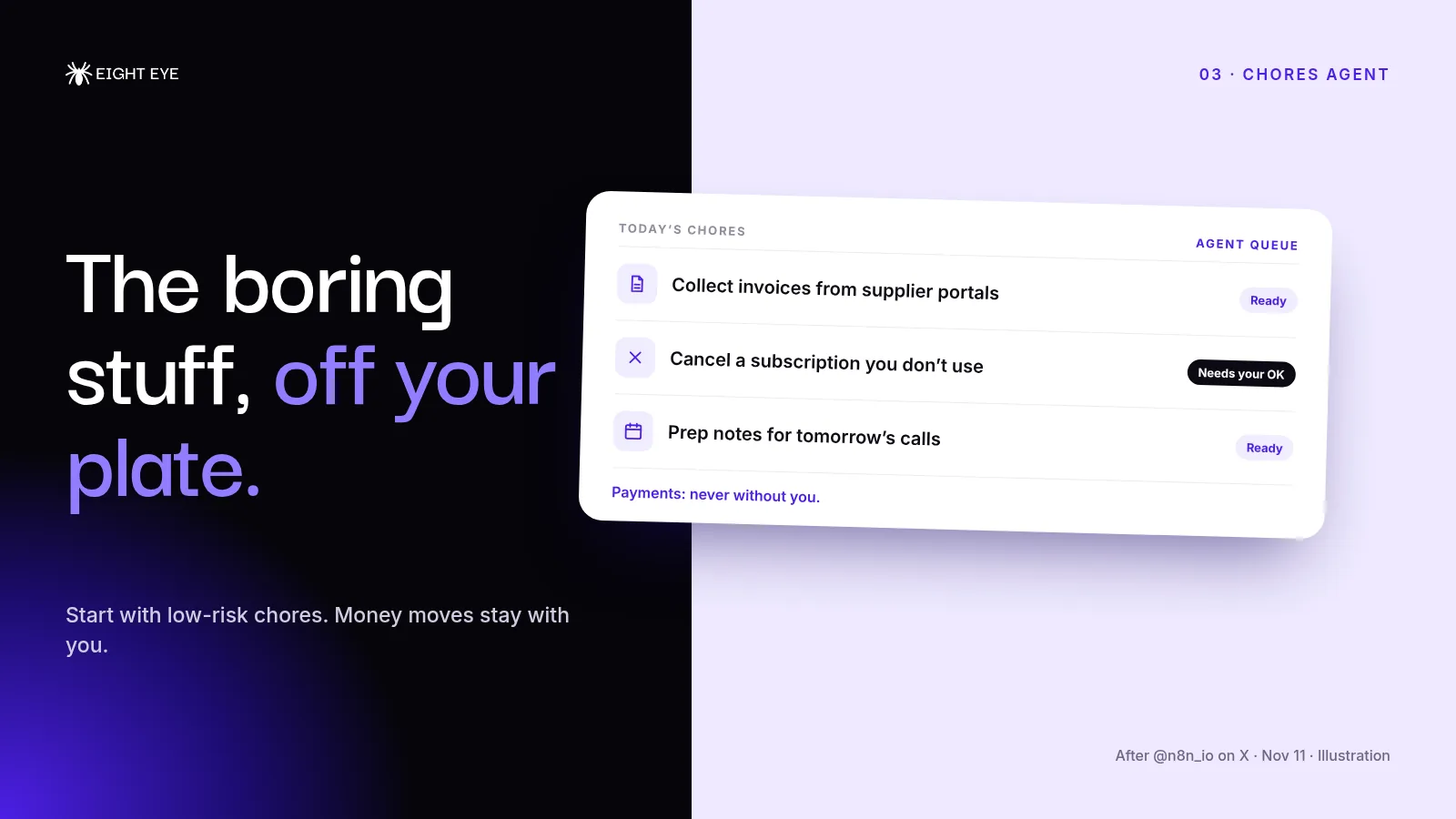
n8n, the workflow automation company, released Nod, an open-source personal agent from its Labs team. You can ask it to prep your calls, collect invoices or cancel a subscription. It runs on your own computer, uses its own browser to work across apps and websites, and works with the AI provider you choose.
Our take: This is the stuff that eats a Friday afternoon. Logging into four supplier portals to download invoices. Canceling the trial nobody remembers starting. If you're curious, test it on chores where a mistake costs nothing. Never let any agent pay a bill or move money without you looking first. And if open-source setup sounds like a weekend project, that's fair. Have your tech person try it, or skip it for now.
4. An "AI CEO" now runs three businesses
@spisallyouneed, November 9. About 1,560 likes and 1.5 million views.
Sam Pasupalak of Skyfall AI introduced Steve, which his company calls the first AI CEO for fully autonomous companies. He says Steve runs three software businesses they acquired, using a team of specialist AI agents. AI researcher François Chollet (about 770 likes) called handing a business to an agent "the ultimate real-world eval," with profit and loss as the scorecard.
Our take: Interesting experiment. Software businesses are the easy case, though. Nobody has to crawl into an attic. In the trades, customers buy trust. They want to know who's coming to the house. Let AI run the paperwork side so you have more time for the part only you can do.
5. Stop making AI slop
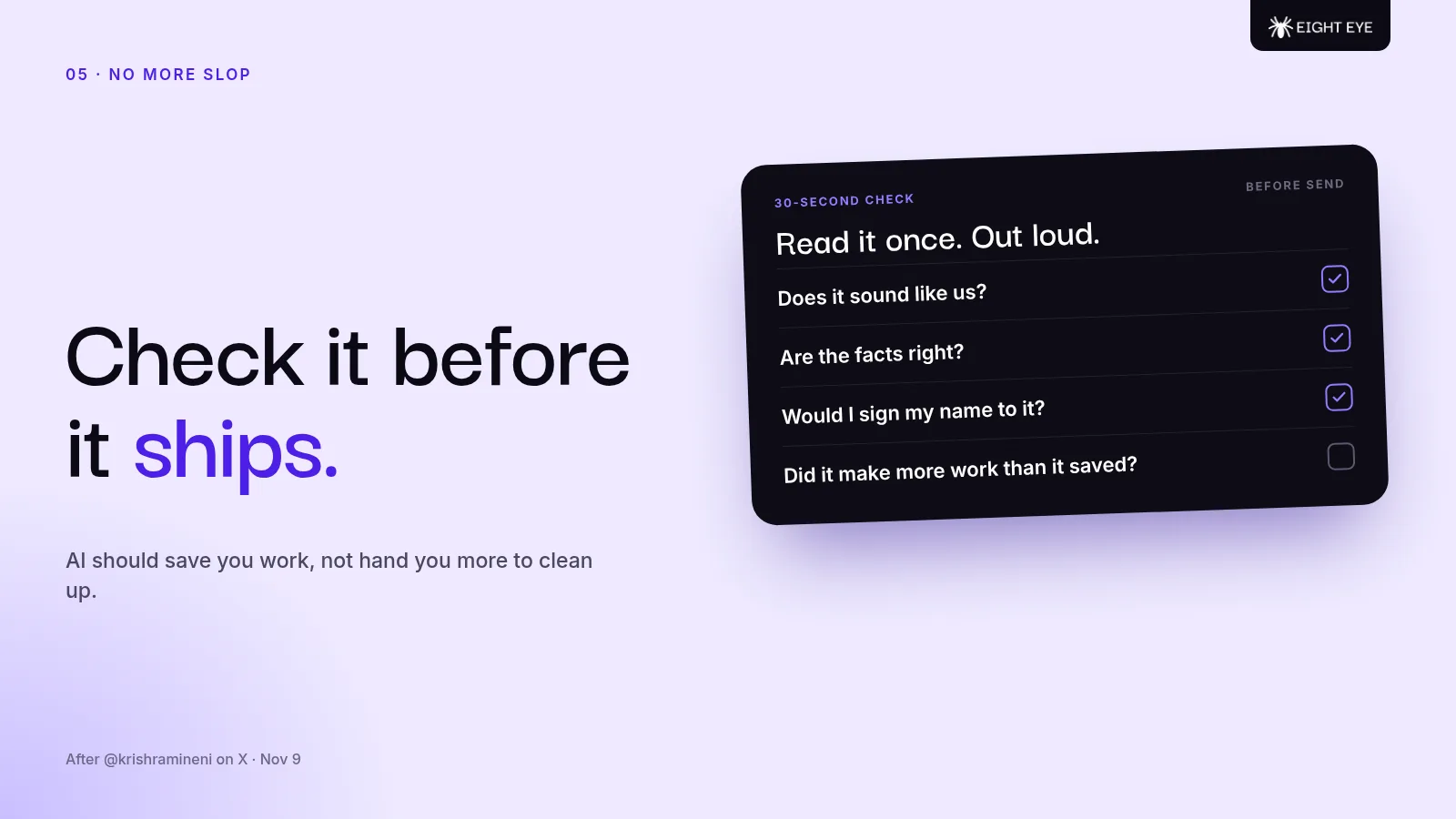
@krishramineni, November 9. About 35,000 views and 60 replies.
Krish Ramineni, CEO of Fireflies.ai, said the quiet part out loud. Employees use AI to make slop. Managers use AI to review it. Then everyone uses AI to fix it. His line: AI should help people do better work, not create more work to clean up. He says Fireflies hasn't laid off anyone because of AI and is hiring.
Our take: Customers can smell a robot text. Before anything AI-written goes out under your name, run a 30-second check. Does it sound like us? Are the facts right? Would I sign it? If the answer is no, fix it or don't send it.
One more for the tech crowd
Mark Zuckerberg (about 10,000 likes and 550,000 views) announced Muse Ember, Meta's smallest model, built for the repetitive work agents do all day, like tool calls and pulling details out of long documents. And Alex Lieberman (about 560 likes) argued it will take 10+ years for AI to spread through most big companies because of bureaucracy. Good news if you're small. You can move this week.
That's issue twenty-nine
One thing to try today: open ChatGPT, find Business Hub and search your shop name. Claim it, check your hours and service area, and match them to your Google profile. If calls and follow-ups are slipping while you're on a job, write to us at support@eighteye.ai. Eight Eye is the AI growth partner for small businesses. We answer your calls, text back missed leads, follow up until they book and help you get found online, while you keep the final say. See how it works, compare plans and pricing, or book a demo.
See you in the next issue.