
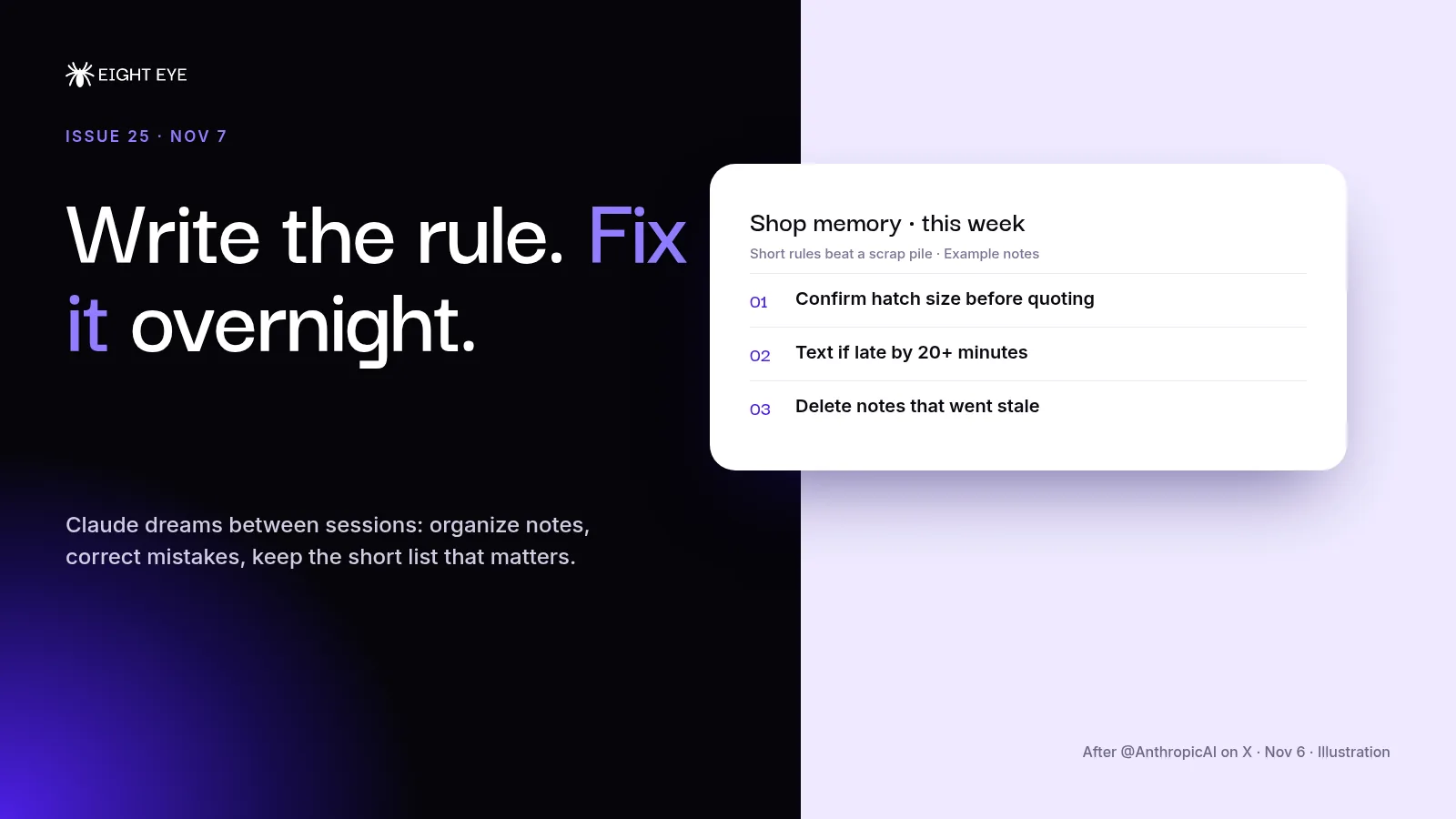
Yesterday Anthropic explained how Claude learns between chats. Not by rewriting the model. By writing notes, then "dreaming" over the logs when it is idle, so bad notes get fixed and useful rules float to the top. For a shop that repeats the same mistakes every storm week, that is the interesting part.
That is our lead. After that: a16z put numbers on how breaches actually start, Greg Isenberg said cracked marketers are outrunning cracked engineers, and he retold the famous Ritz-Carlton guest-recovery rule (classically a set dollar limit per guest) for fixing a problem on the spot. Each item links to the original post on X. Engagement numbers are as of the morning of November 7.
1. Claude's "dreaming": write the lesson, clean it when you are idle
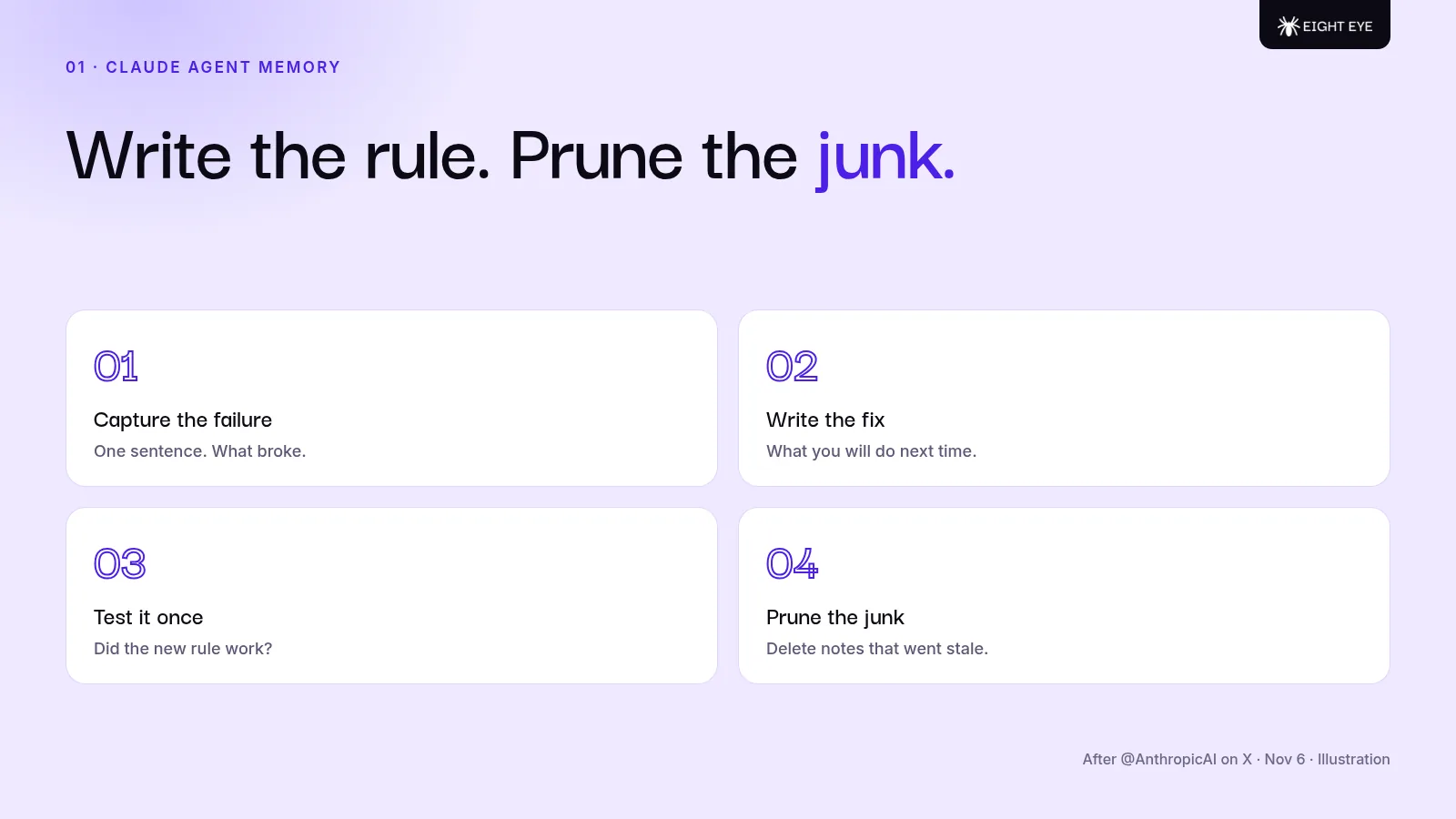
@AnthropicAI, November 6. About 10,600 likes, 9,100 bookmarks and 1.2 million views. Full write-up: The components of agent memory.
Anthropic's engineering team described how Claude keeps knowledge between sessions. In the moment, Claude can tag what matters and write short memory notes. Later, in idle time, a process they call dreaming replays the logs. It corrects wrong notes, builds cleaner maps of what it knows, and decides what to load next time. In their tests, dumping every detail into memory slowed Claude down. A small set of tested rules and goals worked better. Dreaming also caught a bad landmark note in a long Pokémon run and sent Claude back into the cave instead of looping the same wrong turn.
Our take: You do not need Claude playing Pokémon. You need the habit. After a messy job or a missed estimate, write one rule in plain English: "Always confirm the attic hatch size before quoting insulation." "Text the homeowner before rolling if we are more than 20 minutes late." Keep the list short. Review it on a quiet Tuesday. Throw out notes that went stale. An AI that "remembers" only helps if the notes you feed it are true. Garbage notes make confident garbage next week.
- Capture failures, then test the fix. A note that says "we always lose the filter size" is useless until you write what you will do differently and check that it worked.
- Fewer notes beat a scrap pile. Your dispatch board does not need every text from last year. It needs the five rules that stop callbacks.
- Idle time is for cleanup. Friday afternoon is your dreaming. Read the week, fix the bad notes, promote the ones that saved a truck roll.
If answering the phone and booking while you are under a sink is still the hard part, that is a different problem than memory. Fix the front door first.
2. Most breaches are still passwords and phishing, not movie hacks
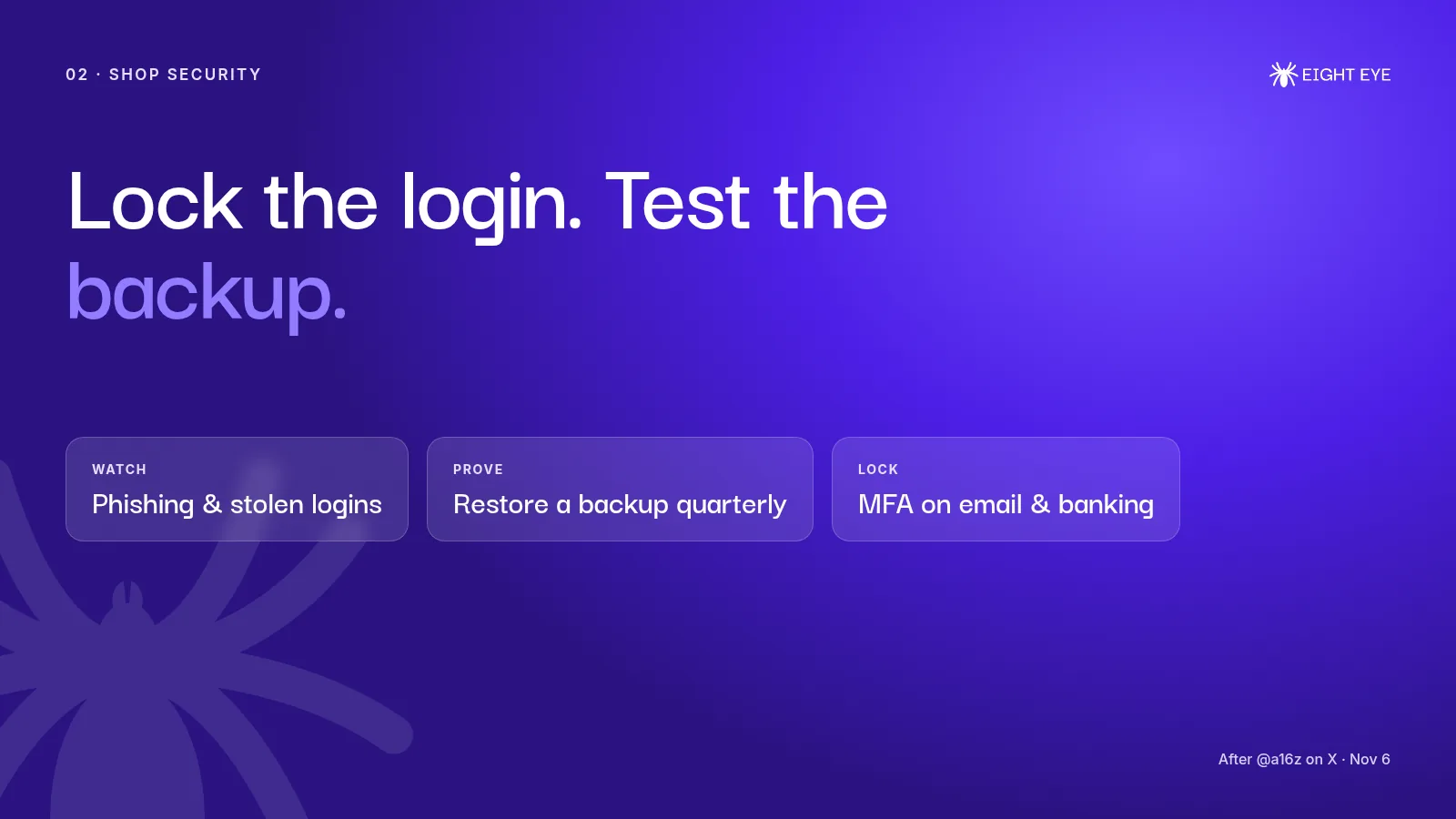
@a16z, November 6. About 220 likes, 200 bookmarks and 38,000 views. Same thread covers backup recovery: 90% of leaders say they can recover from an attack, but only 28% of victims got all their data back. Median recovery cost jumped from about $375K when backups survived to about $3M when backups got hit too. Numbers are from the a16z piece, not our shop floor.
a16z's Asaf Ezra and Steph Zhang argued that a lot of the security opening is not faster patching. In one 2026 report they cite, about 31% of breaches started with a vulnerability exploit, while about 35% started with phishing, stolen logins or impersonation. Nearly half now involve a vendor or partner, up sharply since 2024. They also note AI can help turn a published fix into a working exploit in hours while patching still takes weeks, especially on old routers and cameras.
Our take: For a Massachusetts HVAC, plumbing or electrical shop, skip the venture-capital product list. Steal the boring checklist.
- Turn on MFA for email, banking, payroll and your Google Business Profile.
- Treat a "urgent wire" call that sounds like you as fake until you use a code word.
- Keep office backups off the same machine the office PC sits on, and restore a file once a quarter so you know it works.
- Update the job-site router and camera firmware when the vendor ships a fix, or replace gear that never gets one.
Flashy zero-days make headlines. Phished passwords empty checking accounts.
3. When AI can write the code, the scarce skill is getting the customer
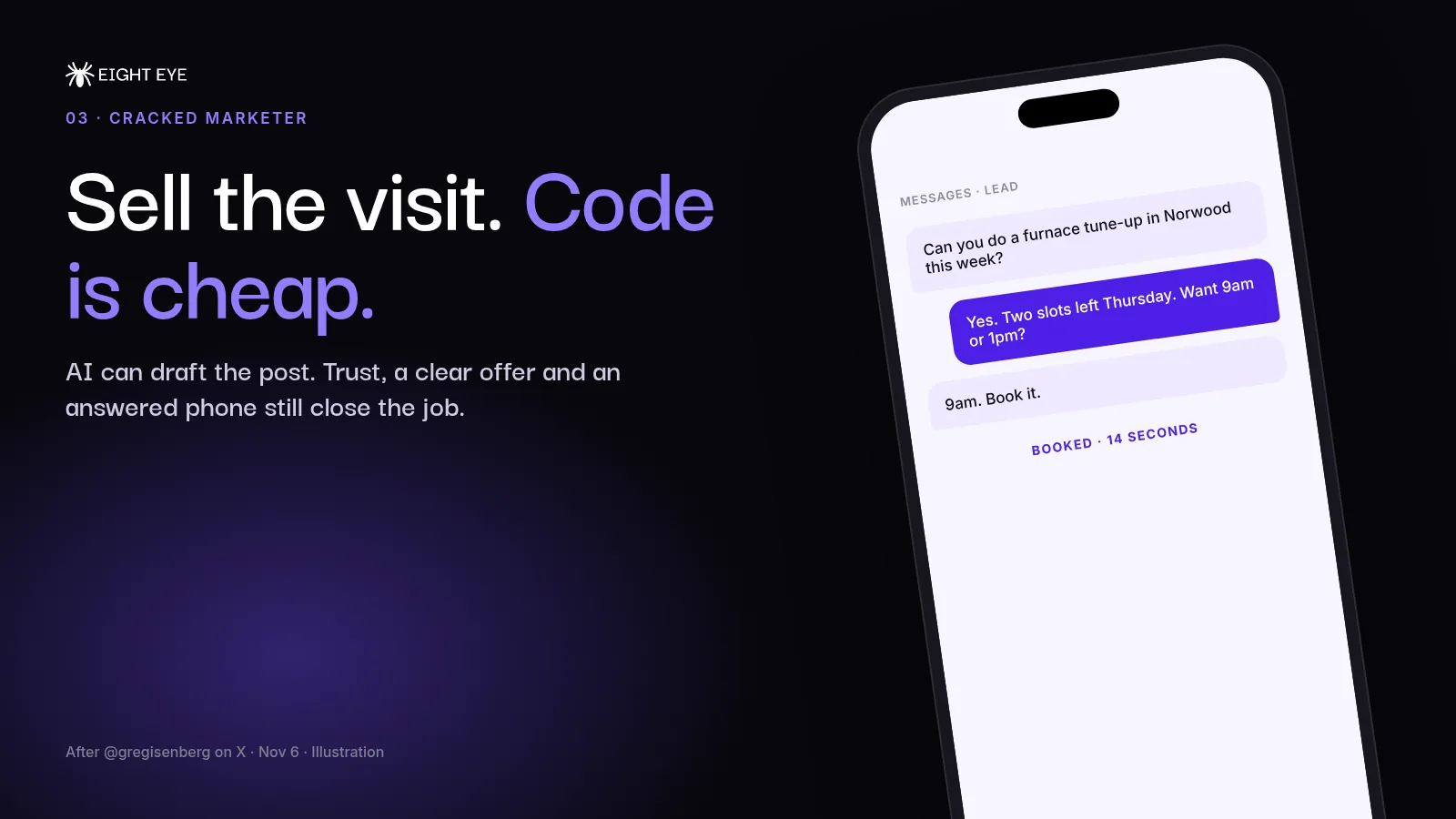
@gregisenberg, November 6. About 2,100 likes, 480 bookmarks and 135,000 views.
Greg's line was short: we have reached the point where the cracked marketer is more in demand than the cracked engineer. In an earlier note the same day, he framed building a company as a loop of grabbing useful context, steering agents, feeding results back in, and calling humans when needed. The faster loop with better context wins.
Our take: For a trade shop this is not "hire a Silicon Valley growth hacker." It is: AI can draft the estimate email and the Facebook post. It cannot earn trust on Main Street by itself. The scarce work is clear offers, honest reviews, a website that says which towns you cover, and a phone that gets answered. If your competitor also has ChatGPT, the shop that shows up first with a clean quote and a booked slot still wins. Spend an hour this week on the message, not on another tool that writes paragraphs you never send.
4. The Ritz guest-recovery rule: fix it at the truck, not after three callbacks
@gregisenberg, November 6. About 640 likes, 730 bookmarks and 99,000 views.
Greg posted a short video from a lesson he says he learned at the Ritz-Carlton Montreal: the $2,000 rule. The famous Ritz-Carlton version is simple. Any employee can spend up to a set amount (classically $2,000 per guest per incident, per long-standing public accounts of the hotel's empowerment policy) to make a problem right without waiting on a manager. Power sits with the person facing the guest.
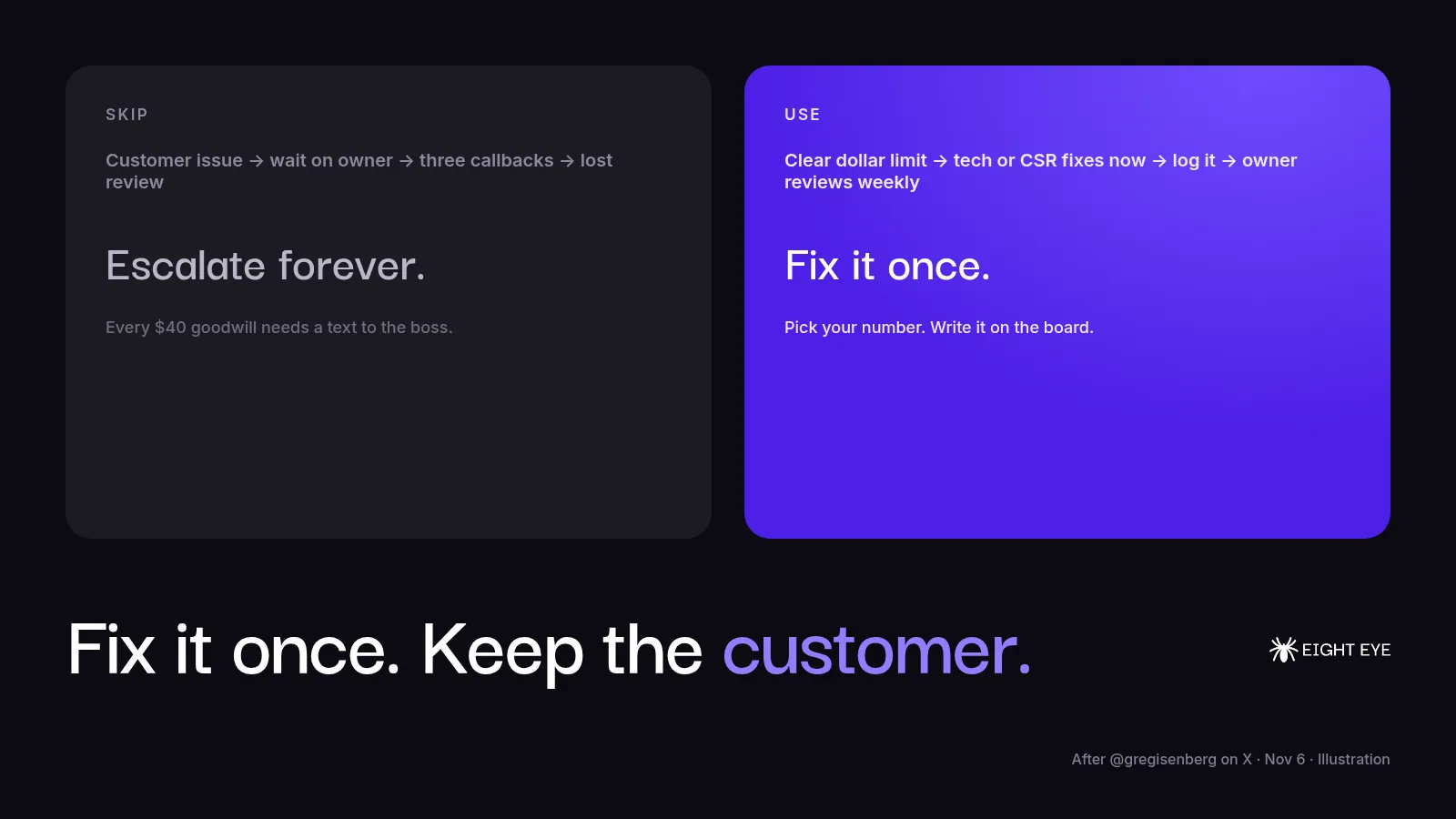
Our take: Translate the dollar figure to your shop. Pick an example limit that will not sink you (say $50, $100 or $250) and write the rule on the whiteboard: if a filter, a return trip for a missed part, or a small courtesy credit will save the relationship, the tech or the CSR can do it now and log it. Waiting for the owner to approve every small goodwill gesture is how you lose a five-star review and then spend more replacing that customer. Clear limit. Clear log. Owner reviews the list weekly, not every text.
That's issue twenty-five
One thing to try today: write three rules from last week's failures, put them where dispatch can see them, and delete one stale note that is no longer true. If the hard part is still answering calls and booking while you are on a roof, write to us at support@eighteye.ai. Eight Eye is the AI growth partner for small businesses. We answer your calls, text back missed leads, follow up until they book and help you get found online, while you keep the final say. See how it works, compare plans and pricing, or book a demo.
See you in the next issue.