
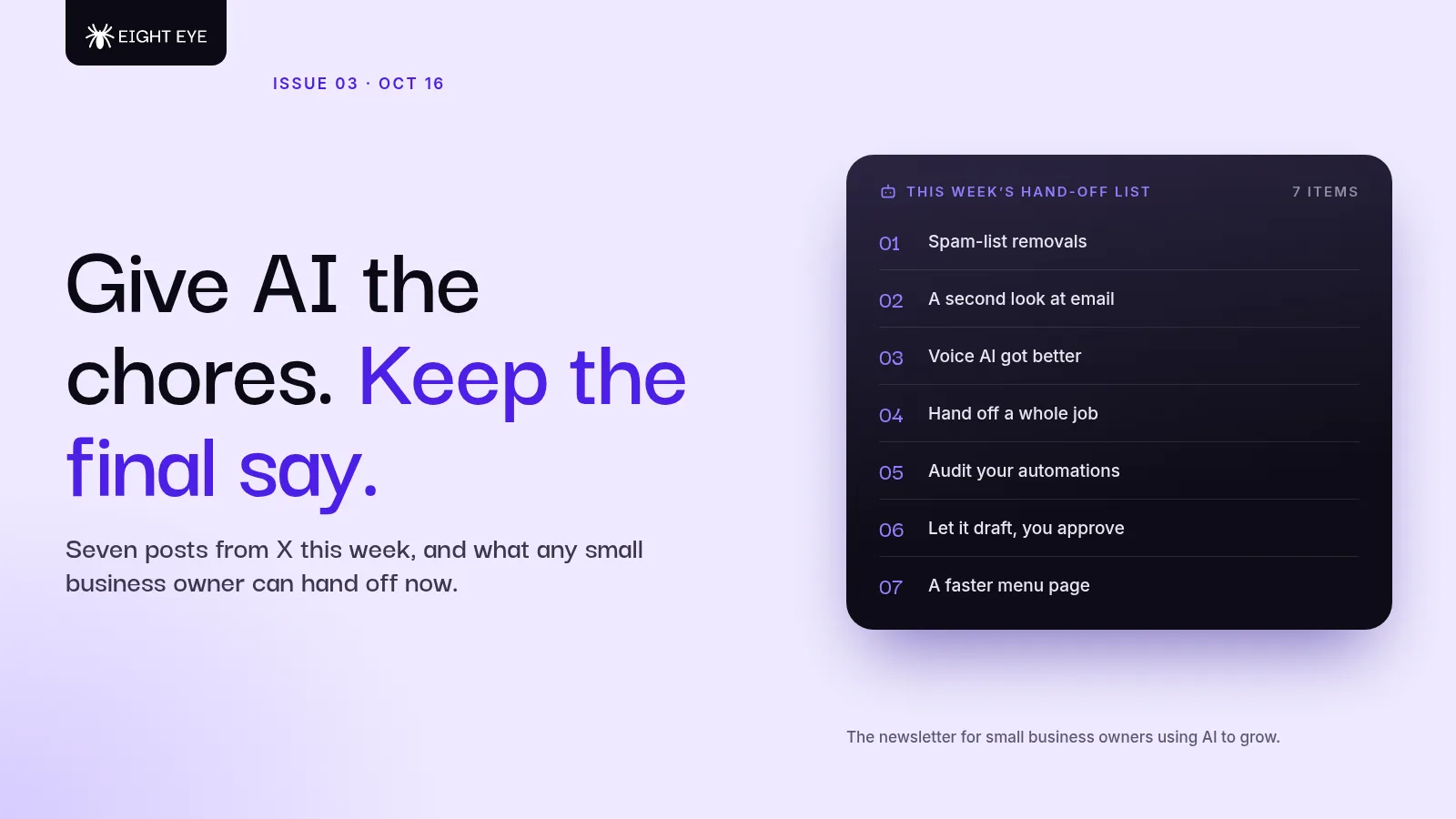
This week the posts that took off on X weren't about AI being clever. They were about AI doing chores: getting a phone number off spam lists, checking a suspicious email, going through a pile of old automations and canceling most of them.
That's good news for anyone running a small business, because chores are what eat your week. Below are seven posts that got a lot of attention over the past two days, what they actually said, a link to each, and what we'd hand off (and what we wouldn't) if it were our business. Engagement numbers are as of the morning of October 16.
1. An AI assistant that files the spam-list removals for you
@elonmusk, October 15. About 31,700 likes, 16,900 bookmarks and 3.8 million views.
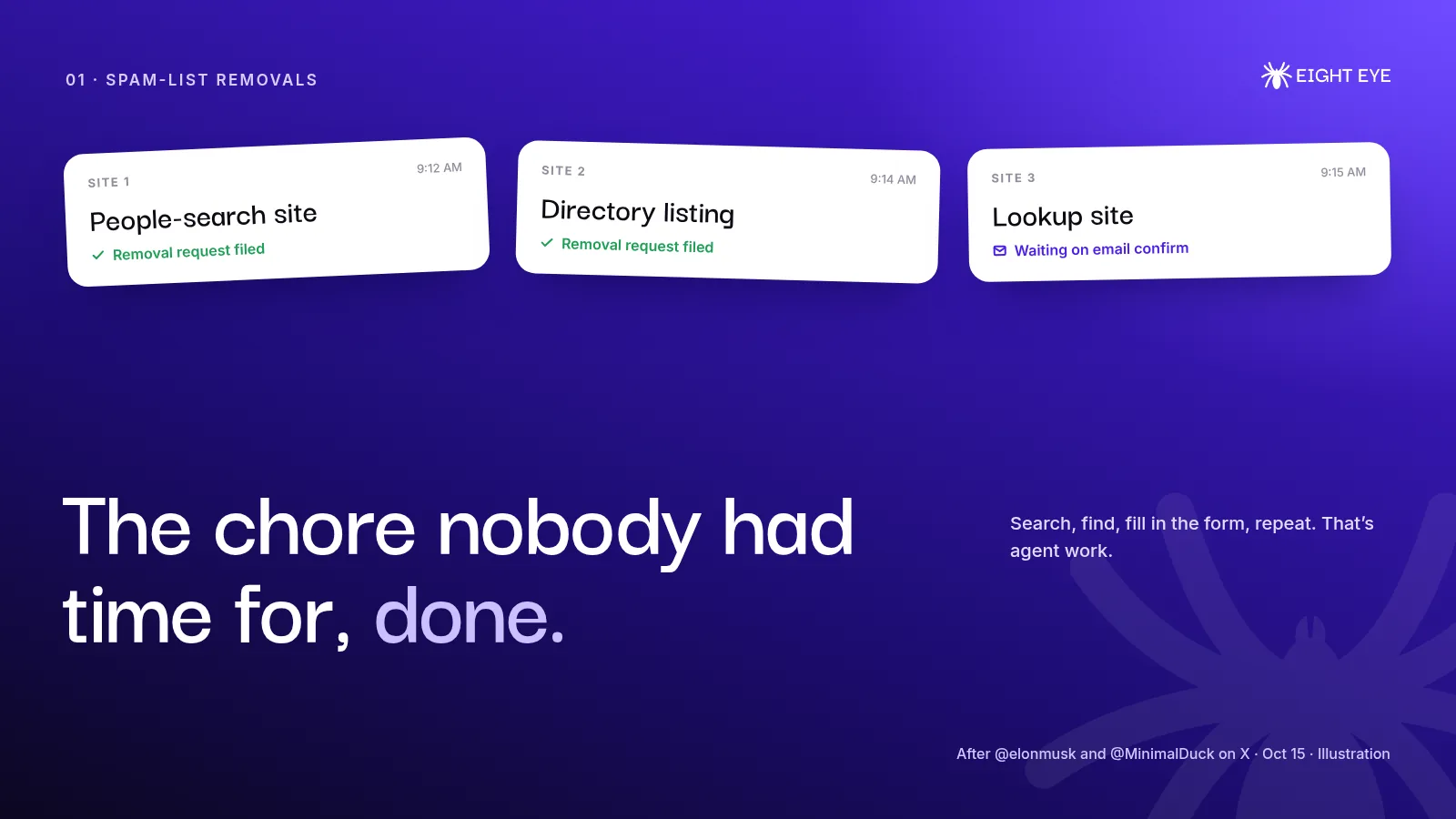
Musk was sharing a post from @MinimalDuck, who got fed up with spam calls and had his Grok Bot assistant track down the sites listing his phone number and file the removal requests. He then packaged the steps as a free skill so other people could run the same thing. Musk's version was one line: ask your assistant to get your number off spam call and text lists.
Our take: The bookmark count says a lot. Nearly 17,000 people saved this for later, which tells you how many of us have a chore like it sitting on a list. Your business number is supposed to be public, so this is mostly about the personal cell that ends up on lookup sites. The bigger lesson is the pattern: search, find the right page, fill in the same form, repeat. That's the kind of job an agent handles well. Pick one you've been putting off, like fixing your hours on old directory listings, and hand it off. Then check the results yourself, because some sites send a confirmation email before anything changes.
2. The email passed every security check. It was still a scam
@elonmusk, October 14. About 5,200 likes and 1.3 million views.
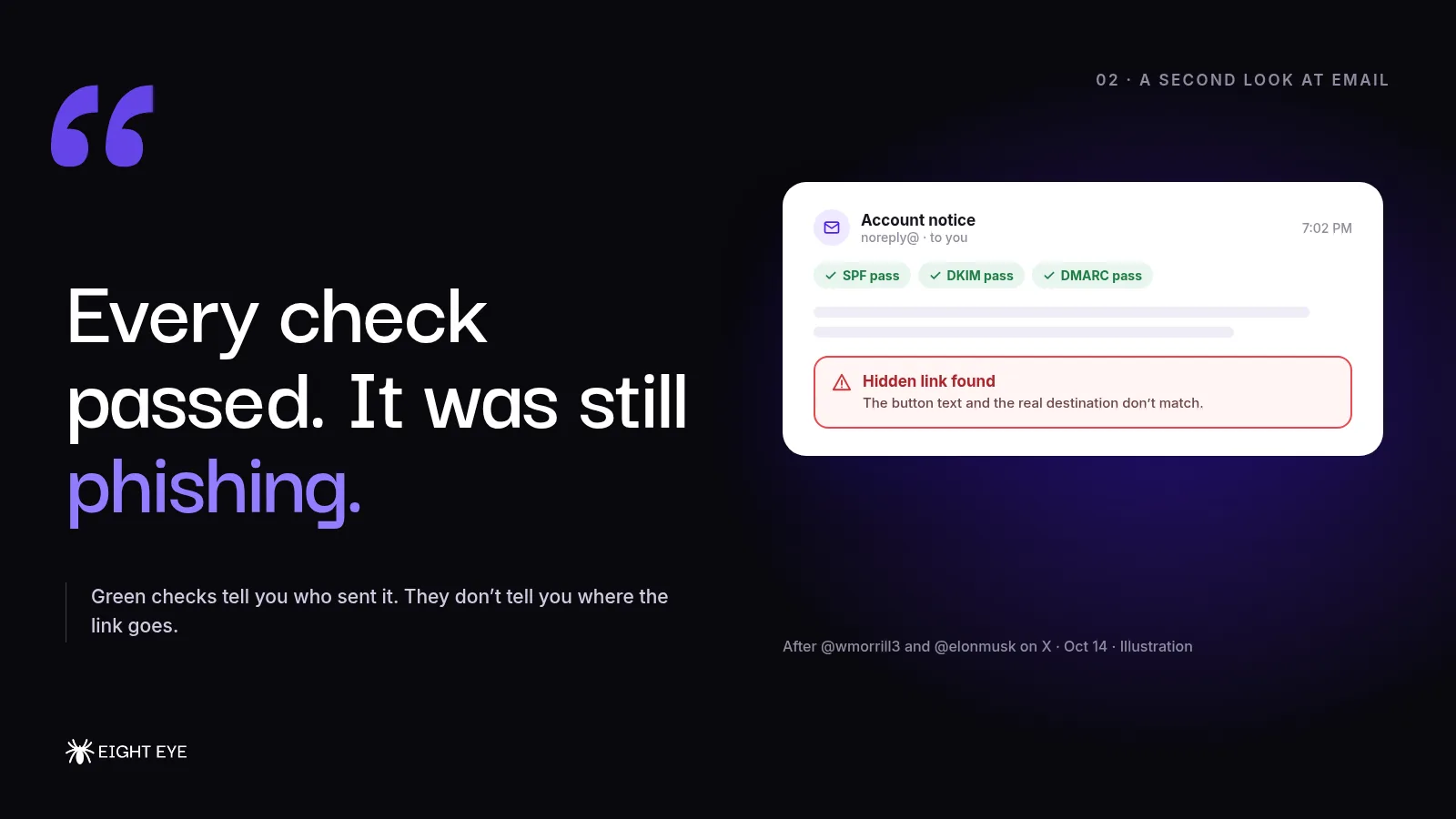
The original post came from @wmorrill3. He got an email that appeared to come from a real company address, passed the standard sender checks (SPF, DKIM and DMARC) and even showed a verified badge. It still felt off, so he asked his assistant for a security review. It found a hidden phishing link, explained how the email got past every check, and wrote up a report for the company with a suggested fix. Musk's comment on it: Grok Bot can detect scam emails.
Our take: Those green checks only confirm where an email came from. They say nothing about where the button sends you. Fake invoices, "we changed our bank details" notes and password-reset scares all hit small businesses, and a busy owner clicks fast. Before you act on any email that asks for money, a login or a change in payment details, paste it into an AI assistant and ask what looks wrong. Don't click anything while you wait. And for any change to how you pay someone, call them on a number you already have, not the one in the email.
3. Voice AI got noticeably better this week
@OpenAI, October 15. About 10,250 likes and 1.4 million views.
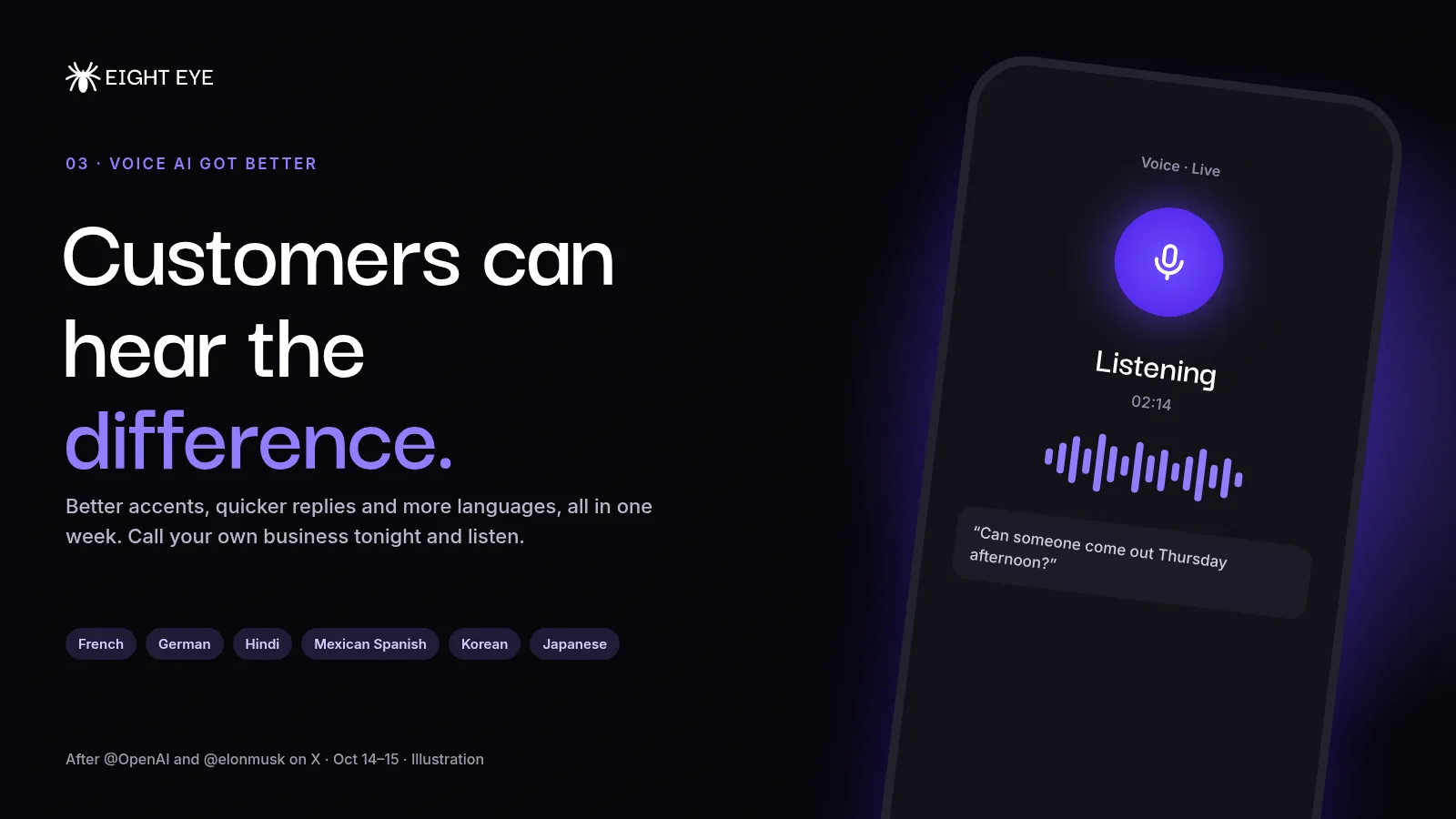
OpenAI rolled out GPT-Live-1.1 to Voice in ChatGPT, with new voices, better accents and, in its words, less "checking..." while it thinks. The update adds voices in French, German, Hindi, Mexican Spanish, Korean and Japanese, and is coming to its API soon. A day earlier, @elonmusk (about 8,700 likes) said Grok Voice 3.0 is now the leading conversational voice model, pointing to Artificial Analysis, which ranked it first on its speech-to-speech index and listed its API price at $0.08 a minute.
Our take: Two of the biggest AI companies spent the same week racing on how natural their voices sound. Customers will get used to that quickly, and it raises the bar for every phone line, human or not. Tonight, call your own business after hours like a customer would. What do you hear? How long until someone, or something, helps you? If a good share of your customers are more comfortable in Spanish or another language, notice that too. That gap is getting cheaper to close.
4. Small businesses are moving from chatting with AI to handing it work
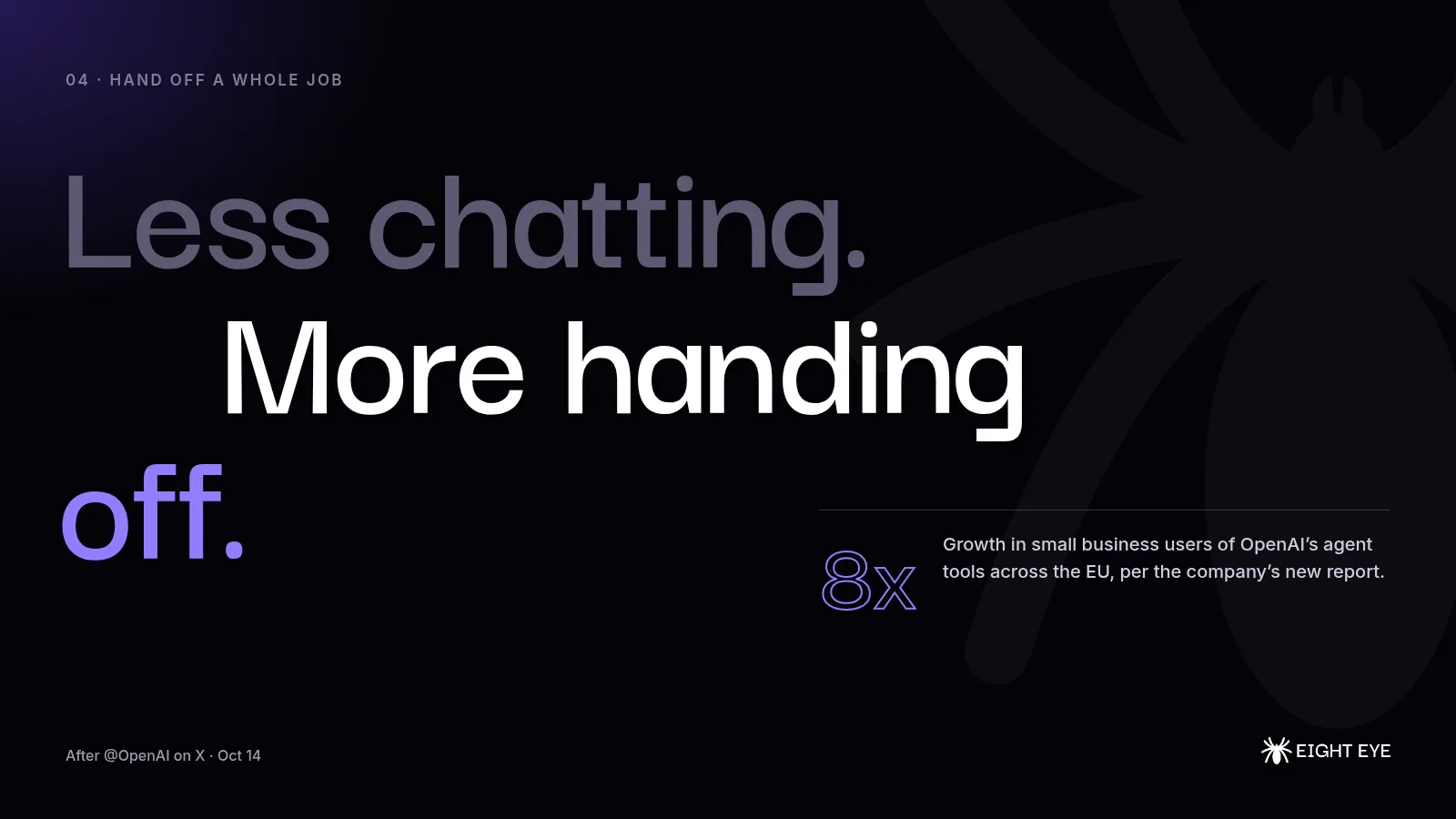
@OpenAI, October 14. About 2,850 likes, 560 replies and 414,000 views.
OpenAI shared a new economic research report on Europe. It says more than half of AI use among its EU enterprise and business customers now involves agents, meaning tools that carry out tasks rather than only answer questions, and that the number of small business users across the region has grown 8x. The report frames the next step as turning wider adoption into deeper use.
Our take: You don't have to be in Europe for this to apply. The shift is from asking AI a question to giving it a whole job with a clear start and finish. Good first candidates: turning a day's job notes into draft invoices, following up on every quote that hasn't gotten an answer in a week, or sorting new reviews into "reply today" and "fine." Write the steps down the way you'd explain them to a new hire. If you can't explain the job in a few lines, it isn't ready to hand off yet.
5. Noah Kagan audited 123 automations. Two did most of the work
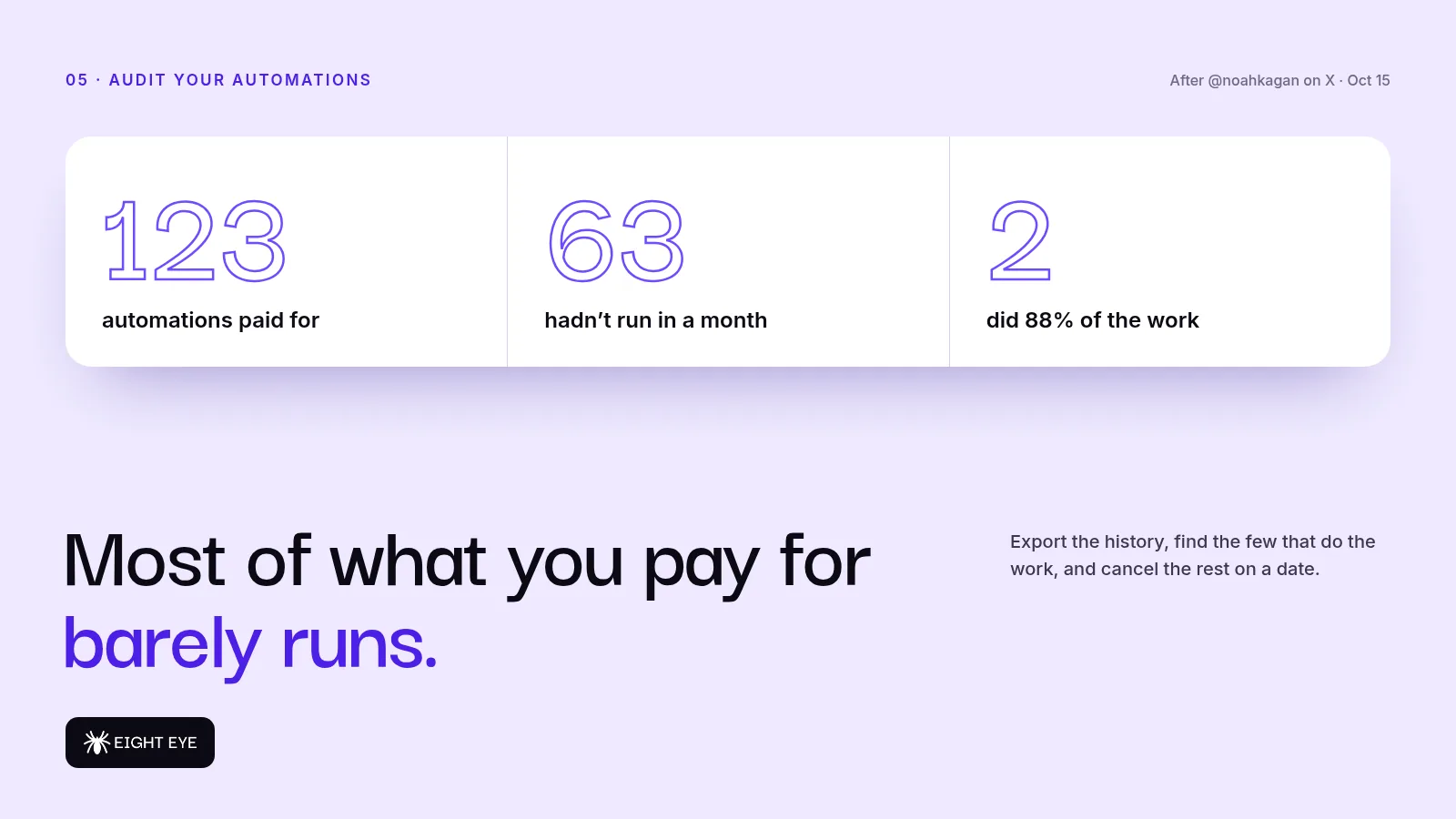
@noahkagan, October 15. About 195 likes and 143 bookmarks.
The AppSumo founder has been cutting expensive software, and this week it was Zapier, a tool his team had used for ten years. They were paying for 123 automations. Sixty-three hadn't run in a month, and two did 88% of the work. Claude rebuilt one of them, the rest moved into tools they already pay for, and he says the line item went from $4,788 a year to zero. He shared the audit as a prompt: export your task history, have an AI assistant list each automation with its owner and recent runs, flag the dead ones, suggest a replacement you already pay for, and draft a cancel plan with dates. A day earlier he posted that out of $46 million in software sales on AppSumo, AI agents and app builders made up 12% of the money.
Our take: Most small businesses have a version of this, just spread across a dozen subscriptions instead of one. Pull last month's card statement, list every software charge, and ask an AI assistant to sort them into "use daily," "use sometimes" and "forgot we had." Cancel the third group on a set date. Whatever you save is budget for the one or two tools that actually bring in customers.
6. Let the agent draft. You hit send
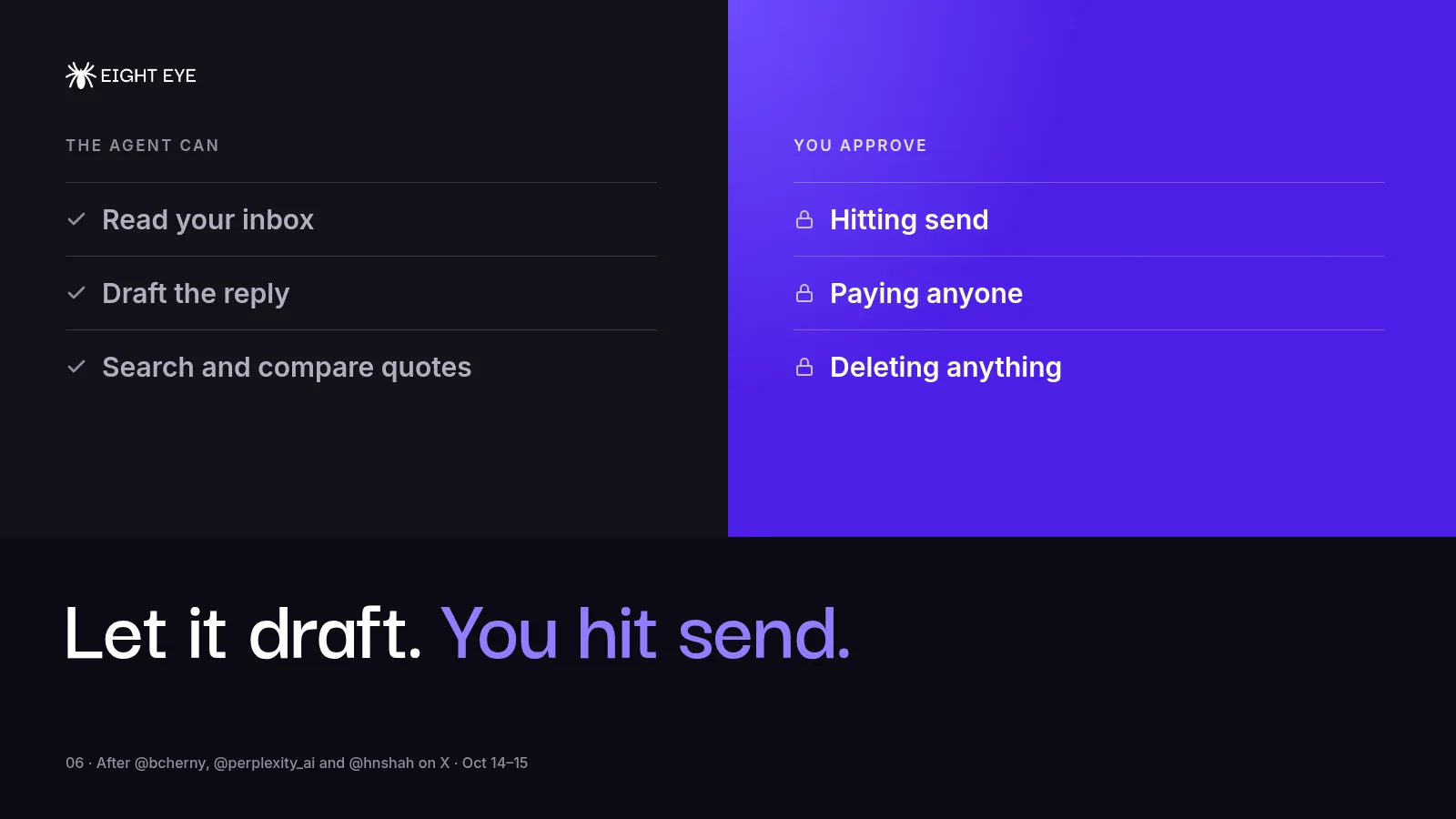
@bcherny, October 15. About 690 likes and 71,000 views.
Boris Cherny wrote that Anthropic has made real progress against prompt injection in its Claude models, but that as agents take on more, the whole industry urgently needs to solve it. Prompt injection is when a web page or email hides instructions meant to steer an AI agent into doing something you didn't ask for. He pointed to a new red-teaming competition from Gray Swan, backed by several AI labs, with $300,000 for people who can break these defenses. The same day, @perplexity_ai (about 1,990 likes and 1,560 bookmarks) open-sourced SPACE, the system that runs each of its agent tasks in its own sealed-off virtual machine and controls passwords and outside connections from outside that box.
Our take: You don't need to understand virtual machines to borrow the idea. Give an agent the smallest amount of access that gets the job done, and keep the risky steps for yourself. Founder Hiten Shah put it simply: for email, he's fine with an agent reading and drafting, but he still approves what gets sent. That's a sensible rule for any business. Let it read, search and draft. You approve anything that sends, pays or deletes.
7. A faster menu page sold more food
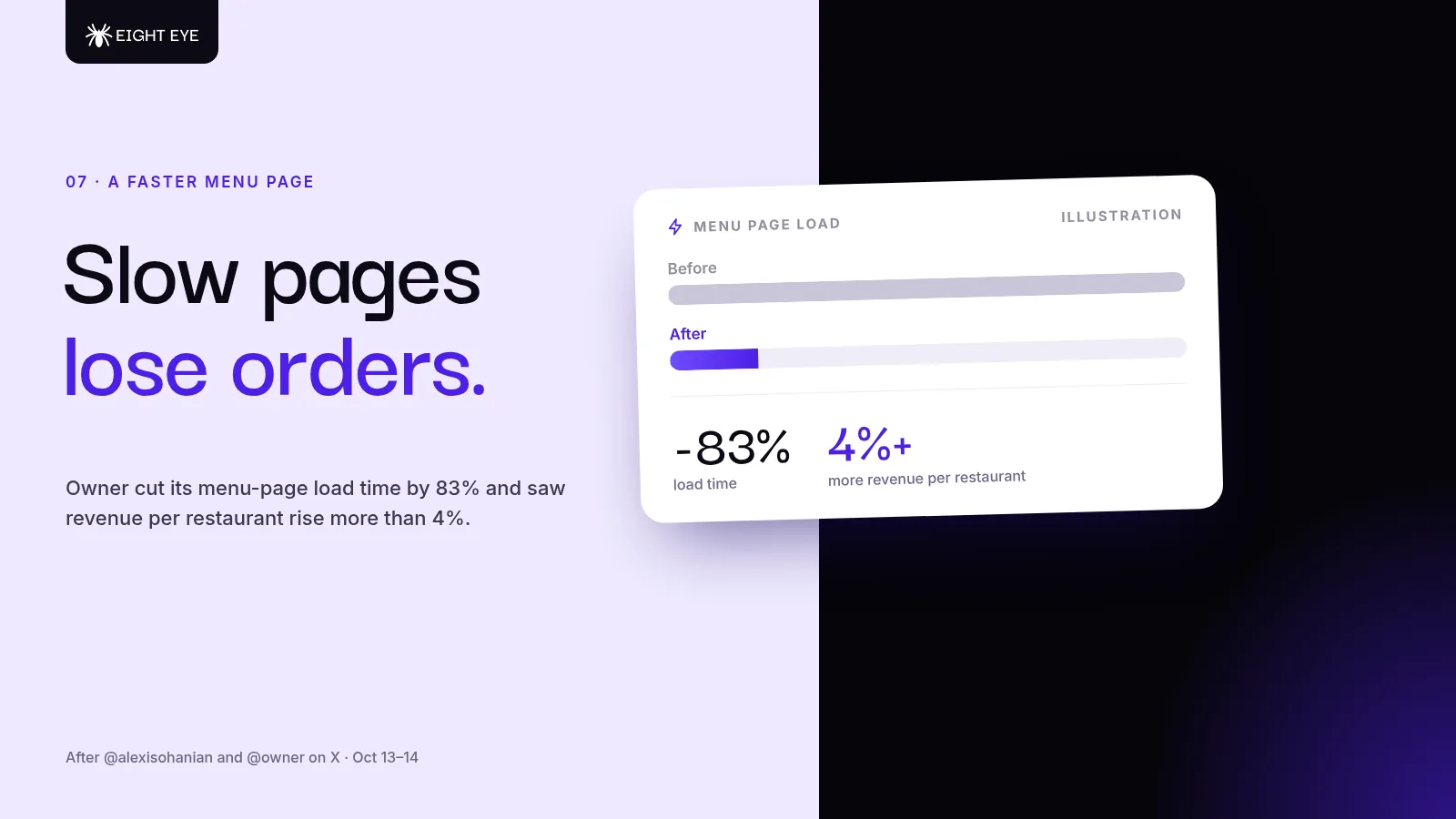
@alexisohanian, October 14. About 45 likes and 15,700 views. A smaller post, but one every owner with a website should see.
Reddit co-founder Alexis Ohanian, whose firm 776 backs restaurant software company Owner, summed it up: load the menu slower and people buy less food. He was sharing Owner's write-up of rebuilding its website setup, which it says cut menu-page loading time by 83% and raised revenue per restaurant by more than 4%. His point was that this kind of unglamorous infrastructure work is what actually moves the needle for small businesses.
Our take: Open your own website on your phone, on cellular data, not office Wi-Fi. Count how long it takes before you can see your menu, your prices or your "book now" button. Google's free PageSpeed Insights tool will show you what's slowing it down. Oversized photos are a common culprit. Speed rarely gets attention, but it's often one of the cheaper fixes for getting more of your visitors to actually order or book.
One more for the tech crowd
The most-liked AI launch post we saw this week was @AIatMeta releasing Muse Spark Open (about 10,700 likes), which Meta calls the most capable US open-weight model so far, built for coding and long, multi-step agent work, with a 1 million token context window. Most owners will never run a model like this themselves. Still, strong open models usually mean more choice and more price pressure across the tools you do use.
That's issue three
If one of these gave you an idea for a chore you'd like off your plate, write to us at support@eighteye.ai. Eight Eye is the AI growth partner for small businesses, from answering and following up with every lead to getting found online and keeping the busywork moving. See how it works, compare plans and pricing, or book a demo.
See you in the next issue.