

Most voice assistants you've called sound like what they are: a machine waiting for you to stop talking so it can read back a transcript. This week Block, the company behind Square and Cash App, showed one that doesn't. It laughs, sighs, talks while you talk and sounds tired when it says it's tired.
That's the lead story, because it touches both sides of your phone line: the calls your business answers and the calls your business gets. We also cover a big study on which local businesses AI tools agree to recommend, Gemini reading your customers' saved places, a "security week" habit worth stealing and a list of business ideas that doubles as a map of where AI is going. Each item links to the original post on X, and engagement numbers are as of the morning of October 25.
1. Block's new voice AI talks like a person
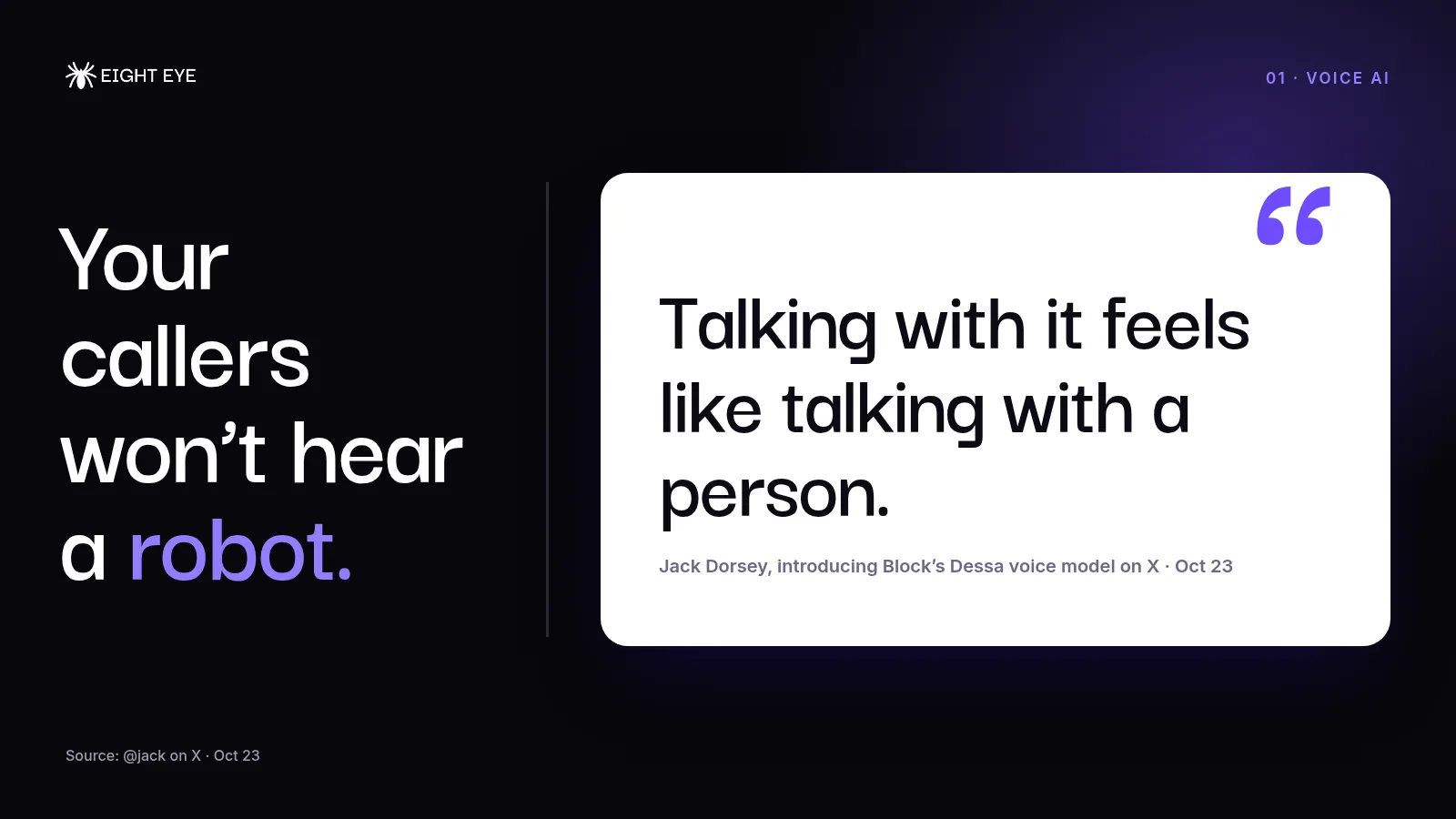
@jack, October 23. About 67,000 likes and 12.9 million views.
Jack Dorsey introduced Dessa, a research model from Block's lab that Block calls "the most authentic full-duplex speech model ever built." Full-duplex means it listens and speaks at the same time, so it can jump in, say "yeah" while you're talking and react to how you sound, not just what you said. Most voice assistants turn your words into text, think, then read an answer back. According to TechCrunch's write-up, Block says Dessa was trained only on human speech, runs on a high-end laptop, and isn't open to the public yet. Block has asked safety researchers to test it first.
The business angle came fast. Dan Garon (about 450 likes) called it "the future of how small businesses will be able to talk to their customers," pointing out that Block is building for Main Street from the payment terminal up. TechCrunch notes Square already uses voice AI to take orders.
Our take: Two things to do with this, one for each direction of the call.
- Calls you answer. Phone AI that sounds natural is coming, from Block and others. When you use it, tell callers up front they're talking with your business's AI assistant and make it easy to reach a person. People forgive a machine. They don't forgive being fooled.
- Calls you get. The same tech makes fake calls more convincing. Set one rule this week: nobody on your team changes payment details, wires money or reads out a code because of a phone call alone, even if the voice sounds like your supplier, your bank or you. Hang up and call back on a number you already have.
2. When four AI tools agree on the best local business
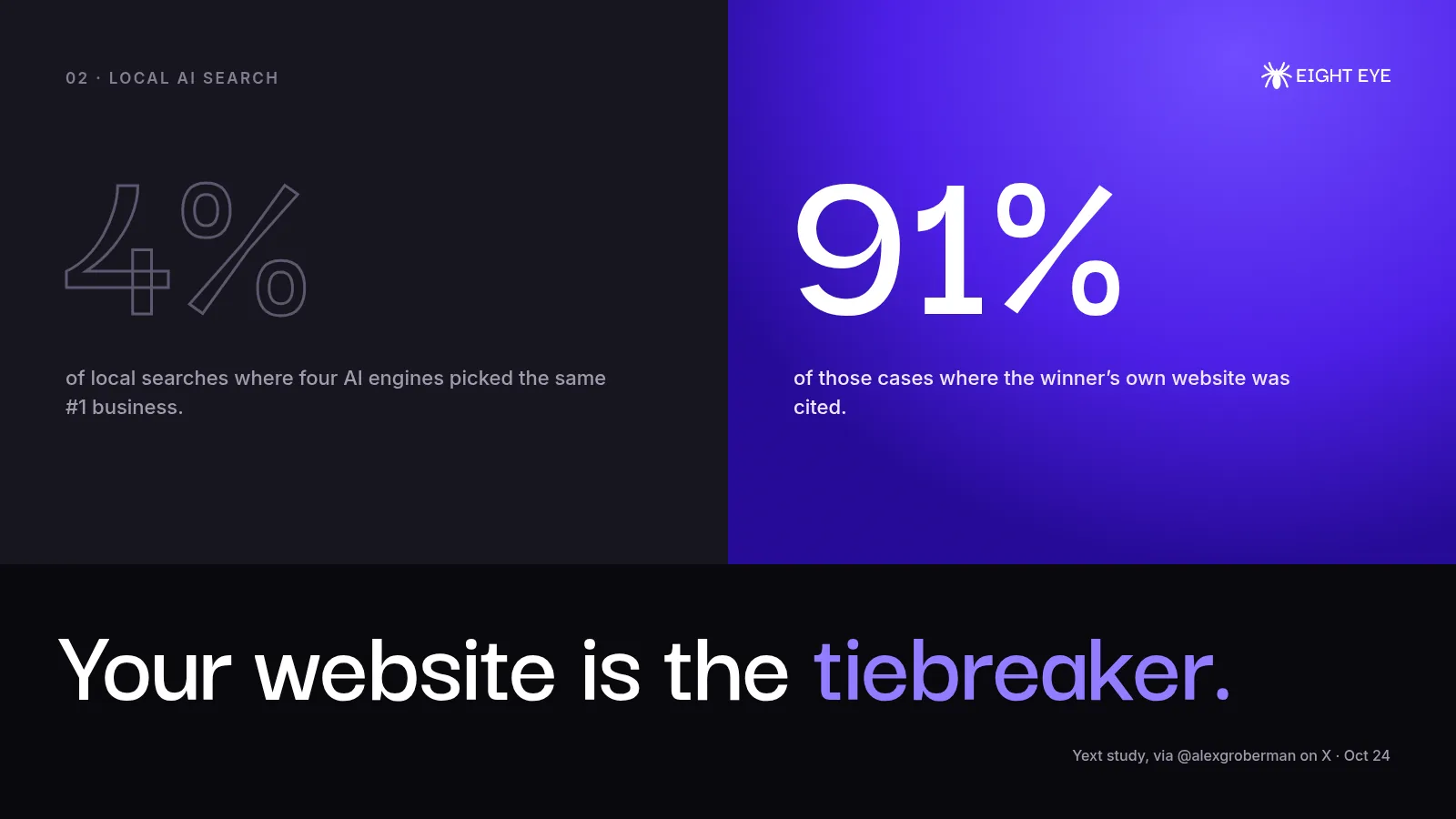
@alexgroberman, October 24. About 80 likes, 38 reposts and 22,000 views.
Alex Groberman walked through a Yext study of 491,972 local searches run across four AI engines: Gemini, OpenAI, Perplexity and Anthropic. The searches were unbranded, the kind a homeowner types when they don't have a name in mind yet. All four picked the same top business only 4% of the time. In 48% of cases, each engine picked a different business for the top spot.
The interesting part is what the rare winners had in common. When all four agreed, the winning business's own website was one of the cited sources 91% of the time. His point: an AI can't recommend you for something your site never says. Where you are, what you do, which towns you serve, roughly what things cost and what customers usually ask.
Our take: For an HVAC, plumbing or electrical shop, this is the clearest to-do list we've seen. One page per real service (not one "Services" page with a bulleted list), the towns you actually cover written out, honest answers to the questions people ask on the phone, and hours that match your Google profile. Do that and you're not hoping an AI guesses right. You're giving it the answer.
3. Gemini can now look at your customers' saved places
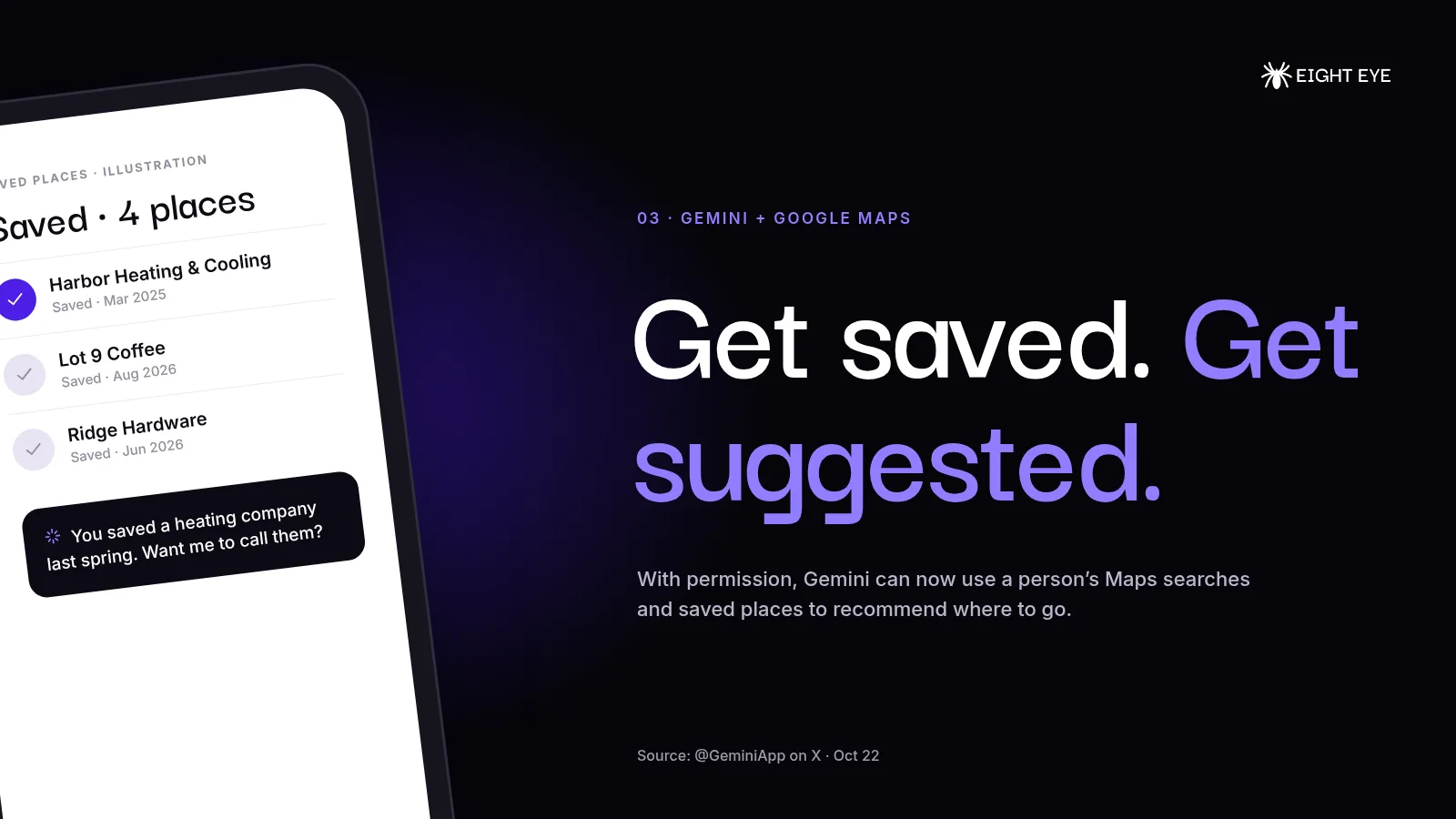
@GeminiApp, October 22. About 1,300 likes and 94,000 views.
Google says that, with a user's permission, Gemini can now use their Google Maps searches and saved places alongside their Google Calendar to make recommendations for their day. It's opt-in, and the examples are mostly about restaurants and errands for now.
Our take: It's a small feature with a clear signal. The assistant starts with places a person already searched for or saved. For a home-service business, that means the customer who saved your listing after the last repair is the easiest one for an AI to steer back to you. Keep your Google Business Profile complete and current, and after a good job, it's fair to say "save us in Google Maps so you can find us next time."
4. One week a month for security
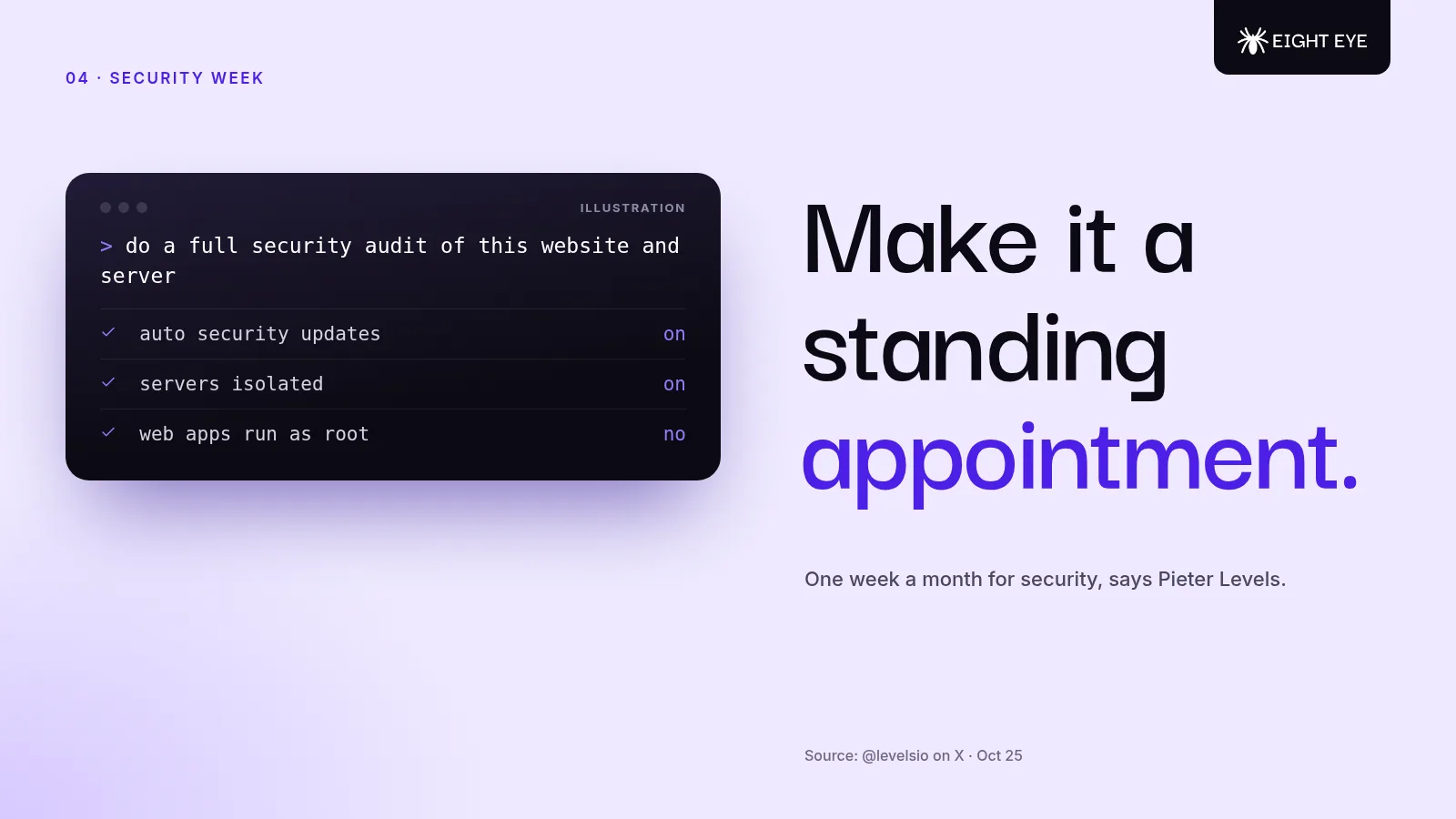
@levelsio, October 25. About 620 likes and 840 bookmarks.
Pieter Levels, who runs several popular websites mostly on his own, said he spent a full day typing "Do a full security audit of this website and server" into Claude Code for every server he has. He already had automatic security updates on. He also walled each server off from the others so one break-in can't spread, and kept web apps from running with full admin rights. His conclusion: alongside a "marketing week," founders now need a "security week" every month, because AI is getting better at attacks and defenses have to keep up.
Our take: You don't need to run the audit yourself. Put a recurring monthly reminder on the calendar and use it to ask three questions: are automatic updates on for the website, the computers and the phones? Does every account that touches money or customer data have two-step login? And who would we call if something got in? Ten minutes a month beats one very bad week.
5. Business ideas that show where AI is heading
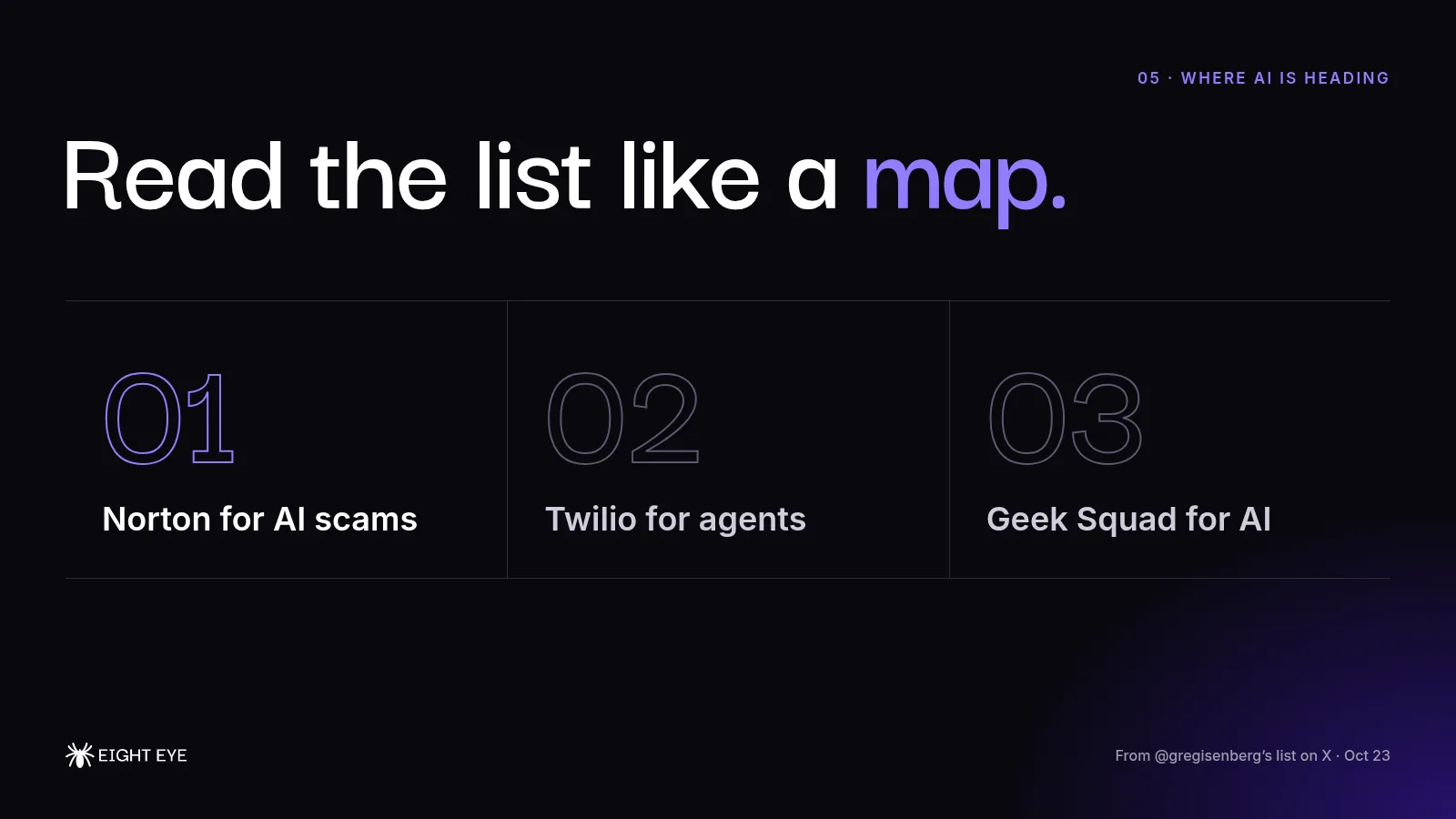
@gregisenberg, October 23. About 4,600 likes and 9,700 bookmarks.
Greg Isenberg posted a long list of "obvious (but really good)" ideas for new companies. Most are aimed at founders, but a few read like a forecast for every business. "Norton for AI scams" to protect people from fake voices and emails. "Twilio for agents," meaning phone numbers and texting for AI agents. "Geek Squad for AI," setting up personal agents for families and small businesses. And "Google Analytics for agents," so a site owner can see which AI agents visit and what they want.
Our take: When smart people start pitching insurance, security and setup help for something, that something is going mainstream. AI agents are about to call, text and visit your website on behalf of customers, and scammers will use the same tools. Lead story, again, in one list.
One more for the tech crowd
Big retailers are picking opposite sides on AI shoppers. As @glenngabe summarized from TechCrunch, Walmart unveiled an Agent Gateway, an MCP server that lets approved AI agents search its inventory and buy on a customer's behalf, plus Agent Profiles so each agent's purchases are tracked separately. Amazon, meanwhile, is blocking agents. Put it next to last issue's story on banks locking agents out and you can see the pattern: the companies that welcome agents are giving each one its own identity and its own limits.
That's issue twelve
If you're thinking about letting AI answer your phones and want to know what a natural, honest setup looks like, write to us at support@eighteye.ai. Eight Eye is the AI growth partner for small businesses, from answering and following up with every lead to getting found online and keeping the busywork moving. See how it works, compare plans and pricing, or book a demo.
See you in the next issue.