
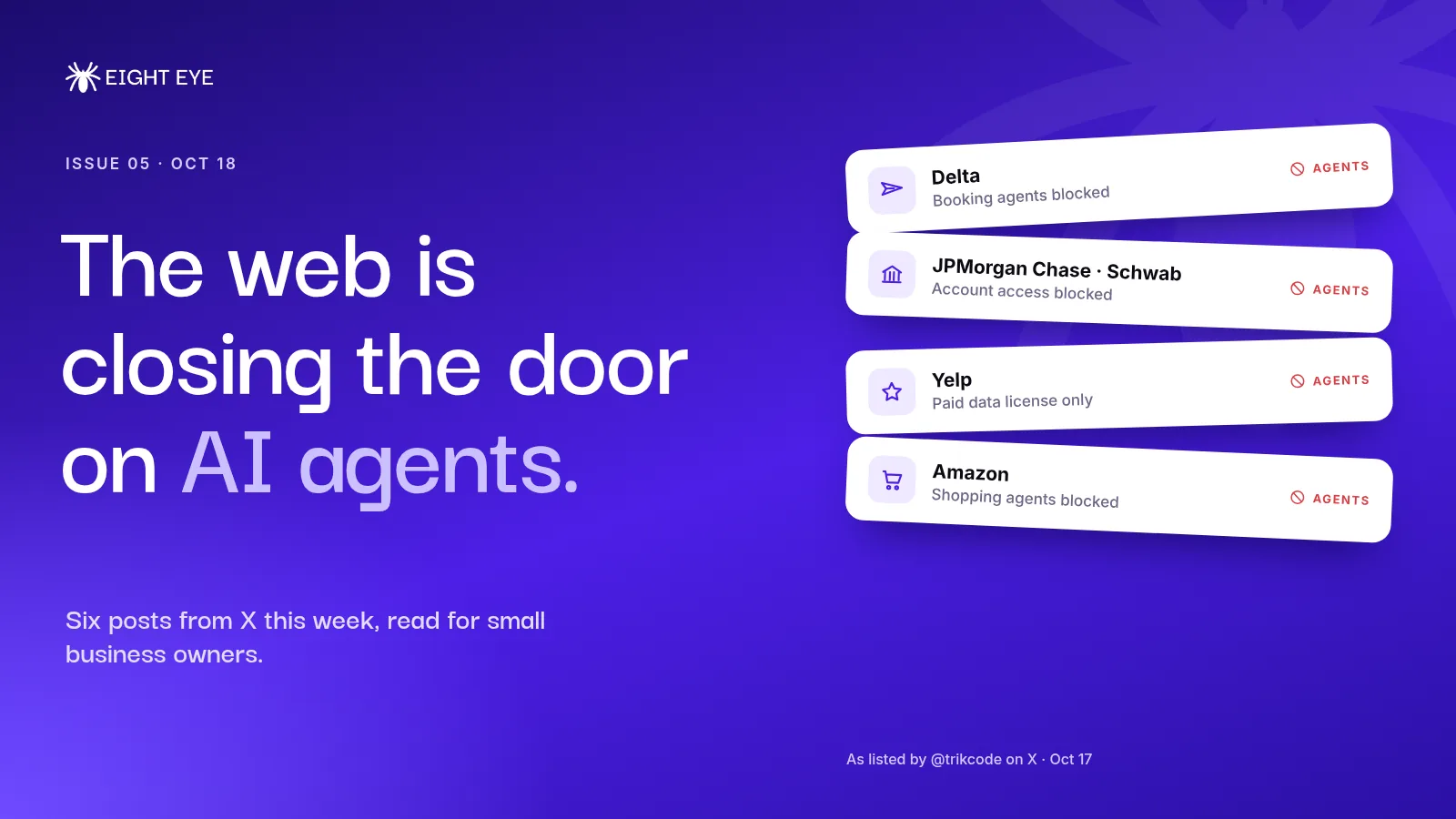
For two years the pitch was simple: soon an AI agent will book your flights, pay your bills and order your groceries while you do something else. This week a lot of people noticed the other side of that story. Some of the biggest sites online are telling those agents no.
That matters for anyone who runs a business, because the same question is coming to your website, your booking page and your inbox. Below are six of the posts people engaged with most over the past two days, what each one said, a link to the original, and what we'd do about it. Engagement numbers are as of the morning of October 18.
1. Big sites are shutting AI agents out
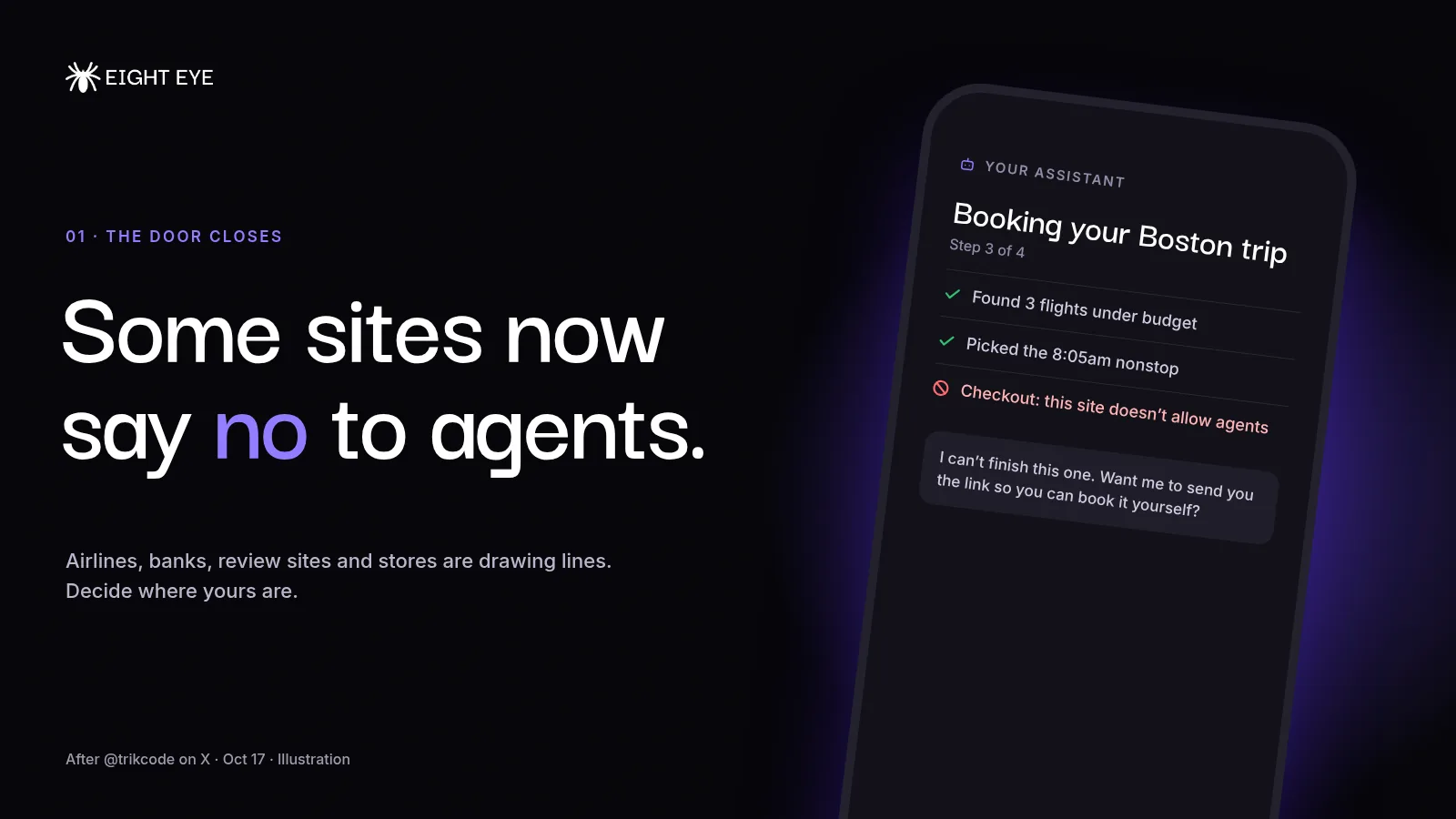
@trikcode, October 17. About 7,300 likes, 520 replies and 660,000 views.
The post was a short list. Delta is blocking AI agents from booking flights. JPMorgan Chase and Charles Schwab are blocking agents from getting into customer accounts. Yelp wants agents to pay for a data license. Amazon has blocked Grok bot and other shopping agents. The author's summary: the internet is starting to block the agents that were supposed to do everything for us. Other posts that day pointed to a report in The Verge covering the same examples, and the replies split between people who think the sites are protecting customers and people who think they're protecting their own business.
Our take: Each of those companies is drawing a line in a different place, and that's the useful part. A bank keeps agents away from moving money. An airline keeps them out of checkout. A review site wants to be paid for its data. You'll face the same choice on a smaller scale. If a customer's assistant wants to book a tune-up, a haircut or a table, that's still a customer, and turning it away probably means losing the job. Where you should want a person involved is anything touching money or account changes: refunds, card details, cancelling a contract. Write down which is which for your business now, before your software vendor decides for you.
2. More AI-written requests are coming. Make things worse or better?
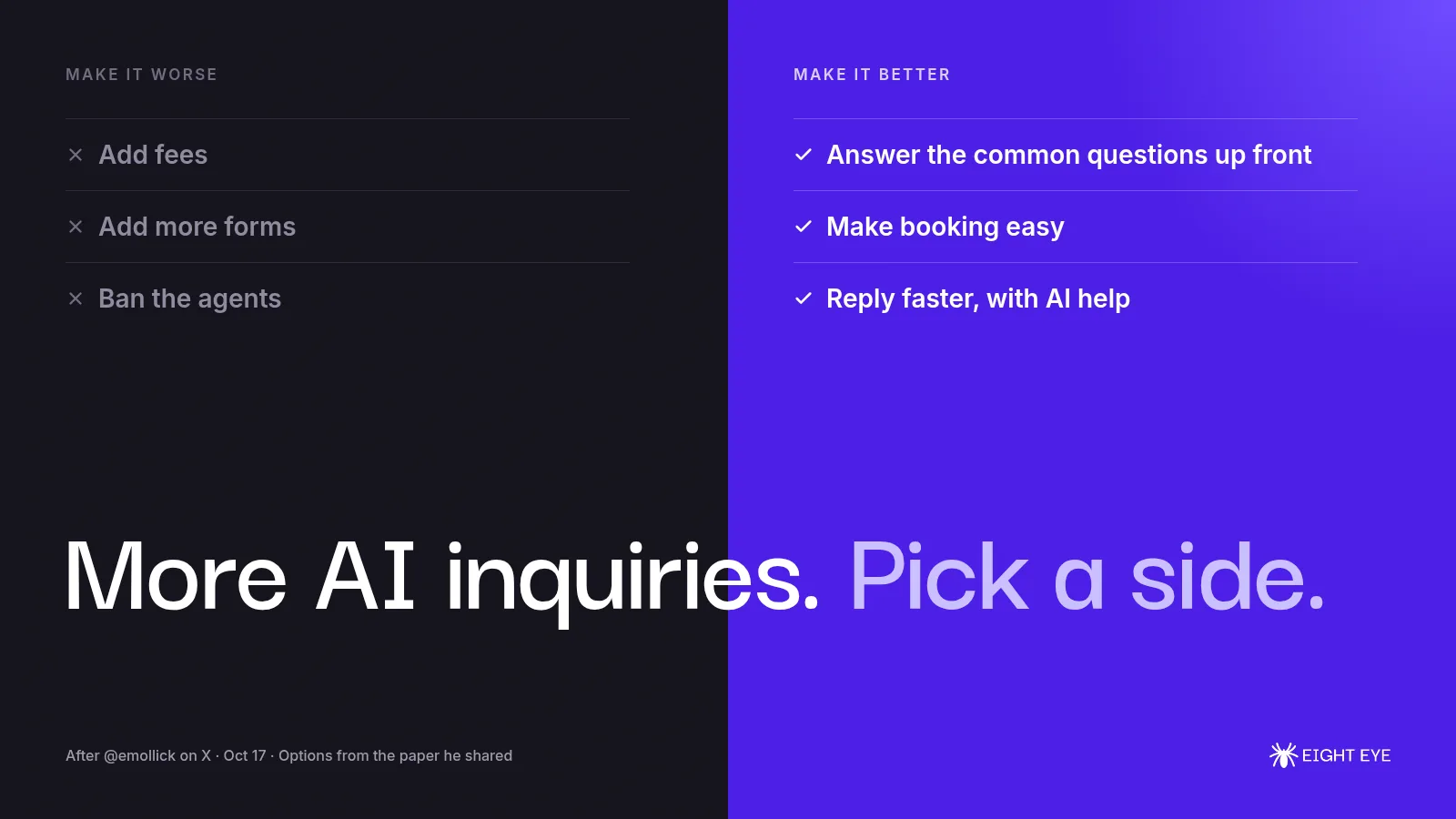
@emollick, October 17. About 770 likes, 530 bookmarks and 230 replies.
Wharton professor Ethan Mollick wrote that governments and companies are about to face a big choice. AI tools are making it easy for people to send requests, claims and complaints that used to take real effort, and the volume has already started rising. In a follow-up he said the status quo isn't an option: you either add friction (fees, worse service, banning agents) or remove it (more service with AI help, work redesigned so access is easier). He linked a paper, Characterizing Agentic Flooding of Government Services by Chris Schmitz, Lewis Hammond and Alan Chan. It collects 84 possible cases across 11 jurisdictions, including Australia considering bringing back fees for freedom-of-information requests after a wave of AI-generated submissions. The authors found that fees and other hurdles are the fastest fix, but they make the service worse for everyone.
Our take: Your quote form and inbox are next. Expect more inquiries that are longer, more detailed and clearly written with AI, and some sent by an assistant on the customer's behalf. Skip the extra form fields and the "call us for pricing" wall. Put the answers people keep asking for on your site: where you work, how you price, how soon you can come out, how to book. Then let AI sort and draft replies so a person can answer the real ones quickly. A business that's easy to deal with will win the customers that a fussy one turns away.
3. ChatGPT can now split one job across several agents
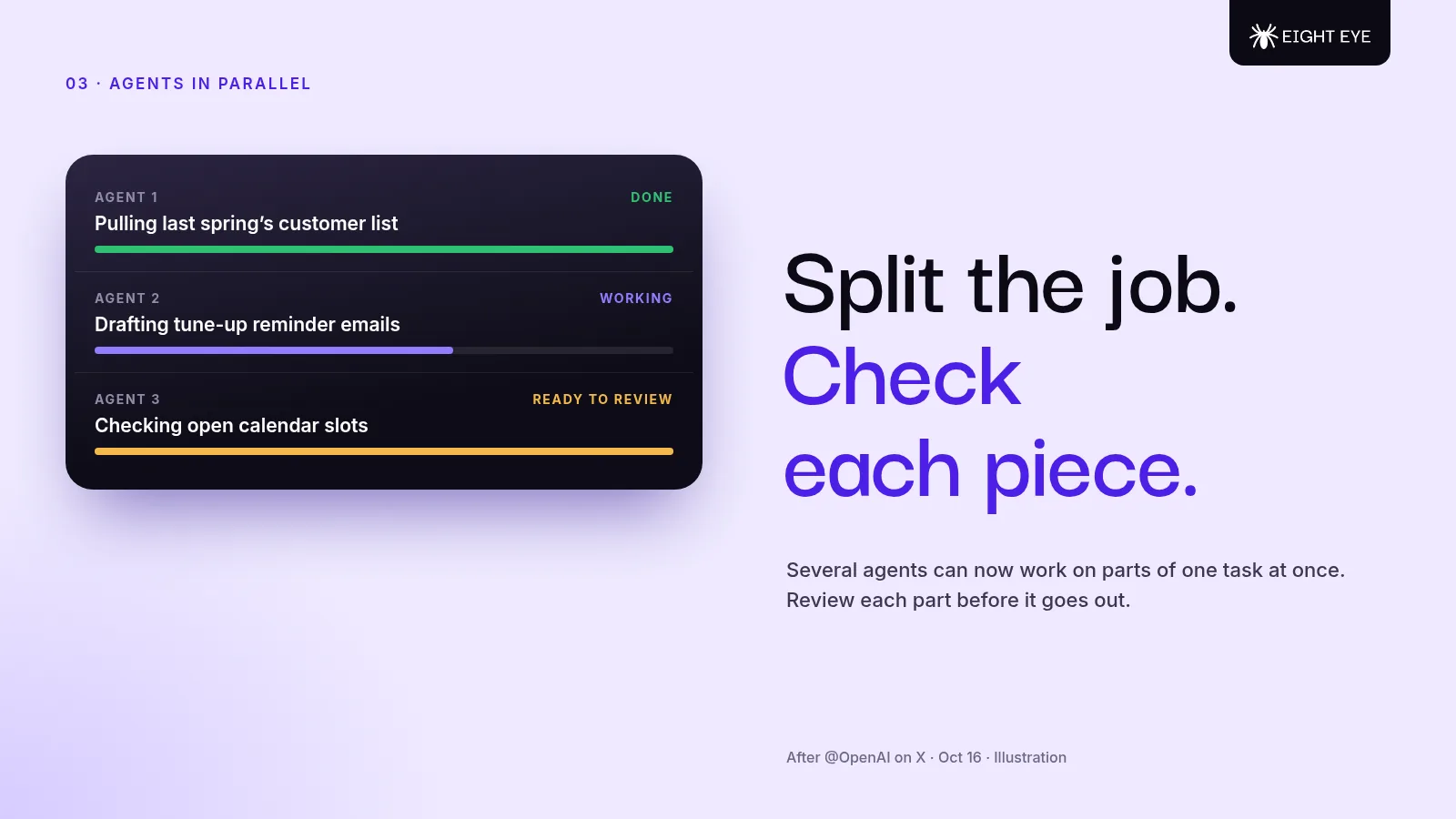
@OpenAI, October 16. About 12,000 likes and 2.1 million views.
OpenAI announced an upgrade to GPT-6 Astra Pro in ChatGPT: faster responses, better use of plugins and tools, and the ability for several agents to work on different parts of one task at the same time. You can follow each agent's progress and open its finished piece to review it. It's available to Pro subscribers in the Chat tab.
Our take: This fits how jobs in a small business already break apart. Take a spring reminder campaign: one part pulls last year's customers, one drafts the emails, one checks which days you can actually take the work. Running those side by side saves time. The line in the announcement worth paying attention to is the one about reviewing each agent's work. Three agents can make three different mistakes at once. Open every finished piece before anything goes to a customer, and keep the final send for yourself.
4. There's no single "AI search result"
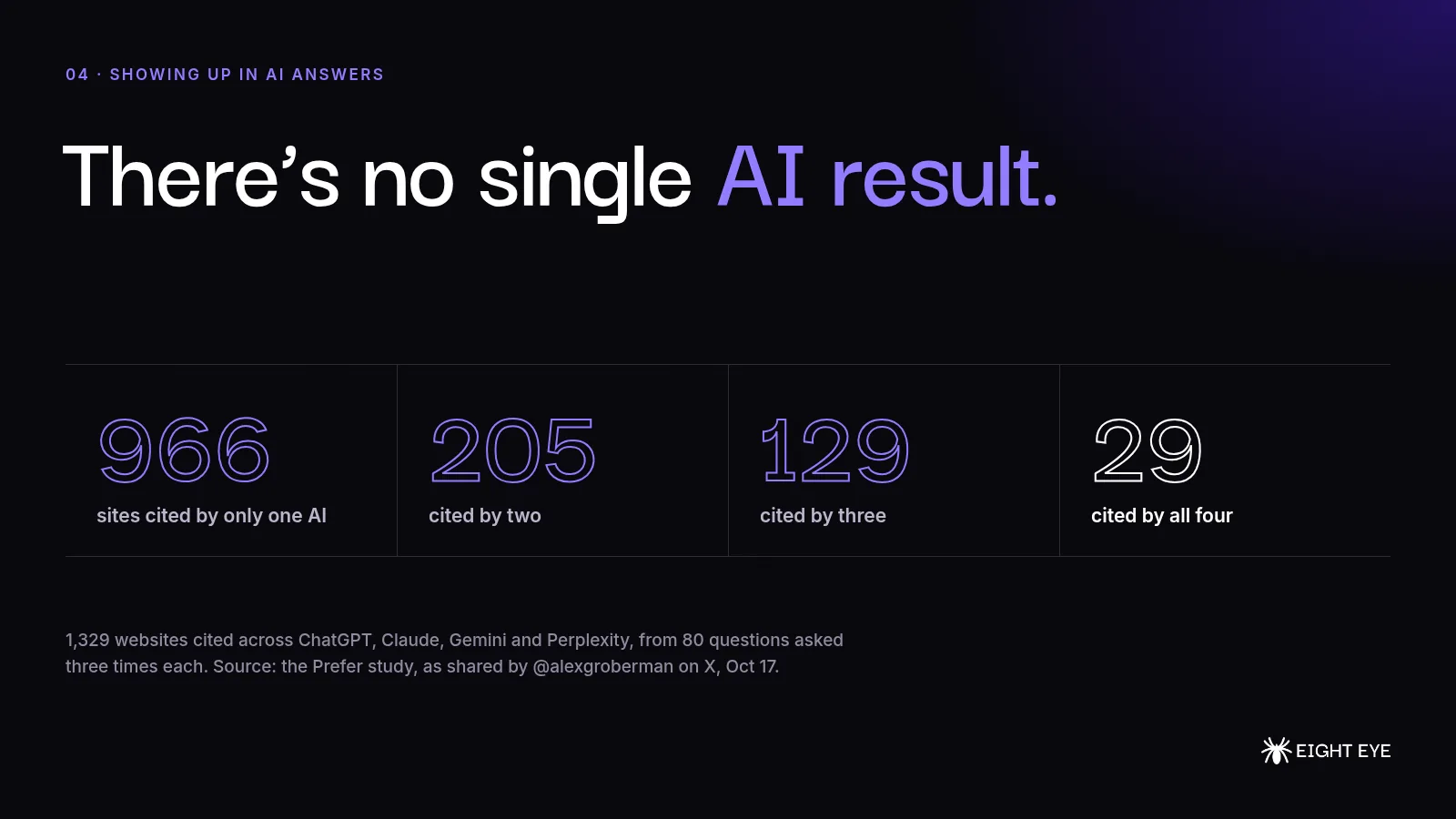
@alexgroberman, October 17. About 90 likes and 84,000 views.
Alex Groberman, who runs an SEO business, walked through a study by Prefer that asked ChatGPT, Perplexity, Gemini and Claude the same 80 questions, three times each. The 960 answers cited 1,329 different websites. Of those, 966 showed up in only one of the four tools, and just 29 showed up in all four. Even asking the same question twice seconds apart changed the sources: repeat runs overlapped 96% of the time on Perplexity but only 37% on ChatGPT and 35% on Gemini. He noted the questions were about AI search itself, so local service questions could look different. The big, trusted sources did show up across most tools.
The same morning, @paulg posted that putting something behind a paywall now makes it invisible: if AI can't find it, for practical purposes it doesn't exist. He added that this isn't fully true yet but will only get truer.
Our take: Asking ChatGPT once whether it knows your business tells you very little. Ask a few assistants, a few different ways, a few times, the way a customer would: "Who fixes furnaces near Woburn?" or "Best bakery for a birthday cake in Winchester?" Then make sure the facts they need are on plain, public pages. Your services, the towns you cover, your hours and how to book shouldn't live only in a PDF, a Facebook post or behind a login. Reviews and mentions on other trusted sites help too, since those are the sources that travel across every tool.
5. The phrases that give AI writing away
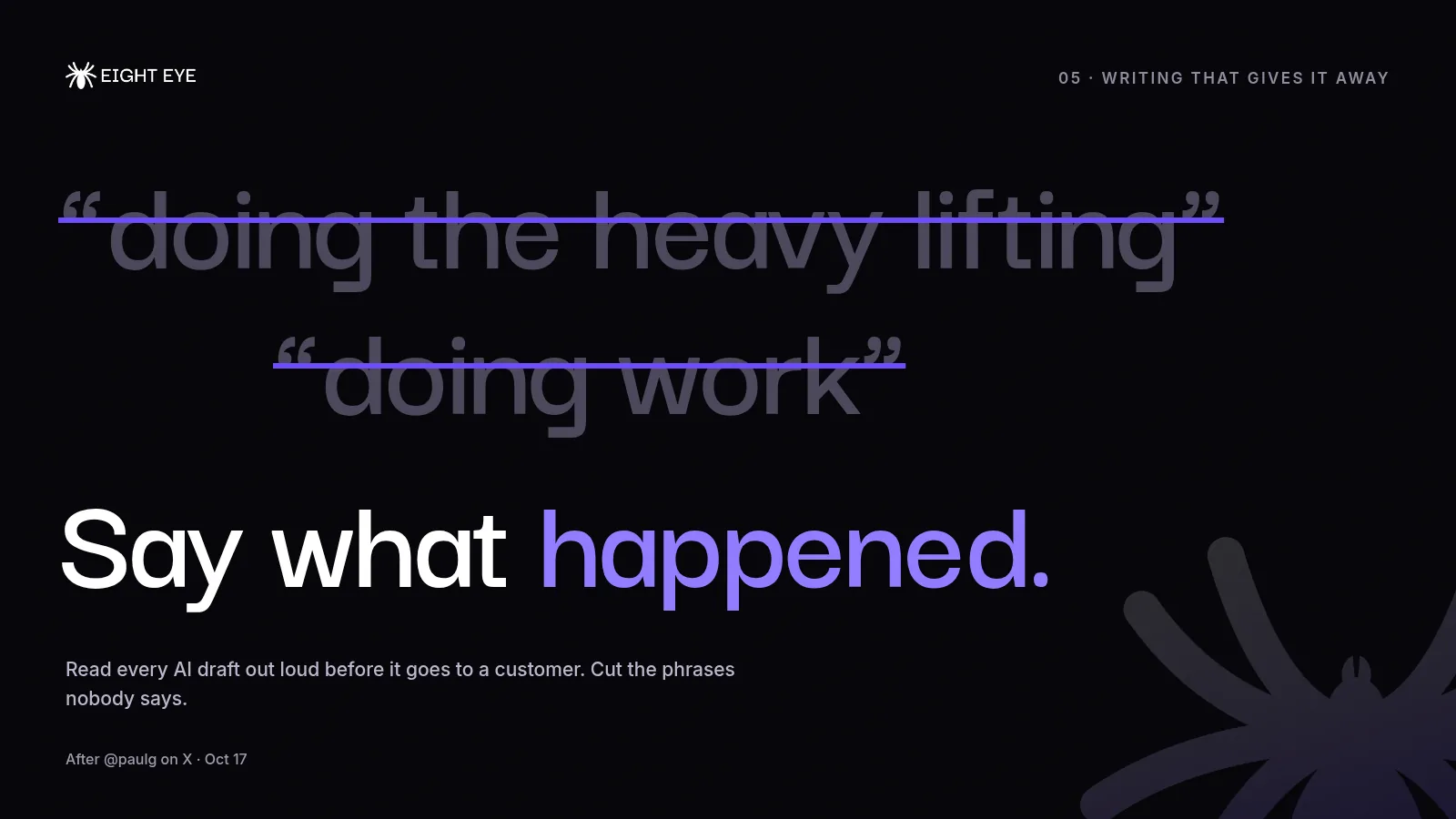
@paulg, October 17. About 330 likes, 220 replies and 86,000 views.
Paul Graham, who co-founded the Y Combinator investment firm, asked why phrases like "doing work" or "doing heavy lifting" turn up so often in AI-written replies. He guessed the habit will pass, and wondered whether one model picked it up and the rest copied it. The replies filled up with other examples people have learned to spot.
Our take: Customers have started noticing too. An email that says "our team did the heavy lifting on your project" sounds like nobody in particular wrote it. "We replaced the cracked flue pipe and your furnace is running again" sounds like someone was there. Before an AI draft goes to a customer, read it out loud. Cut any phrase you'd never say at the counter, and swap vague lines for the actual detail: what you did, when and who did it.
6. Ask the people who didn't buy
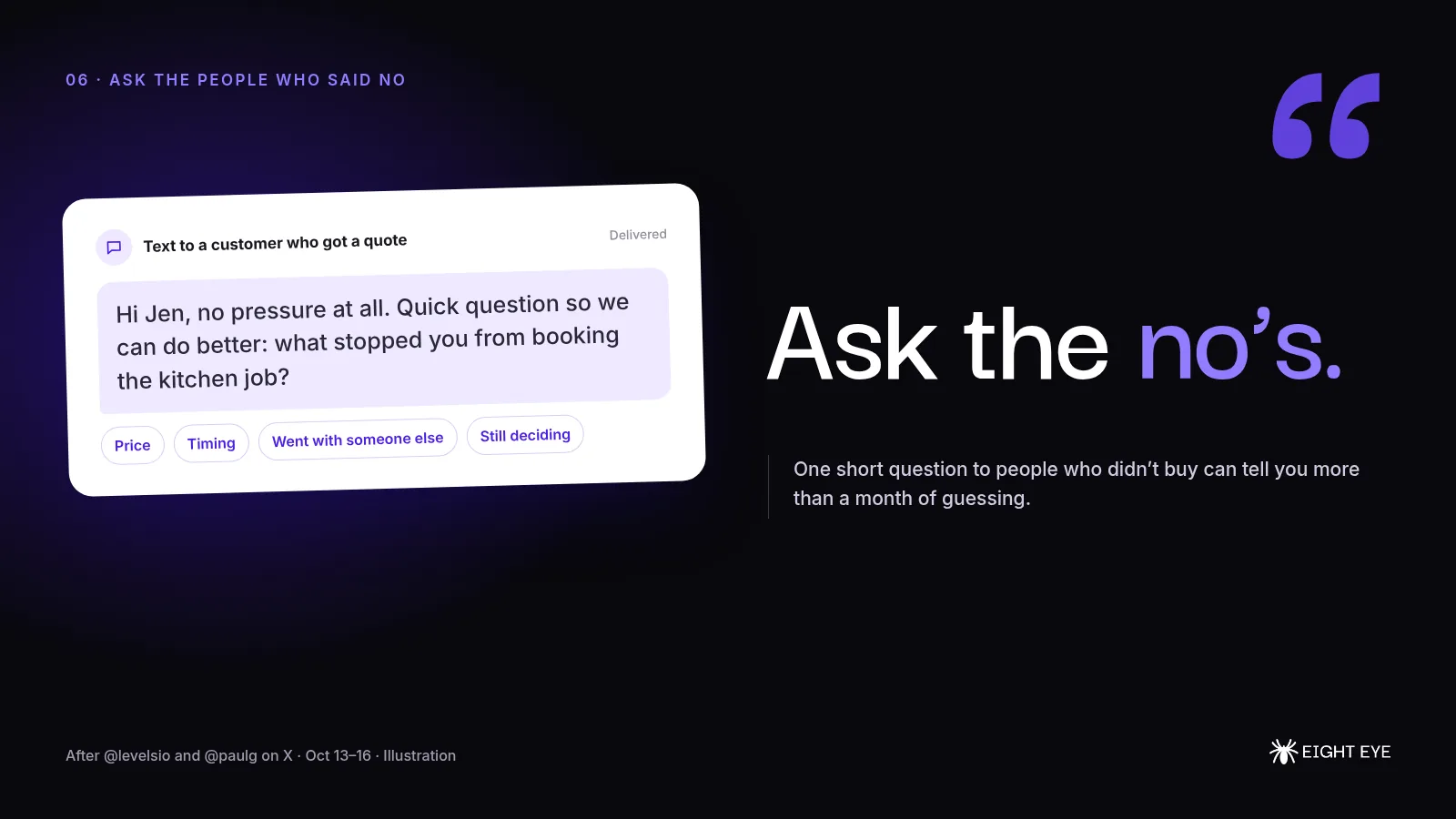
@levelsio, October 16. About 480 likes and 330 bookmarks.
@levelsio, who runs several profitable one-person websites, added a small link under the checkout on Nomads.com: "Don't want to join? Tell me why." It opens a short form. He was answering @paulg, whose post earlier in the week (about 6,200 likes) said that if customers won't buy, you should ask what they would buy, and that surprisingly few founders do.
Our take: Most local businesses never hear from the people who got a quote and went quiet. Send one short, friendly text a few days later asking what stopped them, with a few easy answers to tap: price, timing, went with someone else, still deciding. Keep every answer in one place. After a month, have AI sort them and tell you which reason keeps coming up. That's usually a fix you can make this season, like quoting faster or explaining your price better.
One more for the tech crowd
@AnthropicAI (about 5,300 likes and 800,000 views) shared work from its STEM Fellows Program: given plain-language instructions, Claude Mythos 5 designed quantum circuits that Anthropic says beat the best published ones, sometimes by an order of magnitude or more. More efficient circuits mean quantum computers need fewer resources to run useful programs, which could bring applications in chemistry and materials science closer. It's far from booking service calls, but it shows these tools doing real research work.
That's issue five
If this week got you thinking about how your business should treat AI agents, write to us at support@eighteye.ai. Eight Eye is the AI growth partner for small businesses. We answer and follow up with every lead, help you get found in search and AI answers, and keep the busywork moving. See how it works, compare plans and pricing, or book a demo.
See you in the next issue.