
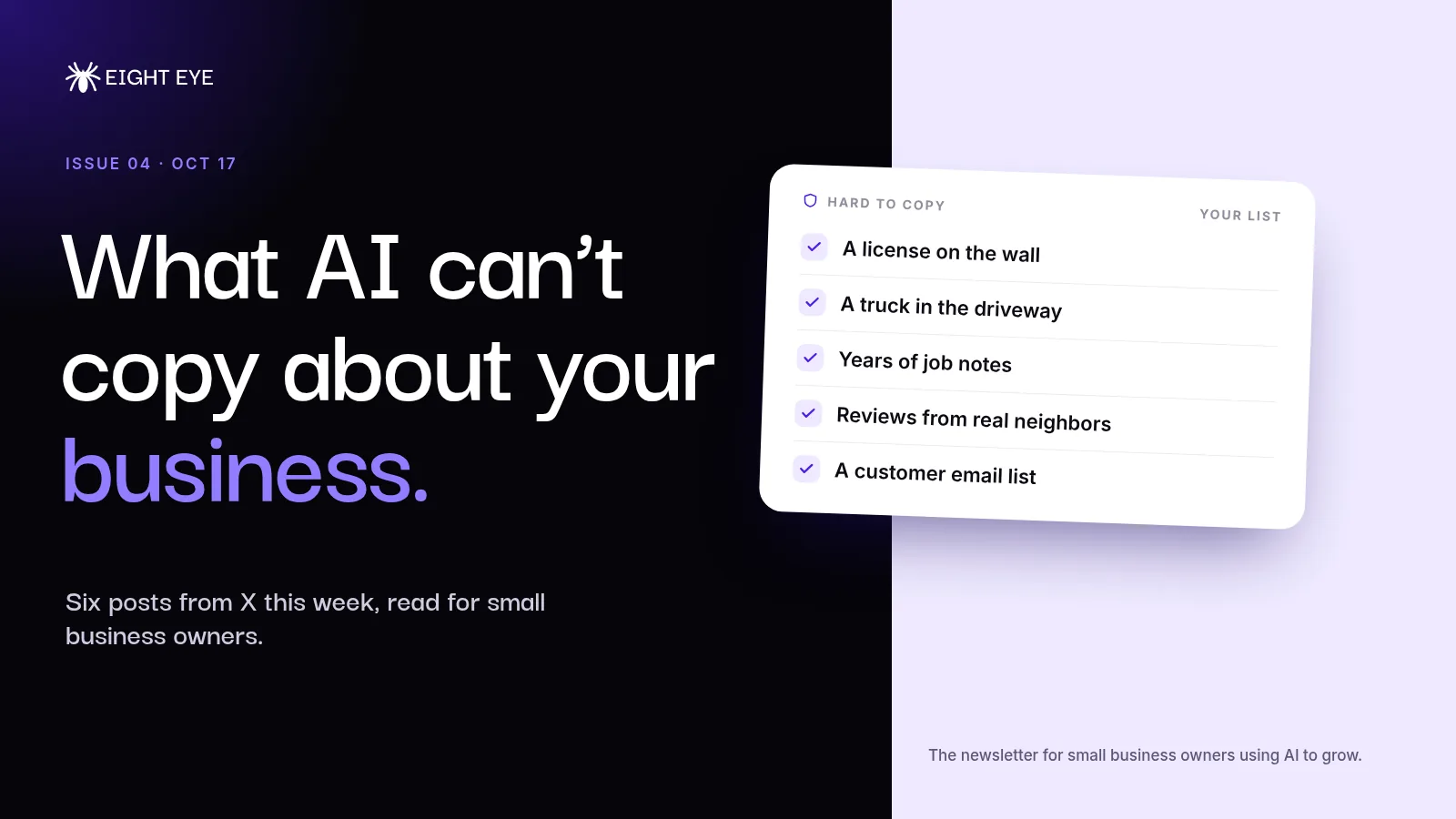
Every week someone on X announces that AI is about to copy everything. This week a few of the most-read posts asked the more useful question: what can't it copy? The answer turned out to be a lot of things a local business already has.
Below are six posts that got real attention over the past two days, what they said, a link to each, and what we'd do about it if it were our shop, office or storefront. Engagement numbers are as of the morning of October 17.
1. An app update switched on AI agent access without asking

@AgustinCordes, October 15. About 27,700 likes, 20,500 bookmarks and 1.7 million views.
Game developer Agustín Cordes posted a warning: the NVIDIA App, the software that comes with a lot of Windows PCs that have NVIDIA graphics cards, had updated itself and turned on a setting that lets AI agents control the app. He called it a privacy problem and a security risk people may not want. Other users who checked after updating reported the same thing. The feature runs on the computer itself, and people who don't use AI agents said the simplest move is to turn it off under the app's Settings, then Features.
Our take: The 20,000-plus bookmarks tell you how many people went to check their own machines. Most small businesses have a few PCs nobody really owns: the office desktop, the one at the front counter, the laptop that runs the shop printer. Software on those machines updates on its own, and more of it is adding "let AI agents in" options. Once a month, open the settings on anything that touches customer info or payments and look for new AI or agent switches. Turn on the ones you actually use, on purpose. Leave the rest off.
2. levelsio is chasing the advantages AI can't copy
@levelsio, October 16. About 2,600 likes, 3,700 bookmarks and 320,000 views.
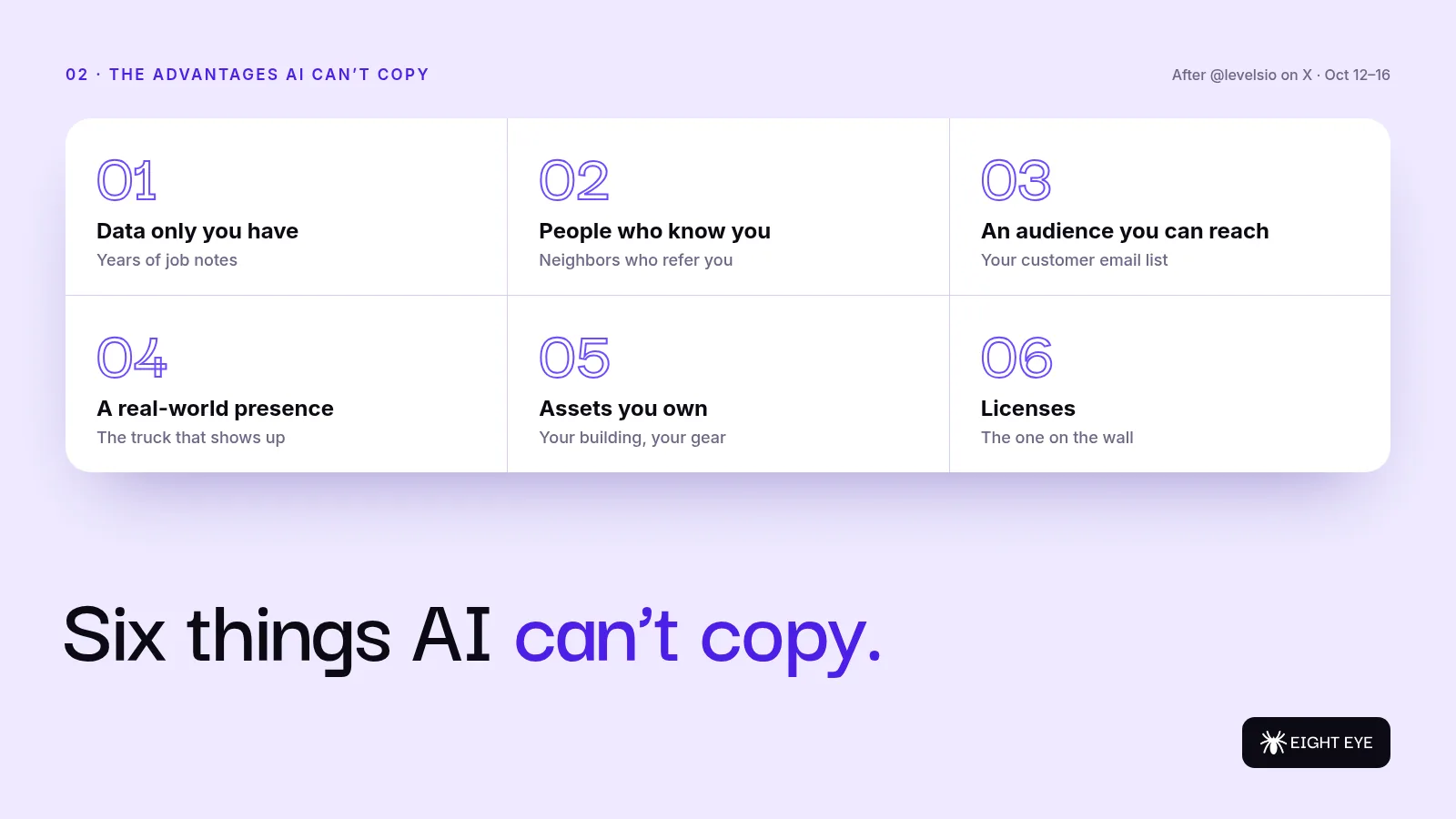
@levelsio, who runs a string of profitable one-person websites, wrote that he's now scrambling toward whatever advantages are left, because he expects AI companies to absorb almost everything else. A few days earlier he'd listed them: data nobody else has, a community whose members make it more valuable for each other, an audience you can reach whenever you want, a physical or real-world part, owned assets, and licenses or legal barriers. This week he went through his own businesses one by one: a paid data product built from real member reviews, more in-person meetups, an email list he can reach without any platform in the way. He admitted the licenses part isn't for him.
Our take: Read that list again as a local business owner. You probably have more of these than he does. A license on the wall. Years of job notes about which houses have which equipment. Reviews from real neighbors. A truck that shows up. A list of past customers you can email in the spring. AI can write a website in an hour, but it can't hold a Massachusetts electrical license or knock on a door. Write down your own list this weekend, then spend a little more time on the items software can't touch, like getting every past customer's email address into one place.
3. Your business now has to win twice: once with the AI, once with the customer
@gregisenberg, October 15. About 2,000 likes, 2,200 bookmarks and 151,000 views.
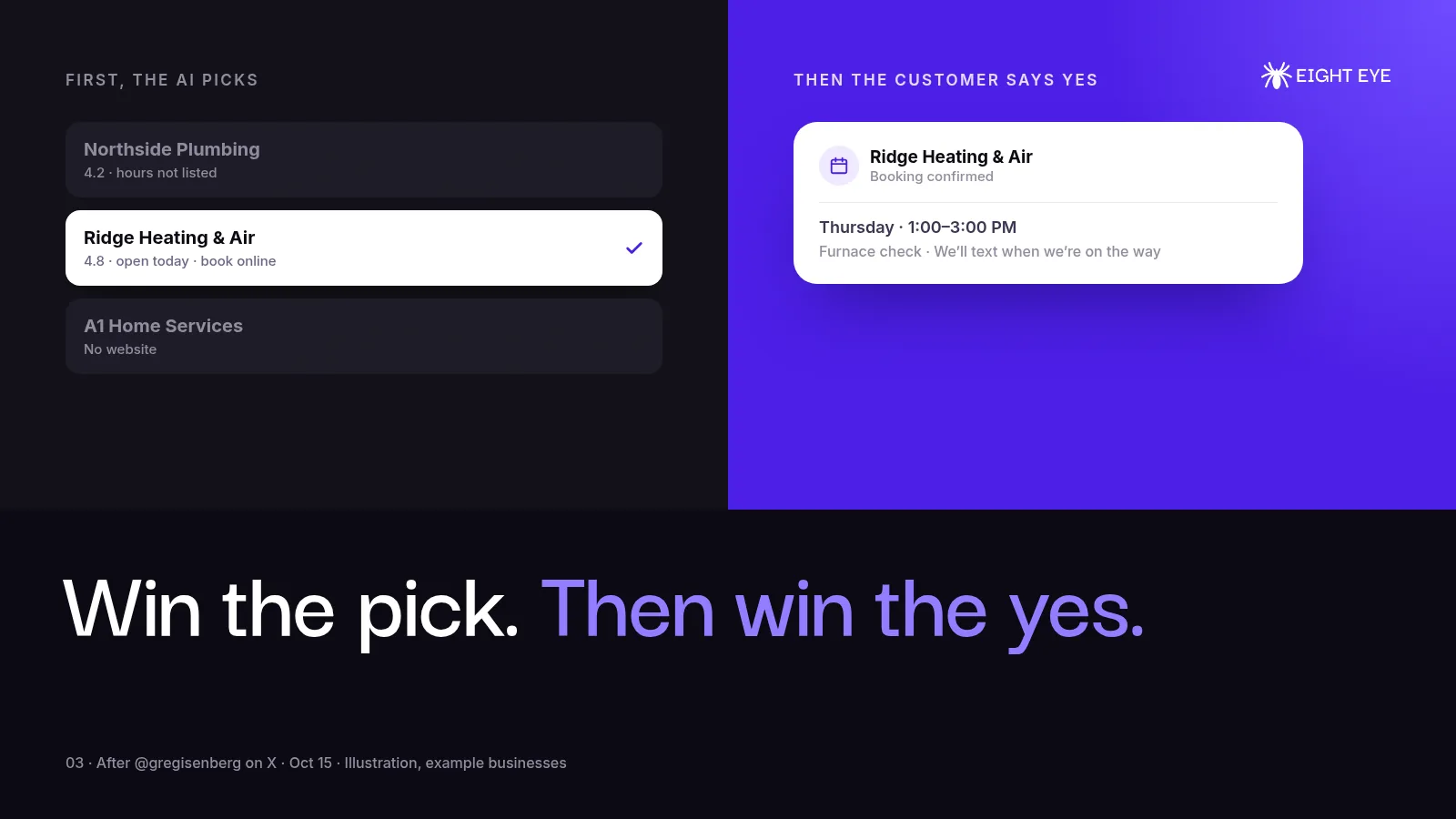
Greg Isenberg, who builds and invests in internet businesses, posted a second round of notes from a trip to San Francisco. Two stood out for anyone who sells a service. First: your product now has to sell itself twice. An AI agent has to pick it, and then a person has to trust that pick enough to say yes. Second: if AI makes people work much faster, anyone who bills by the hour earns less for the same job, so he expects a lot of freelancers and agencies to rethink how they price.
Our take: More people are asking an AI assistant to find them a plumber, a dentist or a caterer. The assistant can only pick you if it can read clear facts about you: what you do, where you work, your hours, how to book. Make sure your website and Google listing say those things in plain words, and that they match each other. The pricing point matters too. If AI tools cut your paperwork from an hour to ten minutes, think about quoting by the job instead of the hour, so the time you save turns into profit instead of a smaller invoice.
4. The tools AI agents use are selling fast
@gregisenberg, October 16. About 810 likes and 1,300 bookmarks.
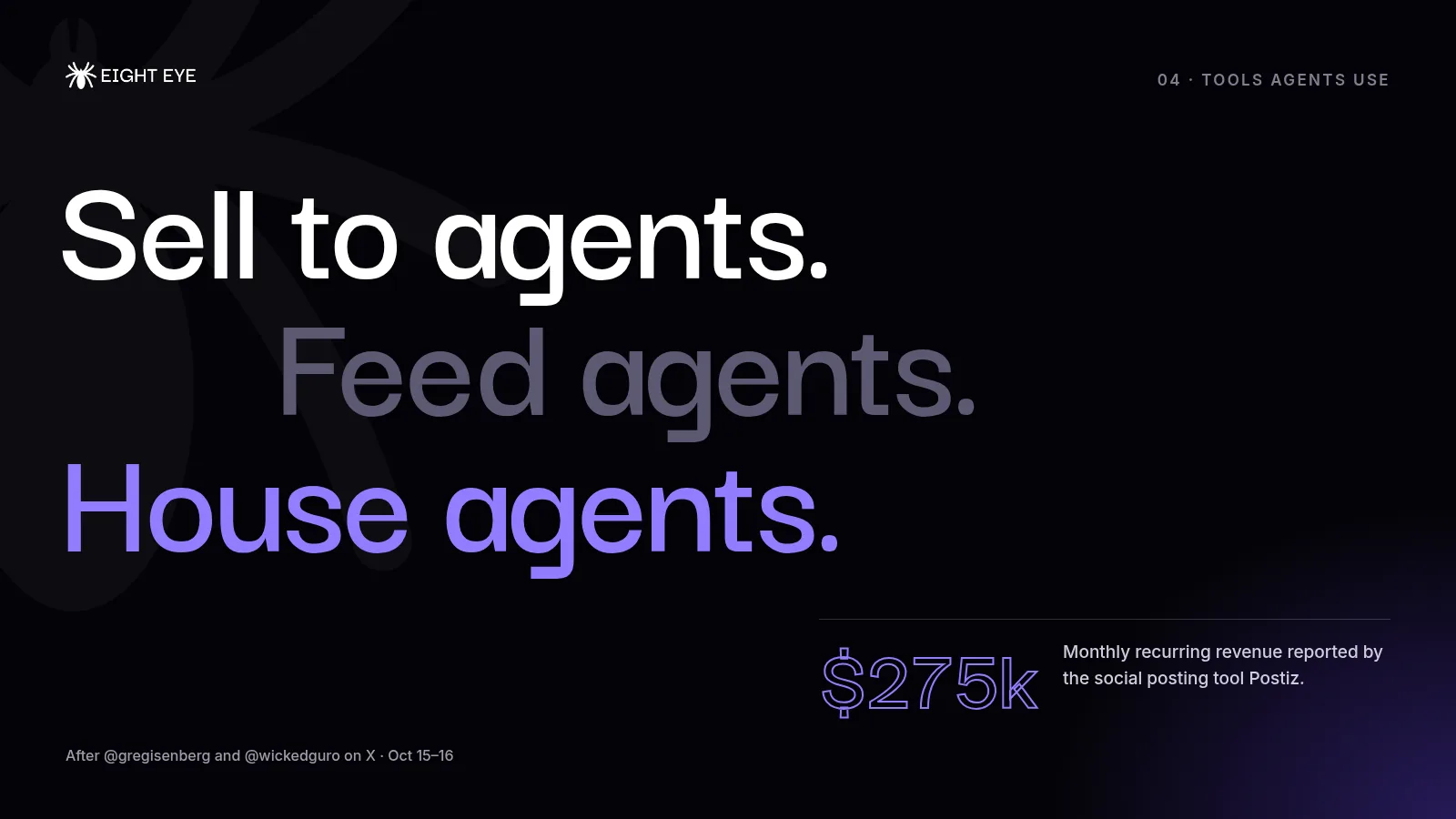
Isenberg was reacting to @wickedguro, founder of the social posting tool Postiz, who shared that it's at $275,000 in monthly recurring revenue with 8,052 customers. Isenberg's read: tools that AI agents use for posting, email, payments, phone numbers and browsing are growing fast. His list of other businesses taking off included hosting that keeps agents running around the clock, agents built for one industry, and done-for-you agent setup, where local businesses pay someone to set up agents the same way they once paid someone to build their website. His summary: these businesses sell to agents, feed agents or house agents.
Our take: We're in the done-for-you business ourselves, so read this with that in mind. Whoever you hire, the questions are the same. What exactly will the agent do each week? What can it touch, and what does it need your OK for? Where can you see what it did? And if you stop paying, do you keep your accounts, your contacts and your content? A good partner answers all four without hesitating.
5. People are getting tired of AI replies
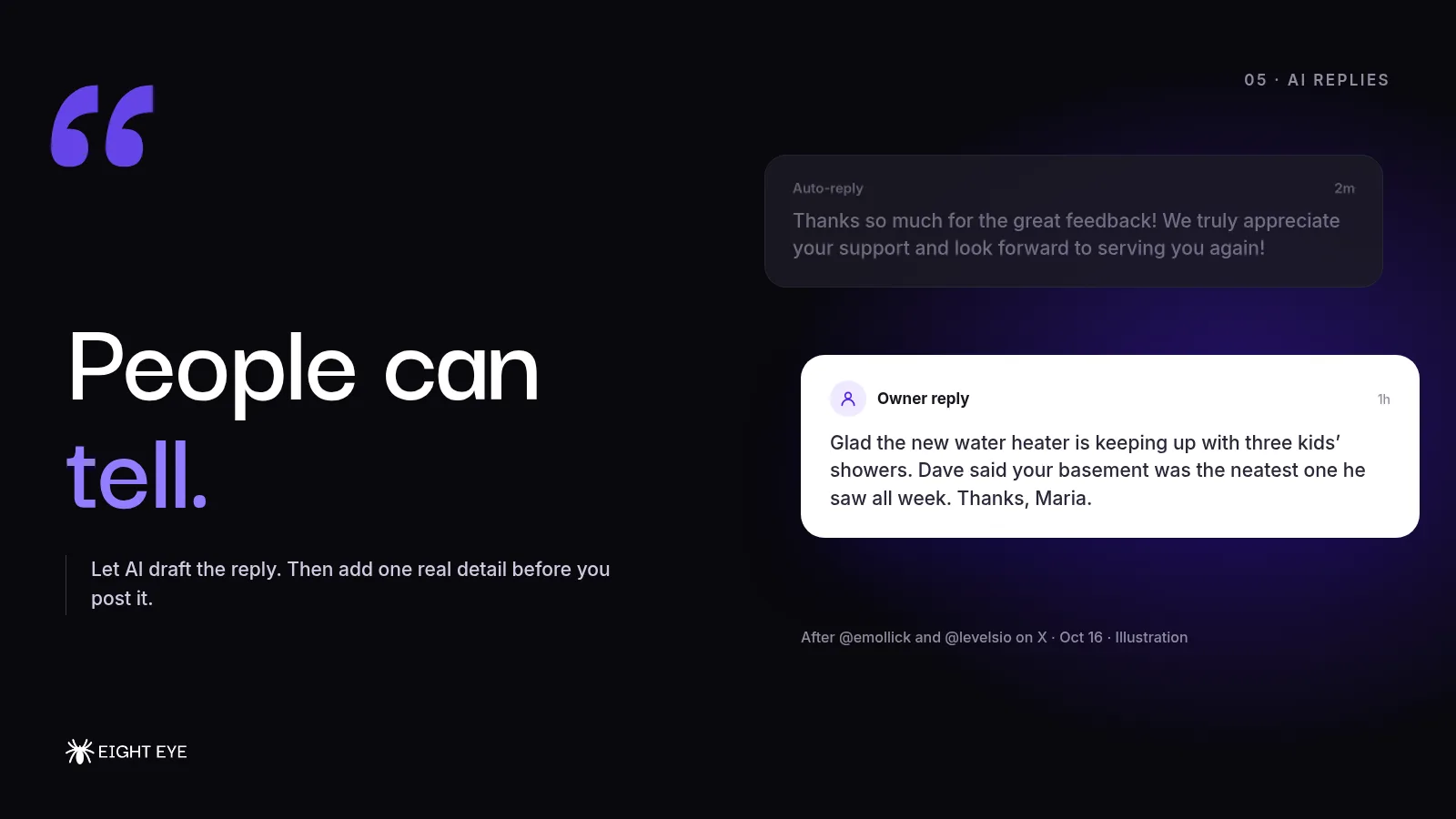
@emollick, October 16. About 480 likes and 100 replies.
Wharton professor Ethan Mollick shared screenshots of the replies under one of his own posts and asked whether there's really no way to filter out the obvious AI-written ones. The same day @levelsio pointed to more than 150 AI replies stacked under a joke he'd posted, and said AI replies have never been this bad.
Our take: If two of the most AI-friendly people on X are fed up, your customers are too. It's tempting to let a tool answer every review and comment automatically, but generic praise like "Thanks for the great feedback, we appreciate you!" reads like nobody's home. Use AI to draft, then add one real detail before you post: the job, the technician's name, the fix. If you can't add a detail, a short reply in your own words beats a long one in the machine's.
6. Ask the AI to show its work along the way
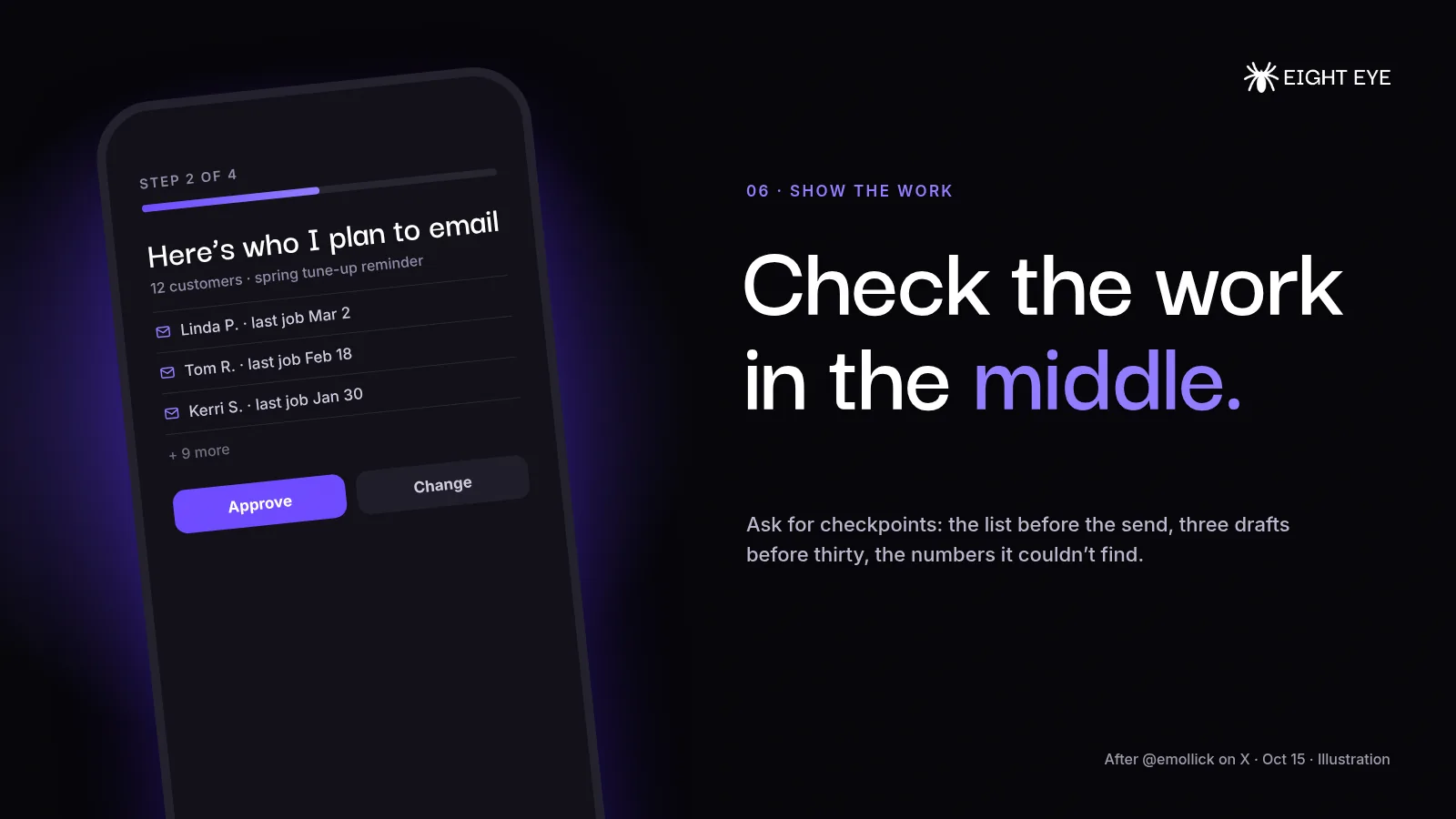
@emollick, October 15. About 325 likes and 147 replies.
Mollick made a quieter point that matters more as AI does longer jobs. The step-by-step reasoning AI tools used to show is much less useful now that agents work for long stretches on their own. To steer them and see what's going on, he says, you have to ask for interim results and tests along the way, and use AI to help you troubleshoot what you find.
Our take: Don't hand off a ten-step job and only look at the end. Build checkpoints into the request. "Before you send anything, show me the list of customers you plan to email." "Draft three of the invoices and stop so I can look." "Tell me which numbers you couldn't find." It takes a few extra minutes, and it's how you catch the wrong price or the duplicate customer before it goes out.
One more for the tech crowd
Mollick also recommended a paper (about 450 likes and 250 bookmarks) on a team of Gemini 4 agents beating Minecraft. He called it an accessible example of agents coordinating on their own to reach a complicated goal, and of how their approach differs from the way people play. It's a long way from scheduling service calls, but it's a good look at where multi-agent work is heading.
That's issue four
If one of these got you thinking about what makes your business hard to copy, write to us at support@eighteye.ai. Eight Eye is the AI growth partner for small businesses, from answering and following up with every lead to getting found online and keeping the busywork moving. See how it works, compare plans and pricing, or book a demo.
See you in the next issue.